Hilgetag Claus C, Goulas Alexandros, Changeux Jean-Pierre
Institute of Computational Neuroscience, University Medical Center Eppendorf, Hamburg University, Hamburg, Germany.
Department of Health Sciences, Boston University, Boston, MA, USA.
Netw Neurosci. 2022 Oct 1;6(4):950-959. doi: 10.1162/netn_a_00256. eCollection 2022.
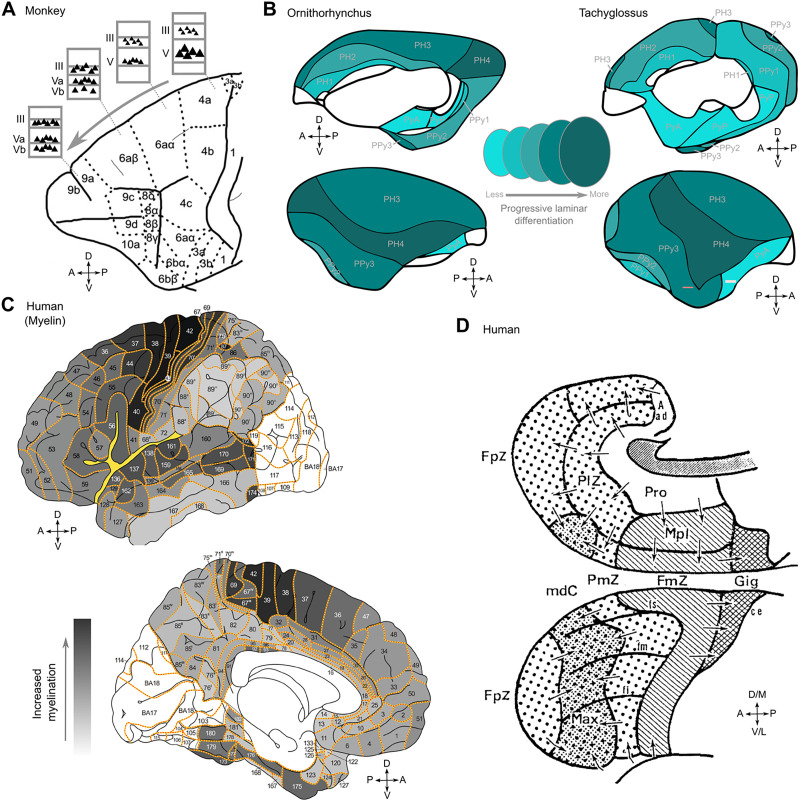
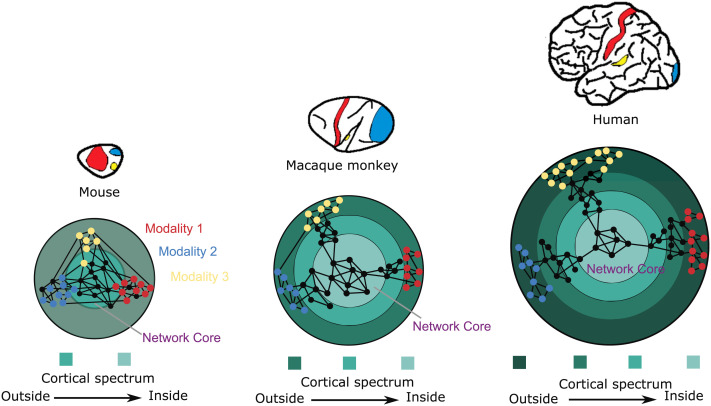
What structural and connectivity features of the human brain help to explain the extraordinary human cognitive abilities? We recently proposed a set of relevant connectomic fundamentals, some of which arise from the size scaling of the human brain relative to other primate brains, while others of these fundamentals may be uniquely human. In particular, we suggested that the remarkable increase of the size of the human brain due to its prolonged prenatal development has brought with it an increased sparsification, hierarchical modularization, as well as increased depth and cytoarchitectonic differentiation of brain networks. These characteristic features are complemented by a shift of projection origins to the upper layers of many cortical areas as well as the significantly prolonged postnatal development and plasticity of the upper cortical layers. Another fundamental aspect of cortical organization that has emerged in recent research is the alignment of diverse features of evolution, development, cytoarchitectonics, function, and plasticity along a principal, natural cortical axis from sensory ("outside") to association ("inside") areas. Here we highlight how this natural axis is integrated in the characteristic organization of the human brain. In particular, the human brain displays a developmental expansion of outside areas and a stretching of the natural axis such that outside areas are more widely separated from each other and from inside areas than in other species. We outline some functional implications of this characteristic arrangement.
人类大脑的哪些结构和连接特征有助于解释人类非凡的认知能力?我们最近提出了一组相关的连接组学基本原理,其中一些源于人类大脑相对于其他灵长类大脑的大小缩放,而其他一些基本原理可能是人类独有的。特别是,我们认为,由于人类大脑在产前发育时间延长,其大小显著增加,这带来了脑网络稀疏化加剧、层次模块化增加,以及脑网络深度和细胞结构分化增加。这些特征还伴随着投射起源向许多皮质区域上层的转移,以及皮质上层出生后显著延长的发育和可塑性。近期研究中出现的皮质组织的另一个基本方面是,进化、发育、细胞结构、功能和可塑性的各种特征沿着从感觉(“外部”)到联合(“内部”)区域的主要自然皮质轴排列。在这里,我们强调这条自然轴是如何融入人类大脑的特征性组织中的。特别是,人类大脑表现出外部区域的发育性扩张和自然轴的延伸,使得外部区域之间以及与内部区域之间的距离比其他物种更大。我们概述了这种特征性排列的一些功能意义。