Helen Wills Neuroscience Institute, University of California Berkeley, Berkeley, California, United States of America.
Psychology Department, University of California Berkeley, Berkeley, California, United States of America.
PLoS Biol. 2019 Jul 3;17(7):e3000362. doi: 10.1371/journal.pbio.3000362. eCollection 2019 Jul.
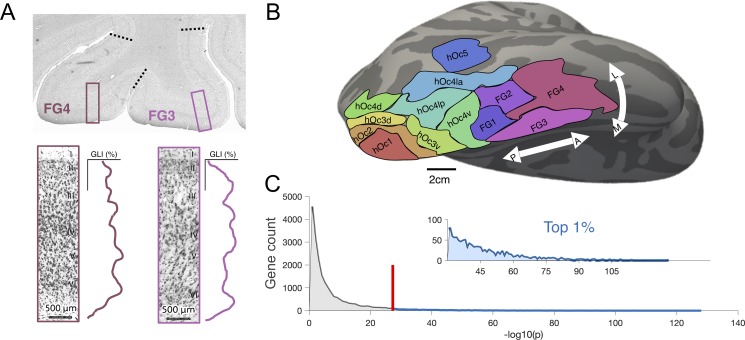
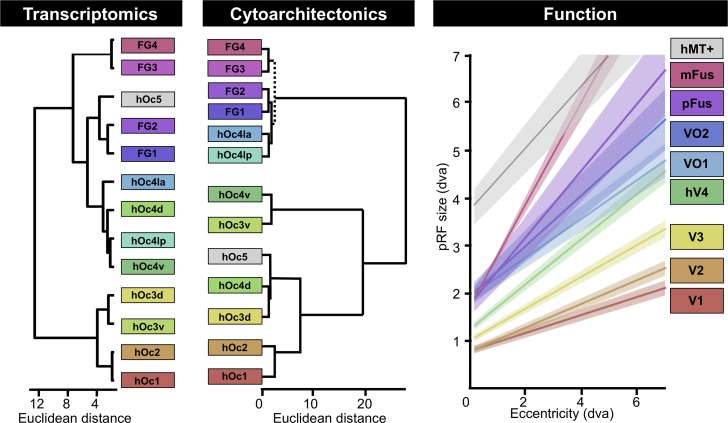
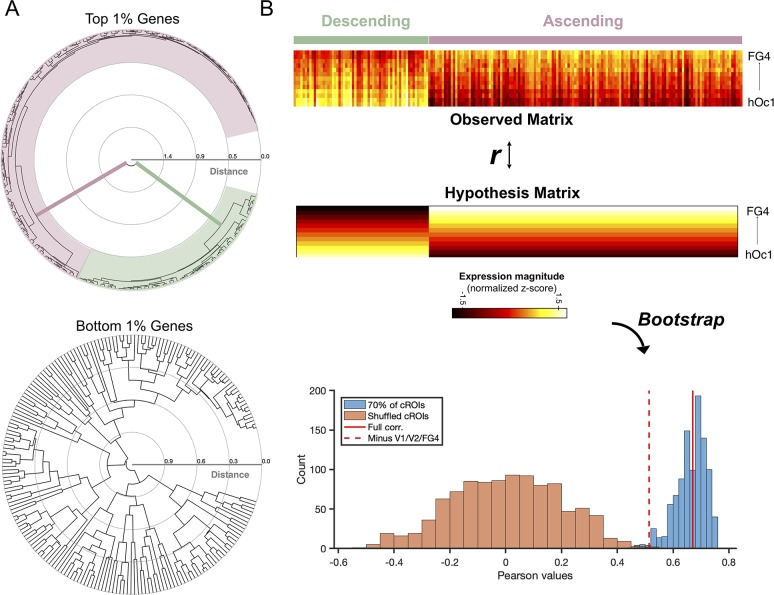
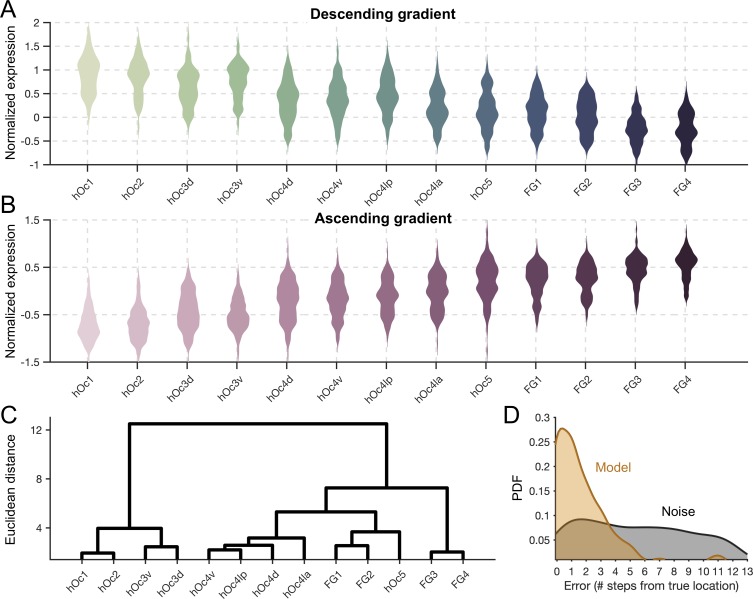
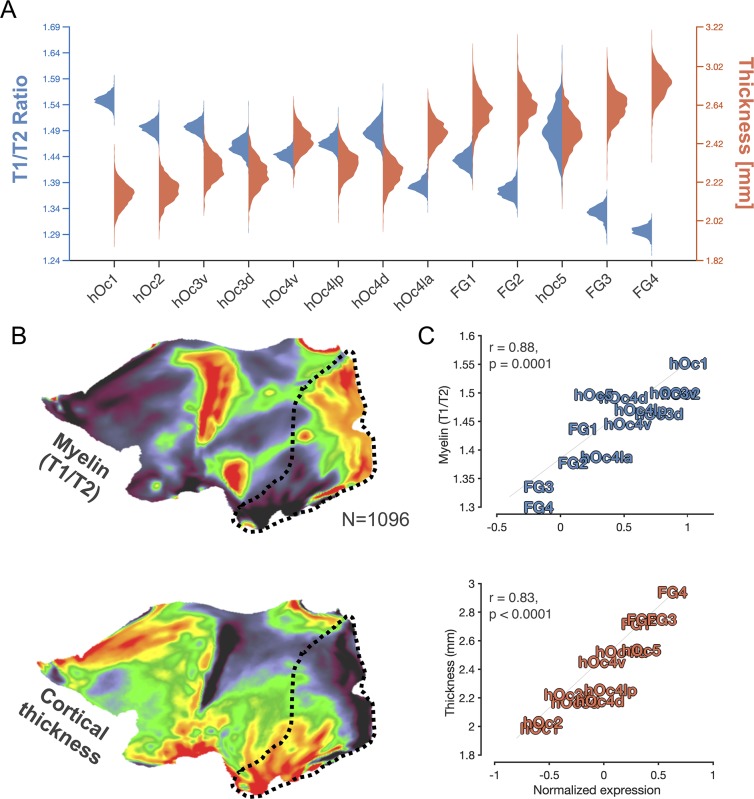
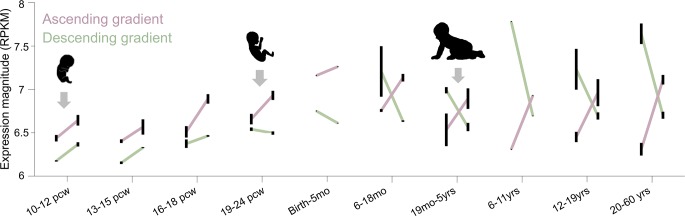
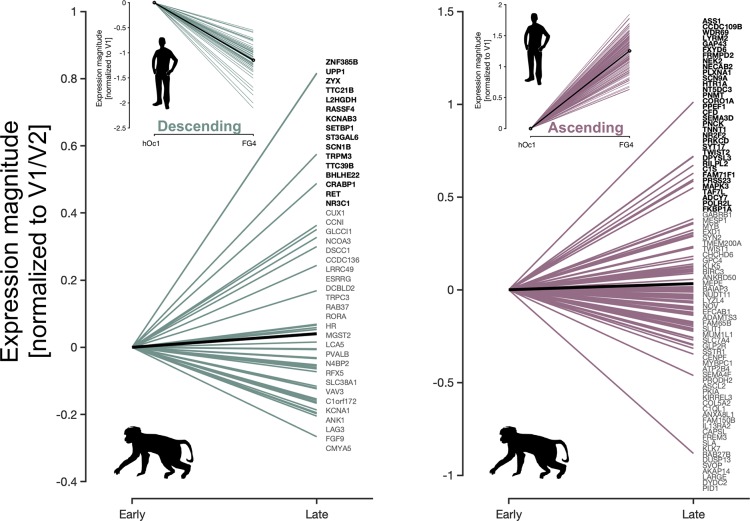
Human visual cortex is organized with striking consistency across individuals. While recent findings demonstrate an unexpected coupling between functional and cytoarchitectonic regions relative to the folding of human visual cortex, a unifying principle linking these anatomical and functional features of the cortex remains elusive. To fill this gap in knowledge, we combined independent and ground truth measurements of cytoarchitectonic regions and genetic tissue characterization within human occipitotemporal cortex. Using a data-driven approach, we examined whether differential gene expression among cytoarchitectonic areas could contribute to the arealization of occipitotemporal cortex into a hierarchy based on transcriptomics. This approach revealed two opposing gene expression gradients: one that contains a series of genes with expression magnitudes that ascend from posterior (e.g., areas human occipital [hOc]1, hOc2, hOc3, etc.) to anterior cytoarchitectonic areas (e.g., areas fusiform gyrus [FG]1-FG4) and another that contains a separate series of genes that show a descending gradient from posterior to anterior areas. Using data from the living human brain, we show that each of these gradients correlates strongly with variations in measures related to either thickness or myelination of cortex, respectively. We further reveal that these genetic gradients emerge along unique trajectories in human development: the ascending gradient is present at 10-12 gestational weeks, while the descending gradient emerges later (19-24 gestational weeks). Interestingly, it is not until early childhood (before 5 years of age) that the two expression gradients achieve their adult-like mean expression values. Additional analyses in nonhuman primates (NHPs) reveal that homologous genes do not generate the same ascending and descending expression gradients as in humans. We discuss these findings relative to previously proposed hierarchies based on functional and cytoarchitectonic features of visual cortex. Altogether, these findings bridge macroscopic features of human cytoarchitectonic areas in visual cortex with microscopic features of cellular organization and genetic expression, which, despite the complexity of this multiscale correspondence, can be described by a sparse subset (approximately 200) of genes. These findings help pinpoint the genes contributing to healthy cortical development and explicate the cortical biology distinguishing humans from other primates, as well as establishing essential groundwork for understanding future work linking genetic mutations with the function and development of the human brain.
人类视觉皮层在个体之间表现出惊人的一致性。尽管最近的研究结果表明,相对于人类视觉皮层的折叠,功能和细胞构筑区域之间存在出乎意料的耦合,但将皮层的这些解剖和功能特征联系起来的统一原则仍然难以捉摸。为了填补这一知识空白,我们结合了人类枕颞叶皮层中细胞构筑区域的独立和真实测量值以及遗传组织特征。我们使用数据驱动的方法,研究了细胞构筑区域之间的差异基因表达是否有助于基于转录组学将枕颞叶皮层划分为层次结构。这种方法揭示了两个相反的基因表达梯度:一个包含一系列表达幅度从后部(例如,人枕叶[hOc]1、hOc2、hOc3 等)到前部细胞构筑区域(例如,梭状回[FG]1-FG4)的基因;另一个包含一系列表达幅度从后部到前部区域的基因。利用来自活体人脑的数据,我们表明,这些梯度中的每一个都与皮层厚度或髓鞘化相关测量值的变化密切相关。我们进一步揭示,这些遗传梯度沿着人类发育的独特轨迹出现:上升梯度出现在 10-12 孕周,而下降梯度出现在稍后阶段(19-24 孕周)。有趣的是,直到儿童早期(5 岁之前),这两个表达梯度才达到成年时的平均表达值。在非人类灵长类动物(NHPs)中的额外分析表明,同源基因不会产生与人类相同的上升和下降表达梯度。我们将这些发现与基于视觉皮层功能和细胞构筑特征的先前提出的层次结构进行了讨论。总的来说,这些发现将人类视觉皮层的宏观细胞构筑区域特征与细胞组织和基因表达的微观特征联系起来,尽管这种多尺度对应关系非常复杂,但可以用大约 200 个基因的稀疏子集来描述。这些发现有助于确定有助于皮质发育健康的基因,并阐明将人类与其他灵长类动物区分开来的皮质生物学,同时为理解将基因突变与人类大脑的功能和发育联系起来的未来工作奠定了基础。