Health in Disasters and Emergencies Research Center, Institute for Futures Studies in Health, Kerman University of Medical Sciences, Kerman, Iran.
Environmental Health Engineering Research Center, Kerman University of Medical Sciences, Kerman, Iran.
Front Public Health. 2023 Feb 16;11:987418. doi: 10.3389/fpubh.2023.987418. eCollection 2023.
Earthquakes cause many casualties worldwide. Taking preventive measures and improving community preparedness is critical to reducing earthquake damage. The social cognitive theory explains how individual and environmental factors cause behavior. This review was conducted to identify the social cognitive theory structures, in research on the preparedness of households against earthquakes.
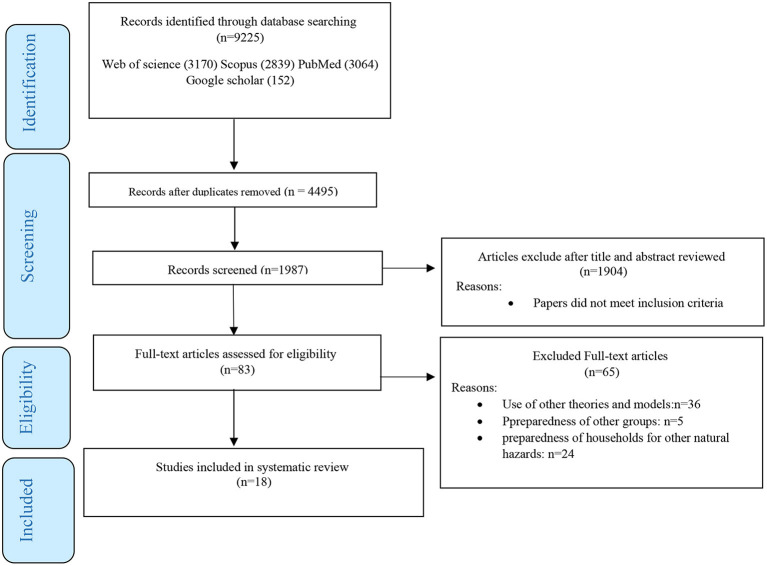
This systematic review was performed based on the Preferred Reporting Items for Systematic Reviews and Meta-Analyses (PRISMA) guidelines. A search was conducted from January 1, 2000, to October 30, 2021 in Web of Science, Scopus, PubMed, and Google Scholar. Studies were selected based on inclusion and exclusion criteria. The initial search yielded 9,225 articles, and finally, 18 articles were selected. Articles were assessed using the Strengthening the Reporting of Observational Studies in Epidemiology (STROBE) checklist.
Eighteen articles about disaster preparedness behaviors based on the socio-cognitive constructs were identified and reviewed. The essential constructs used in the reviewed studies included self-efficacy, collective efficacy, knowledge, outcome expectations, social support, and normative beliefs.
By identifying the dominant structures that have been used in studies related to the preparedness of households against earthquakes, researchers can implement appropriate and more cost-effective interventions by focusing on improving suitable structures.
地震在全球范围内造成了许多人员伤亡。采取预防措施和提高社区的准备水平对于减少地震造成的损失至关重要。社会认知理论解释了个人和环境因素如何导致行为。本综述旨在确定家庭在地震防备方面的研究中使用的社会认知理论结构。
本系统评价按照系统评价和荟萃分析的首选报告项目(PRISMA)指南进行。于 2000 年 1 月 1 日至 2021 年 10 月 30 日在 Web of Science、Scopus、PubMed 和 Google Scholar 中进行了检索。根据纳入和排除标准选择研究。最初的检索产生了 9225 篇文章,最终选择了 18 篇文章。使用观察性研究的强化报告标准(STROBE)检查表对文章进行评估。
确定并回顾了 18 篇基于社会认知结构的关于灾害防备行为的文章。在已审查的研究中使用的重要结构包括自我效能感、集体效能感、知识、结果预期、社会支持和规范信念。
通过确定在与家庭应对地震准备相关的研究中使用的主要结构,研究人员可以通过关注改善合适的结构来实施适当且更具成本效益的干预措施。