He Wencong, Tan Yunhong, Song Zexuan, Liu Binbin, Wang Yiting, He Ping, Xia Hui, Huang Fei, Liu Chunfa, Zheng Huiwen, Pei Shaojun, Liu Dongxin, Ma Aijing, Cao Xiaolong, Zhao Bing, Ou Xichao, Wang Shengfen, Zhao Yanlin
National Institute for Communicable Disease Control and Prevention, Chinese Center for Disease Control and Prevention, Beijing, China.
Hunan Provincial Chest Hospital, Tuberculosis Control Institution of Hunan Province, Changsha, Hunan, China.
Front Microbiol. 2023 Feb 17;14:1115295. doi: 10.3389/fmicb.2023.1115295. eCollection 2023.
Tuberculosis may reoccur due to reinfection or relapse after initially successful treatment. Distinguishing the cause of TB recurrence is crucial to guide TB control and treatment. This study aimed to investigate the source of TB recurrence and risk factors related to relapse in Hunan province, a high TB burden region in southern China.
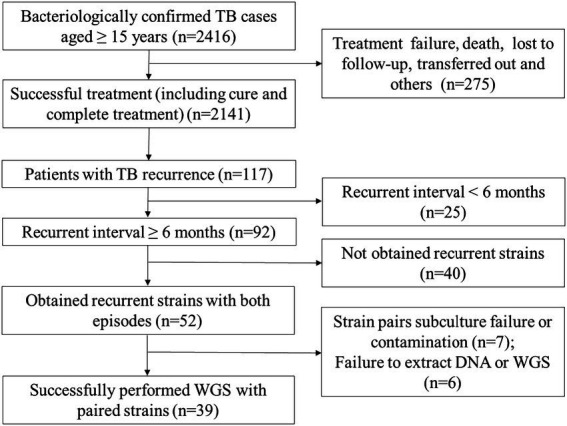
A population-based retrospective study was conducted on all culture-positive TB cases in Hunan province, China from 2013 to 2020. Phenotypic drug susceptibility testing and whole-genome sequencing were used to detect drug resistance and distinguish between relapse and reinfection. Pearson chi-square test and Fisher exact test were applied to compare differences in categorical variables between relapse and reinfection. The Kaplan-Meier curve was generated in R studio (4.0.4) to describe and compare the time to recurrence between different groups. < 0.05 was considered statistically significant.
Of 36 recurrent events, 27 (75.0%, 27/36) paired isolates were caused by relapse, and reinfection accounted for 25.0% (9/36) of recurrent cases. No significant difference in characteristics was observed between relapse and reinfection (all > 0.05). In addition, TB relapse occurs earlier in patients of Tu ethnicity compared to patients of Han ethnicity ( < 0.0001), whereas no significant differences in the time interval to relapse were noted in other groups. Moreover, 83.3% (30/36) of TB recurrence occurred within 3 years. Overall, these recurrent TB isolates were predominantly pan-susceptible strains (71.0%, 49/69), followed by DR-TB (17.4%, 12/69) and MDR-TB (11.6%, 8/69), with mutations mainly in codon 450 of the gene and codon 315 of the gene. 11.1% (3/27) of relapse cases had acquired new resistance during treatment, with fluoroquinolone resistance occurring most frequently (7.4%, 2/27), both with mutations in codon 94 of .
Endogenous relapse is the main mechanism leading to TB recurrences in Hunan province. Given that TB recurrences can occur more than 4 years after treatment completion, it is necessary to extend the post-treatment follow-up period to achieve better management of TB patients. Moreover, the relatively high frequency of fluoroquinolone resistance in the second episode of relapse suggests that fluoroquinolones should be used with caution when treating TB cases with relapse, preferably guided by DST results.
结核病在初始治疗成功后可能因再次感染或复发而再次出现。区分结核病复发的原因对于指导结核病控制和治疗至关重要。本研究旨在调查中国南部结核病高负担地区湖南省结核病复发的来源及与复发相关的危险因素。
对2013年至2020年中国湖南省所有培养阳性的结核病病例进行基于人群的回顾性研究。采用表型药敏试验和全基因组测序检测耐药性并区分复发和再次感染。应用Pearson卡方检验和Fisher确切检验比较复发组和再次感染组分类变量的差异。在R studio(4.0.4)中生成Kaplan-Meier曲线以描述和比较不同组之间的复发时间。P < 0.05被认为具有统计学意义。
在36例复发事件中,27例(75.0%,27/36)配对菌株由复发引起,再次感染占复发病例的25.0%(9/36)。复发组和再次感染组在特征方面未观察到显著差异(均P > 0.05)。此外,土家族患者的结核病复发时间比汉族患者更早(P < 0.0001),而其他组在复发时间间隔上未观察到显著差异。此外,83.3%(30/36)的结核病复发发生在3年内。总体而言,这些复发性结核菌株主要是全敏感菌株(71.0%,49/69),其次是耐多药结核病(17.4%,12/69)和广泛耐药结核病(11.6%,8/69),突变主要发生在 基因的450密码子和 基因的315密码子。11.1%(3/27)的复发病例在治疗期间获得了新的耐药性,其中氟喹诺酮耐药最为常见(7.4%,2/27),两者均在 的94密码子处发生突变。
内源性复发是导致湖南省结核病复发的主要机制。鉴于结核病复发可能在治疗完成后4年以上发生,有必要延长治疗后随访期以更好地管理结核病患者。此外,复发第二阶段氟喹诺酮耐药的频率相对较高,这表明在治疗复发结核病病例时应谨慎使用氟喹诺酮,最好根据药敏试验结果指导用药。