• 文献检索
  • 文档翻译
  • 深度研究
  • 学术资讯
  • Suppr Zotero 插件Zotero 插件
  • 邀请有礼
  • 套餐&价格
  • 历史记录
应用&插件
Suppr Zotero 插件Zotero 插件浏览器插件Mac 客户端Windows 客户端微信小程序
定价
高级版会员购买积分包购买API积分包
服务
文献检索文档翻译深度研究API 文档MCP 服务
关于我们
关于 Suppr公司介绍联系我们用户协议隐私条款
关注我们

Suppr 超能文献

核心技术专利:CN118964589B侵权必究
粤ICP备2023148730 号-1Suppr @ 2026

文献检索

告别复杂PubMed语法,用中文像聊天一样搜索,搜遍4000万医学文献。AI智能推荐,让科研检索更轻松。

立即免费搜索

文件翻译

保留排版,准确专业,支持PDF/Word/PPT等文件格式,支持 12+语言互译。

免费翻译文档

深度研究

AI帮你快速写综述,25分钟生成高质量综述,智能提取关键信息,辅助科研写作。

立即免费体验

术前消化道癌症患者癌症恶病质风险评分的制定与验证。

Development and validation of a cancer cachexia risk score for digestive tract cancer patients before abdominal surgery.

机构信息

Department of General Surgery/Shanghai Clinical Nutrition Research Center, Zhongshan Hospital, Fudan University, Shanghai, China.

Department of Radiology, Zhongshan Hospital, Fudan University, Shanghai, China.

出版信息

J Cachexia Sarcopenia Muscle. 2023 Apr;14(2):891-902. doi: 10.1002/jcsm.13207. Epub 2023 Mar 7.

DOI:10.1002/jcsm.13207
PMID:36880286
原文链接:https://pmc.ncbi.nlm.nih.gov/articles/PMC10067494/
Abstract

BACKGROUND

Cancer cachexia is prevalent in digestive tract cancer patients and has significant impacts on prognosis; it is vital to identify individuals who are at risk of cancer cachexia to allow for appropriate evaluation and treatment. This study evaluated whether digestive tract cancer patients with a risk of cancer cachexia and who had a risk of adverse survival could be identified before abdominal surgery.

METHODS

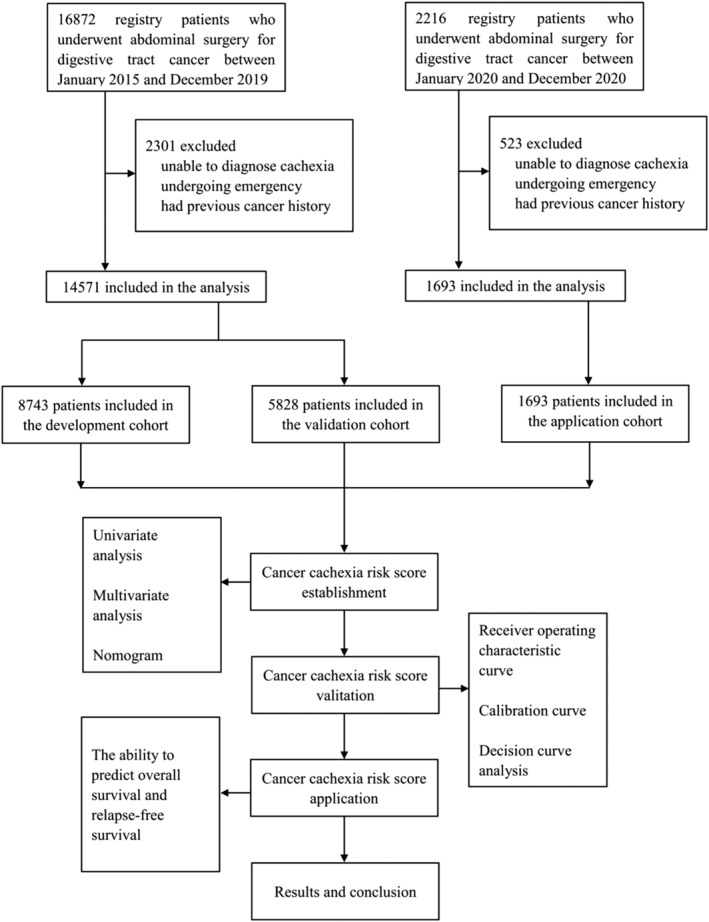
This large-scale cohort study involved patients who underwent abdominal surgery between January 2015 and December 2020 to treat digestive tract cancer. Participants were allocated to the development cohort, the validation cohort, or the application cohort. Univariate and multivariate analyses of the development cohort were performed to detect distinct risk variables for cancer cachexia to create a cancer cachexia risk score. The performance of the risk score across all the three cohorts was assessed through calculating the area under the receiver operating characteristic curve (AUC), as well as calibration and decision curves. We tested how well the score predicted survival outcomes in the application cohort.

RESULTS

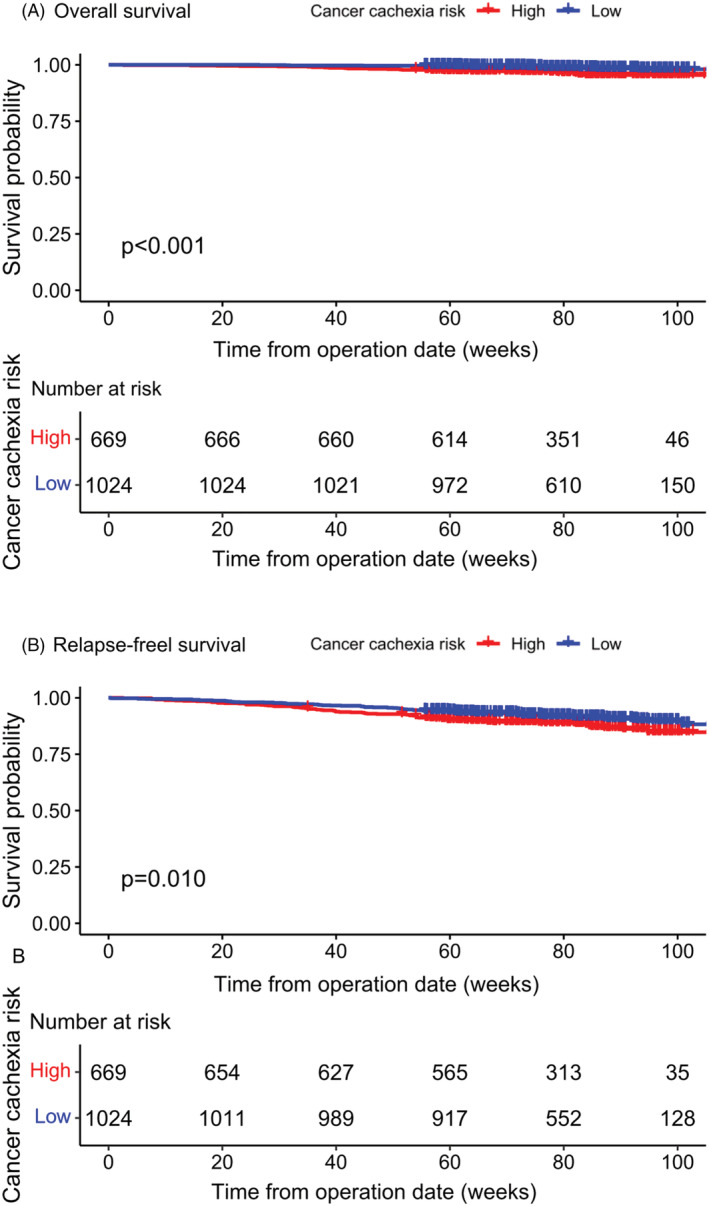
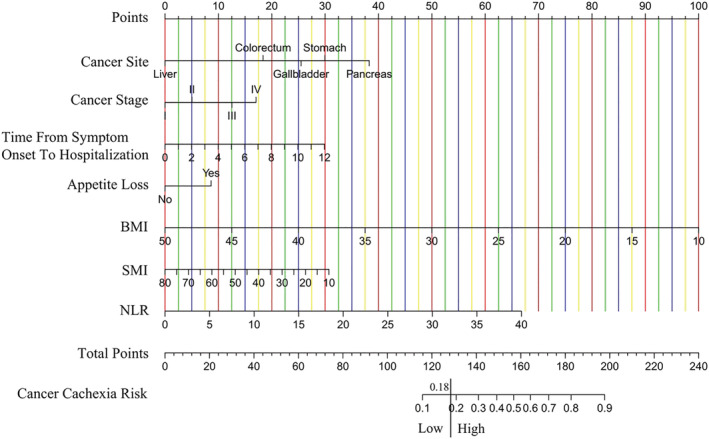
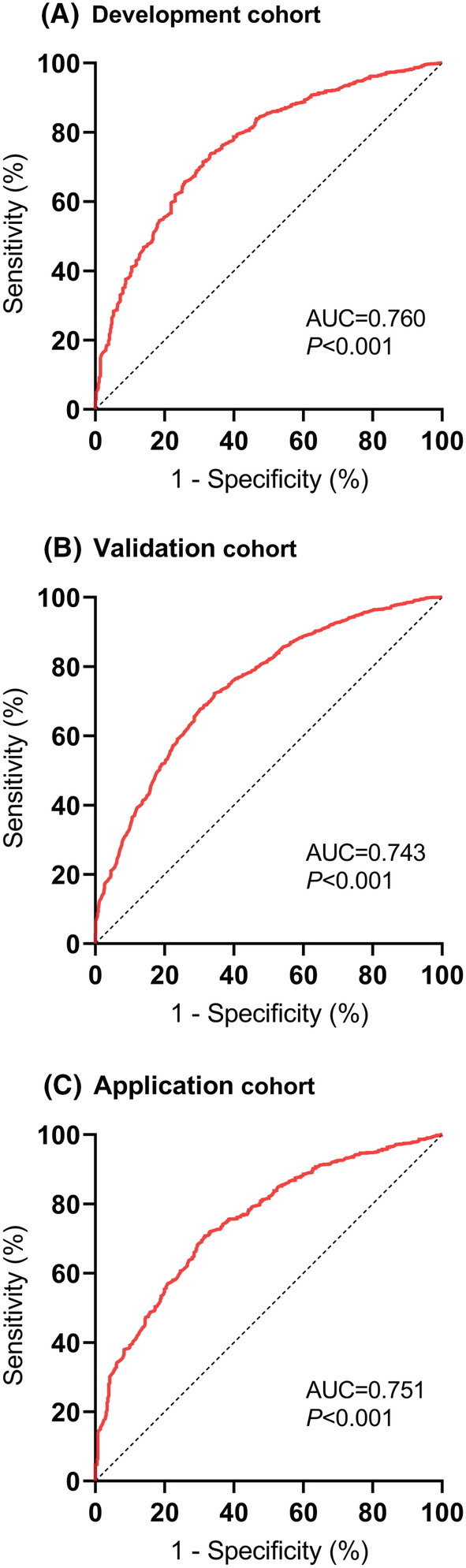
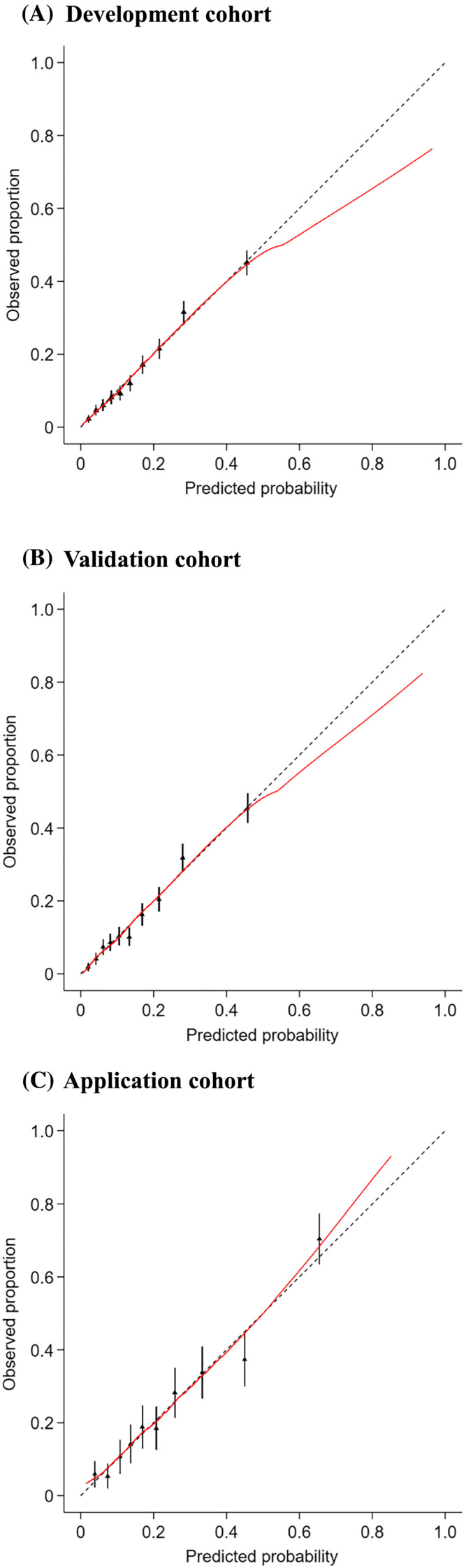
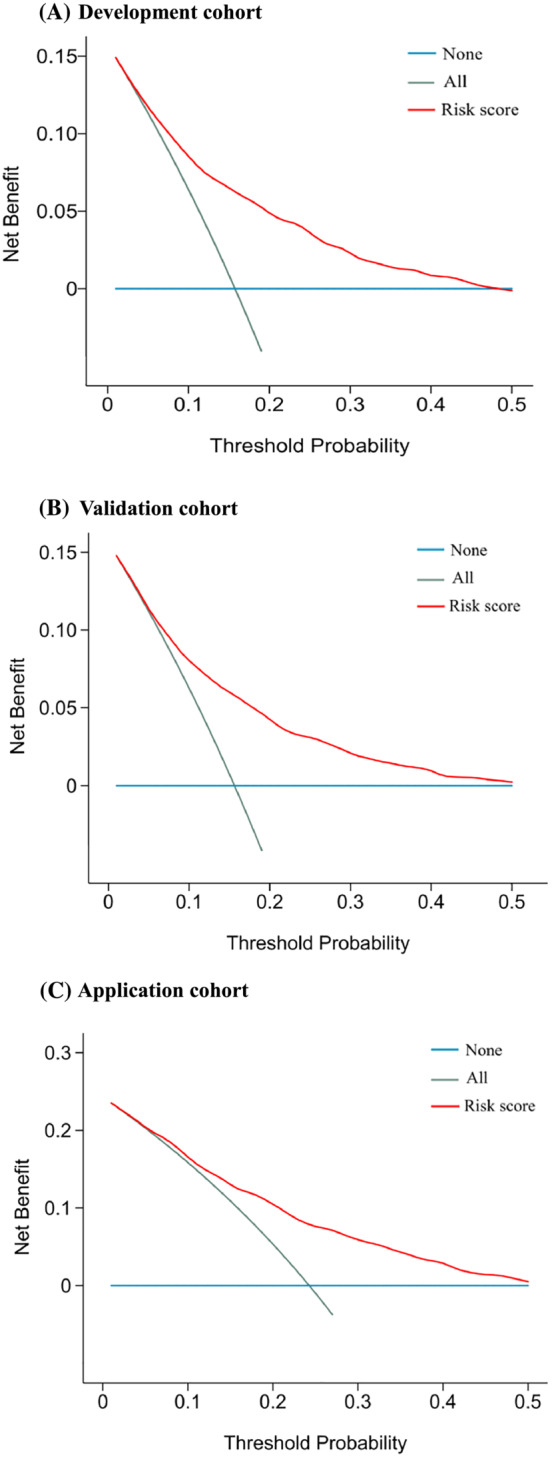
A total of 16 264 patients (median 64 years of age; 65.9% male) were included, with 8743 in the development cohort, 5828 in the validation cohort, and 1693 in the application cohort. Seven variables were identified as independent predictive factors and were included in the cancer cachexia risk score: cancer site, cancer stage, time from symptom onset to hospitalization, appetite loss, body mass index, skeletal muscle index, and neutrophil-lymphocyte ratio. The risk score predicting cancer cachexia owns a good discrimination, with the mean AUC of 0.760 (P < 0.001) in the development cohort, 0.743 (P < 0.001) in the validation cohort, and 0.751 (P < 0.001) in the application cohort, respectively, and had an excellent calibration (all P > 0.05). The decision curve analysis revealed net benefits of the risk score across a range of risk thresholds in the three cohorts. In the application cohort, compared with the high-risk group, the low-risk group experienced significantly longer overall survival [hazard ratio (HR) 2.887, P < 0.001] as well as relapse-free survival (HR 1.482, P = 0.01).

CONCLUSIONS

The cancer cachexia risk score constructed and validated demonstrated good performance in identifying those digestive tract cancer patients before abdominal surgery at a higher risk of cancer cachexia and unfavourable survival. This risk score can help clinicians to enhance their capabilities to screen for cancer cachexia, assess patient prognosis, and strengthen early decision-making on targeted approaches to attune cancer cachexia for digestive tract cancer patients before abdominal surgery.

摘要

背景

癌症恶病质在消化道癌症患者中普遍存在,对预后有重大影响;识别有癌症恶病质风险的个体,以便进行适当的评估和治疗至关重要。本研究旨在评估在腹部手术前,是否可以识别出有癌症恶病质风险和不良生存风险的消化道癌症患者。

方法

这是一项大规模的队列研究,纳入了 2015 年 1 月至 2020 年 12 月期间接受腹部手术治疗消化道癌症的患者。将参与者分配到发展队列、验证队列或应用队列。对发展队列进行单变量和多变量分析,以确定癌症恶病质的独特风险变量,从而建立癌症恶病质风险评分。通过计算受试者工作特征曲线下面积(AUC)、校准和决策曲线评估风险评分在所有三个队列中的表现。我们还在应用队列中检验了评分对生存结局的预测效果。

结果

共纳入 16264 例患者(中位年龄 64 岁;65.9%为男性),其中 8743 例来自发展队列,5828 例来自验证队列,1693 例来自应用队列。7 个变量被确定为独立的预测因素,并纳入癌症恶病质风险评分:癌症部位、癌症分期、从症状出现到住院的时间、食欲减退、体重指数、骨骼肌指数和中性粒细胞-淋巴细胞比值。预测癌症恶病质的风险评分具有良好的区分度,发展队列的平均 AUC 为 0.760(P<0.001),验证队列为 0.743(P<0.001),应用队列为 0.751(P<0.001),且均具有良好的校准度(均 P>0.05)。决策曲线分析显示,该风险评分在三个队列的一系列风险阈值下均具有净获益。在应用队列中,与高危组相比,低危组的总生存时间显著延长[风险比(HR)2.887,P<0.001],无复发生存时间也更长(HR 1.482,P=0.01)。

结论

构建和验证的癌症恶病质风险评分在识别腹部手术前有更高癌症恶病质和不良生存风险的消化道癌症患者方面表现良好。该风险评分有助于临床医生提高筛查癌症恶病质、评估患者预后的能力,并在腹部手术前加强针对消化道癌症患者的癌症恶病质的靶向治疗的早期决策能力。
https://cdn.ncbi.nlm.nih.gov/pmc/blobs/ca8c/10067494/511423967afc/JCSM-14-891-g003.jpg
https://cdn.ncbi.nlm.nih.gov/pmc/blobs/ca8c/10067494/1b63fa0645e1/JCSM-14-891-g006.jpg
https://cdn.ncbi.nlm.nih.gov/pmc/blobs/ca8c/10067494/5f7ed8ab451c/JCSM-14-891-g005.jpg
https://cdn.ncbi.nlm.nih.gov/pmc/blobs/ca8c/10067494/0f2c10513a58/JCSM-14-891-g004.jpg
https://cdn.ncbi.nlm.nih.gov/pmc/blobs/ca8c/10067494/db5b673c3913/JCSM-14-891-g002.jpg
https://cdn.ncbi.nlm.nih.gov/pmc/blobs/ca8c/10067494/14f32db75419/JCSM-14-891-g001.jpg
https://cdn.ncbi.nlm.nih.gov/pmc/blobs/ca8c/10067494/511423967afc/JCSM-14-891-g003.jpg
https://cdn.ncbi.nlm.nih.gov/pmc/blobs/ca8c/10067494/1b63fa0645e1/JCSM-14-891-g006.jpg
https://cdn.ncbi.nlm.nih.gov/pmc/blobs/ca8c/10067494/5f7ed8ab451c/JCSM-14-891-g005.jpg
https://cdn.ncbi.nlm.nih.gov/pmc/blobs/ca8c/10067494/0f2c10513a58/JCSM-14-891-g004.jpg
https://cdn.ncbi.nlm.nih.gov/pmc/blobs/ca8c/10067494/db5b673c3913/JCSM-14-891-g002.jpg
https://cdn.ncbi.nlm.nih.gov/pmc/blobs/ca8c/10067494/14f32db75419/JCSM-14-891-g001.jpg
https://cdn.ncbi.nlm.nih.gov/pmc/blobs/ca8c/10067494/511423967afc/JCSM-14-891-g003.jpg

相似文献

1
Development and validation of a cancer cachexia risk score for digestive tract cancer patients before abdominal surgery.术前消化道癌症患者癌症恶病质风险评分的制定与验证。
J Cachexia Sarcopenia Muscle. 2023 Apr;14(2):891-902. doi: 10.1002/jcsm.13207. Epub 2023 Mar 7.
2
Sarcopenia as a predictor of poor surgical and oncologic outcomes after abdominal surgery for digestive tract cancer: A prospective cohort study.肌肉减少症作为消化道癌症腹部手术后不良手术和肿瘤学结局的预测指标:一项前瞻性队列研究。
Clin Nutr. 2019 Dec;38(6):2881-2888. doi: 10.1016/j.clnu.2018.12.025. Epub 2018 Dec 29.
3
Triceps skinfold-albumin index significantly predicts the prognosis of cancer cachexia: A multicentre cohort study.三头肌皮褶-白蛋白指数显著预测癌症恶病质的预后:一项多中心队列研究。
J Cachexia Sarcopenia Muscle. 2023 Feb;14(1):517-533. doi: 10.1002/jcsm.13156. Epub 2022 Dec 25.
4
Hand grip strength-based cachexia index as a predictor of cancer cachexia and prognosis in patients with cancer.基于握力的恶病质指数作为癌症恶病质和癌症患者预后的预测指标。
J Cachexia Sarcopenia Muscle. 2023 Feb;14(1):382-390. doi: 10.1002/jcsm.13139. Epub 2022 Nov 29.
5
How Does the Skeletal Oncology Research Group Algorithm's Prediction of 5-year Survival in Patients with Chondrosarcoma Perform on International Validation?骨肿瘤研究组算法对软骨肉瘤患者 5 年生存率的预测在国际验证中的表现如何?
Clin Orthop Relat Res. 2020 Oct;478(10):2300-2308. doi: 10.1097/CORR.0000000000001305.
6
A novel tissue inhibitor of metalloproteinases-1/liver/cachexia score predicts prognosis of gastrointestinal cancer patients.一种新型的组织金属蛋白酶抑制剂-1/肝/恶病质评分可预测胃肠道癌症患者的预后。
J Cachexia Sarcopenia Muscle. 2021 Apr;12(2):378-392. doi: 10.1002/jcsm.12680. Epub 2021 Feb 16.
7
Is cachexia associated with chemotherapy toxicities in gastrointestinal cancer patients? A prospective study.恶病质是否与胃肠道癌症患者的化疗毒性相关?一项前瞻性研究。
J Cachexia Sarcopenia Muscle. 2019 Apr;10(2):445-454. doi: 10.1002/jcsm.12391. Epub 2019 Mar 28.
8
Development and application of the Cancer Cachexia Staging Index for the diagnosis and staging of cancer cachexia.癌症恶病质分期指数的制定与应用:用于癌症恶病质的诊断与分期。
Nutrition. 2023 Oct;114:112114. doi: 10.1016/j.nut.2023.112114. Epub 2023 Jun 4.
9
Geriatric Nutrition Risk Index: Prognostic factor related to inflammation in elderly patients with cancer cachexia.老年营养风险指数:与癌症恶病质老年患者炎症相关的预后因素。
J Cachexia Sarcopenia Muscle. 2021 Dec;12(6):1969-1982. doi: 10.1002/jcsm.12800. Epub 2021 Sep 29.
10
Cancer cachexia in the age of obesity: skeletal muscle depletion is a powerful prognostic factor, independent of body mass index.肥胖时代的癌症恶病质:骨骼肌消耗是一个强大的预后因素,与体重指数无关。
J Clin Oncol. 2013 Apr 20;31(12):1539-47. doi: 10.1200/JCO.2012.45.2722. Epub 2013 Mar 25.

引用本文的文献

1
Mechanisms and pharmacotherapy of cancer cachexia-associated anorexia.癌症恶病质相关性厌食的机制与药物治疗
Pharmacol Res Perspect. 2025 Feb;13(1):e70031. doi: 10.1002/prp2.70031.
2
Development and validation of a prognostic model for cachexia in postoperative gastric cancer patients with low nutritional risk: a dual-center retrospective cohort study.低营养风险的术后胃癌患者恶病质预后模型的建立与验证:一项双中心回顾性队列研究
Surg Endosc. 2025 Jan;39(1):237-248. doi: 10.1007/s00464-024-11367-9. Epub 2024 Nov 5.
3
Relevance of Dietary Supplement Use in Gastrointestinal-Cancer-Associated Cachexia.

本文引用的文献

1
Cancer cachexia: a nutritional or a systemic inflammatory syndrome?癌症恶病质:一种营养相关还是系统性炎症综合征?
Br J Cancer. 2022 Aug;127(3):379-382. doi: 10.1038/s41416-022-01826-2. Epub 2022 May 6.
2
Addressing unmet needs for people with cancer cachexia: recommendations from a multistakeholder workshop.满足癌症恶病质患者未满足的需求:多利益相关方研讨会的建议
J Cachexia Sarcopenia Muscle. 2022 Apr;13(2):1418-1425. doi: 10.1002/jcsm.12910. Epub 2022 Feb 26.
3
Validation of GLIM malnutrition criteria in cancer patients undergoing major abdominal surgery: A large-scale prospective study.
膳食补充剂在与胃肠道癌相关的恶病质中的相关性。
Nutrients. 2023 Jul 30;15(15):3391. doi: 10.3390/nu15153391.
GLIM 营养不良标准在接受大腹部手术的癌症患者中的验证:一项大规模前瞻性研究。
Clin Nutr. 2022 Mar;41(3):599-609. doi: 10.1016/j.clnu.2022.01.010. Epub 2022 Jan 13.
4
Ethical guidelines for publishing in the Journal of Cachexia, Sarcopenia and Muscle: update 2021.《恶病质、肌肉减少症与肌肉杂志》发表伦理准则:2021年更新版
J Cachexia Sarcopenia Muscle. 2021 Dec;12(6):2259-2261. doi: 10.1002/jcsm.12899. Epub 2021 Dec 13.
5
Nutrition challenges of cancer cachexia.癌症恶病质的营养挑战。
JPEN J Parenter Enteral Nutr. 2021 Nov;45(S2):16-25. doi: 10.1002/jpen.2287.
6
Cachexia is Prevalent in Patients With Hepatocellular Carcinoma and Associated With Worse Prognosis.恶病质在肝细胞癌患者中普遍存在且与更差的预后相关。
Clin Gastroenterol Hepatol. 2022 May;20(5):e1157-e1169. doi: 10.1016/j.cgh.2021.09.022. Epub 2021 Sep 20.
7
Prevalence and prognostic impact of cachexia among older patients with cancer: a nationwide cross-sectional survey (NutriAgeCancer).癌症老年患者恶病质的流行情况及其对预后的影响:一项全国性横断面调查(NutriAgeCancer)。
J Cachexia Sarcopenia Muscle. 2021 Dec;12(6):1477-1488. doi: 10.1002/jcsm.12776. Epub 2021 Sep 14.
8
Subcutaneous, but not visceral, adipose tissue as a marker for prognosis in gastric cancer patients with cachexia.皮下而非内脏脂肪组织可作为伴有恶液质的胃癌患者预后的标志物。
Clin Nutr. 2021 Sep;40(9):5156-5161. doi: 10.1016/j.clnu.2021.08.003. Epub 2021 Aug 17.
9
Diagnostic criteria for cancer cachexia: reduced food intake and inflammation predict weight loss and survival in an international, multi-cohort analysis.癌症恶病质的诊断标准:国际多队列分析表明,减少食物摄入和炎症可预测体重减轻和生存。
J Cachexia Sarcopenia Muscle. 2021 Oct;12(5):1189-1202. doi: 10.1002/jcsm.12756. Epub 2021 Aug 27.
10
Cancer Cachexia: Its Mechanism and Clinical Significance.癌症恶病质:发病机制及临床意义。
Int J Mol Sci. 2021 Aug 6;22(16):8491. doi: 10.3390/ijms22168491.