Department of Psychology, Sport and Geography, University of Hertfordshire, Hatfield, Hertfordshire, United Kingdom.
Laboratoire d'InfoRmatique en Image et Systèmes d'information, French Centre National de la Recherche Scientifique, University of Lyon, Lyon, France.
PLoS One. 2023 Mar 9;18(3):e0282255. doi: 10.1371/journal.pone.0282255. eCollection 2023.
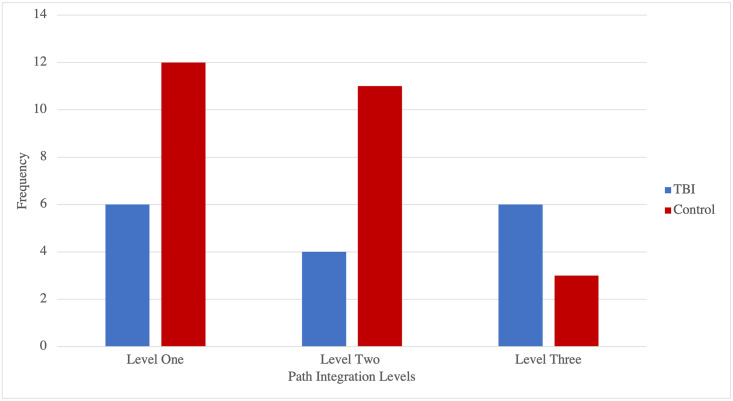
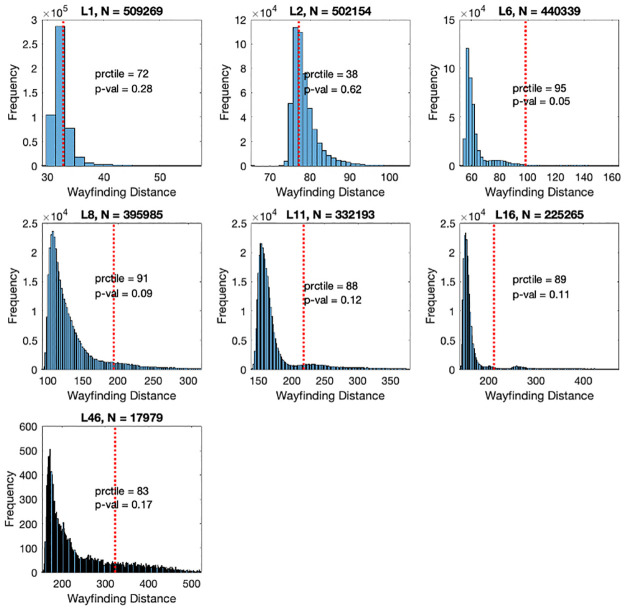
The ability to navigate is supported by a wide network of brain areas which are particularly vulnerable to disruption brain injury, including traumatic brain injury (TBI). Wayfinding and the ability to orient back to the direction you have recently come (path integration) may likely be impacted in daily life but have so far not been tested with patients with TBI. Here, we assessed spatial navigation in thirty-eight participants, fifteen of whom had a history of TBI, and twenty-three control participants. Self-estimated spatial navigation ability was assessed using the Santa Barbara Sense of Direction (SBSOD) scale. No significant difference between TBI patients and a control group was identified. Rather, results indicated that both participant groups demonstrated 'good' self-inferred spatial navigational ability on the SBSOD scale. Objective navigation ability was tested via the virtual mobile app test Sea Hero Quest (SHQ), which has been shown to predict real-world navigation difficulties and assesses (a) wayfinding across several environments and (b) path integration. Compared to a sub-sample of 13 control participants, a matched subsample of 10 TBI patients demonstrated generally poorer performance on all wayfinding environments tested. Further analysis revealed that TBI participants consistently spent a shorter duration viewing a map prior to navigating to goals. Patients showed mixed performance on the path integration task, with poor performance evident when proximal cues were absent. Our results provide preliminary evidence that TBI impacts both wayfinding and, to some extent, path integration. The findings suggest long-lasting clinical difficulties experienced in TBI patients affect both wayfinding and to some degree path integration ability.
导航能力依赖于广泛的大脑区域网络的支持,这些区域特别容易受到大脑损伤的干扰,包括创伤性脑损伤(TBI)。寻路和重新定位到你最近来的方向的能力(路径整合)可能在日常生活中受到影响,但迄今为止尚未在 TBI 患者中进行测试。在这里,我们评估了 38 名参与者的空间导航能力,其中 15 名有 TBI 病史,23 名对照组参与者。使用圣巴巴拉方向感量表(SBSOD)评估自我估计的空间导航能力。TBI 患者和对照组之间没有发现显著差异。相反,结果表明,两组参与者在 SBSOD 量表上都表现出“良好”的自我推断的空间导航能力。通过虚拟移动应用程序测试 Sea Hero Quest (SHQ) 测试客观导航能力,该测试已被证明可预测现实世界中的导航困难,并评估 (a) 多个环境中的寻路能力和 (b) 路径整合。与 13 名对照组参与者的子样本相比,10 名匹配的 TBI 患者子样本在所有测试的寻路环境中表现出普遍较差的表现。进一步分析表明,TBI 参与者在导航到目标之前,始终花费较短的时间查看地图。患者在路径整合任务中的表现参差不齐,近端线索缺失时表现不佳。我们的结果提供了初步证据,表明 TBI 会影响寻路和在某种程度上影响路径整合。研究结果表明,TBI 患者长期存在的临床困难会影响寻路和在某种程度上影响路径整合能力。