Weisberg Steven M, Newcombe Nora S
Department of Neurology, University of Pennsylvania, Philadelphia, PA 19104.
Department of Psychology, Temple University, Philadelphia, Pennsylvania, 19122.
Curr Dir Psychol Sci. 2018 Aug;27(4):220-226. doi: 10.1177/0963721417744521. Epub 2018 Jun 13.
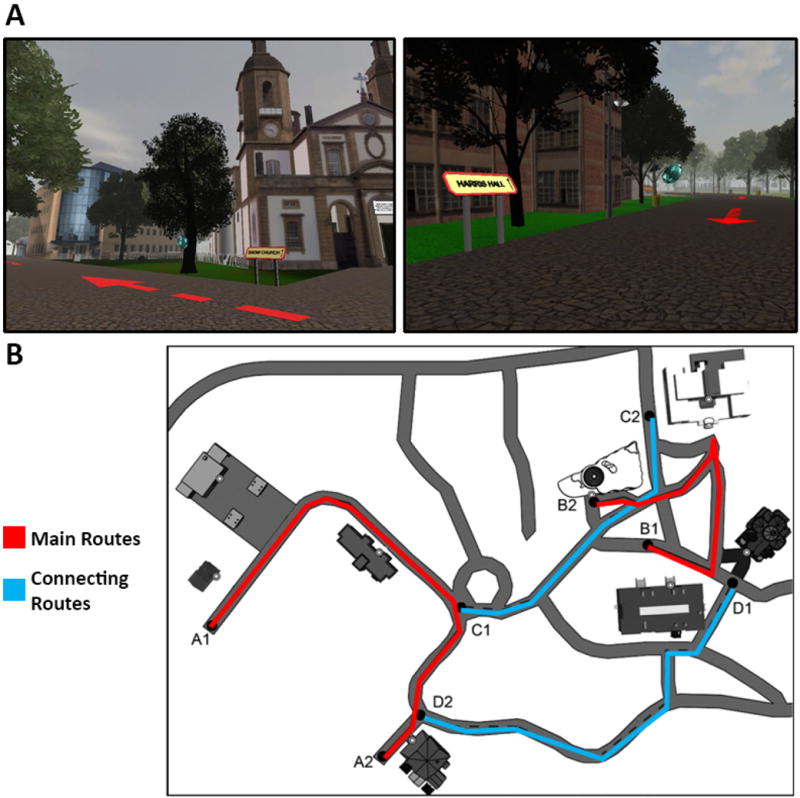
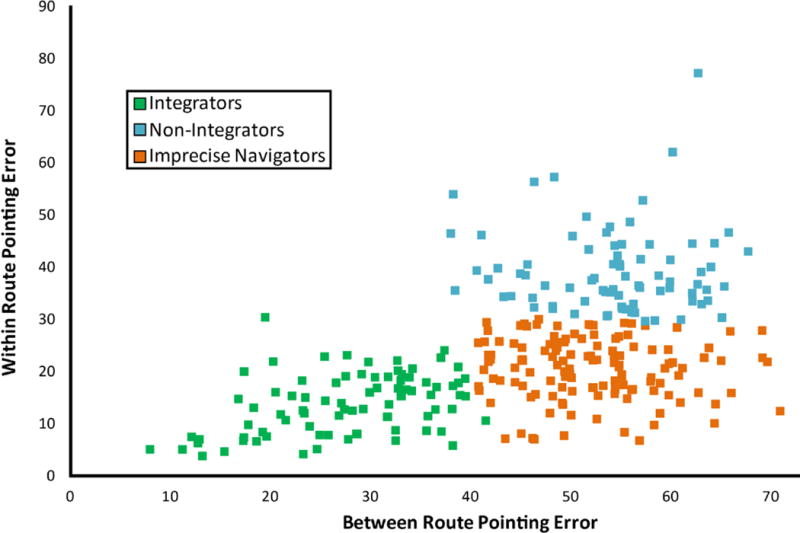
The proposal that humans can develop cognitive maps of their environment has a long and controversial history. We suggest an individual-differences approach to this question instead of a normative one. Specifically, there is evidence that some people derive flexible map-like representations from information acquired during navigation whereas others store much less accurate information. Our research uses a virtual-reality paradigm in which two routes are learned and must be related to each other. It defines 3 groups: Integrators, Non-integrators, and Imprecise Navigators. These groups show distinctive patterns of spatial skills and working memory, as well as personality. We contrast our approach with research challenging the cognitive map hypothesis, and offer directions for rapprochement between the two views.
人类能够构建其所处环境的认知地图这一观点有着漫长且颇具争议的历史。我们建议采用个体差异的方法来研究这个问题,而非规范性方法。具体而言,有证据表明,一些人能够从导航过程中获取的信息中得出灵活的类似地图的表征,而另一些人存储的信息则准确性低得多。我们的研究采用虚拟现实范式,其中要学习两条路线,且这两条路线必须相互关联。研究定义了3组:整合者、非整合者和不精确导航者。这些组在空间技能、工作记忆以及个性方面呈现出独特的模式。我们将我们的方法与挑战认知地图假说的研究进行对比,并为两种观点的和解提供方向。