• 文献检索
  • 文档翻译
  • 深度研究
  • 学术资讯
  • Suppr Zotero 插件Zotero 插件
  • 邀请有礼
  • 套餐&价格
  • 历史记录
应用&插件
Suppr Zotero 插件Zotero 插件浏览器插件Mac 客户端Windows 客户端微信小程序
定价
高级版会员购买积分包购买API积分包
服务
文献检索文档翻译深度研究API 文档MCP 服务
关于我们
关于 Suppr公司介绍联系我们用户协议隐私条款
关注我们

Suppr 超能文献

核心技术专利:CN118964589B侵权必究
粤ICP备2023148730 号-1Suppr @ 2026

文献检索

告别复杂PubMed语法,用中文像聊天一样搜索,搜遍4000万医学文献。AI智能推荐,让科研检索更轻松。

立即免费搜索

文件翻译

保留排版,准确专业,支持PDF/Word/PPT等文件格式,支持 12+语言互译。

免费翻译文档

深度研究

AI帮你快速写综述,25分钟生成高质量综述,智能提取关键信息,辅助科研写作。

立即免费体验

分析现有动物测试数据,提出同行衍生的定量阈值,以确定狂犬病充分监测能力。

Analysis of available animal testing data to propose peer-derived quantitative thresholds for determining adequate surveillance capacity for rabies.

机构信息

Poxvirus and Rabies Branch, Division of High Consequence Pathogens and Pathology, Centers for Disease Control and Prevention, Atlanta, USA.

出版信息

Sci Rep. 2023 Mar 9;13(1):3986. doi: 10.1038/s41598-023-30984-3.

DOI:10.1038/s41598-023-30984-3
PMID:36894610
原文链接:https://pmc.ncbi.nlm.nih.gov/articles/PMC9998015/
Abstract

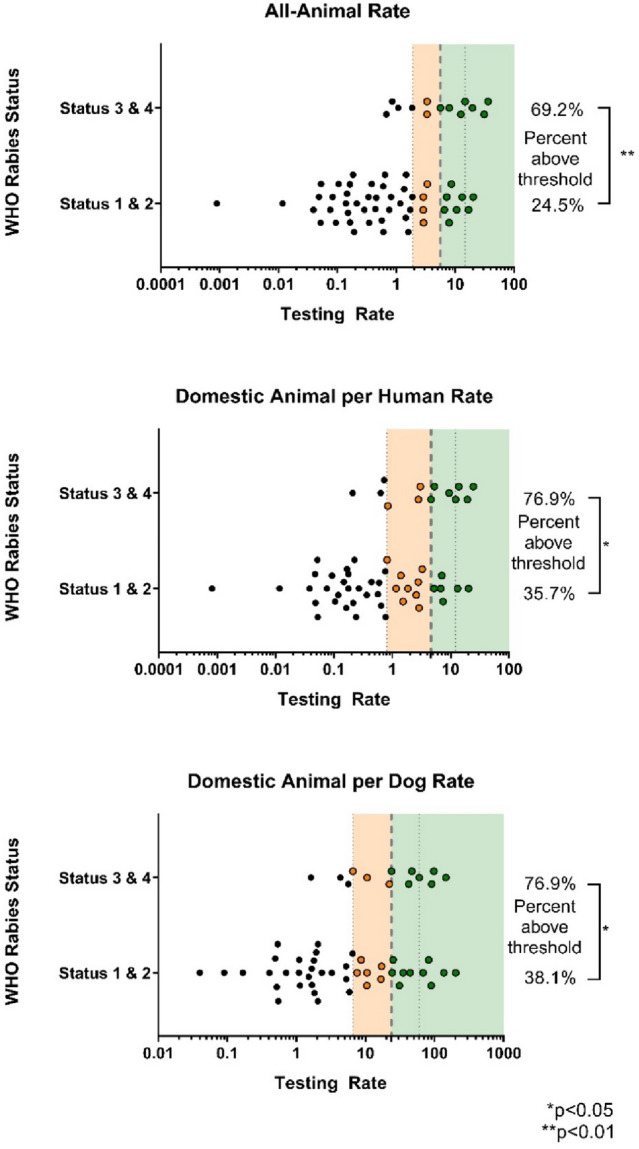
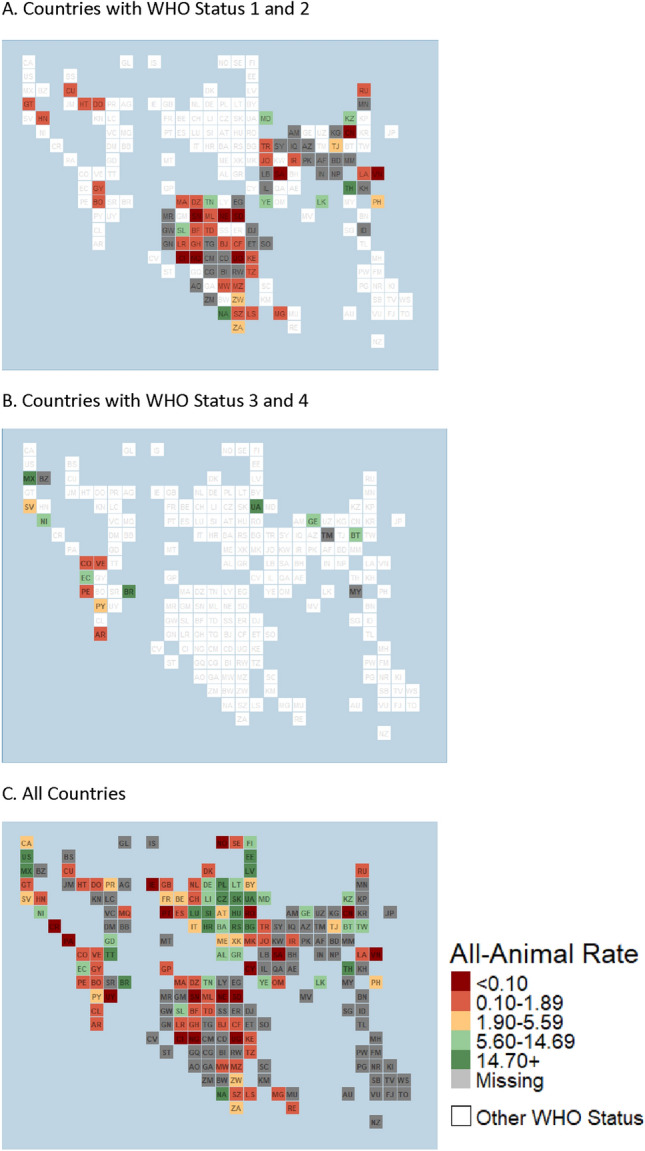
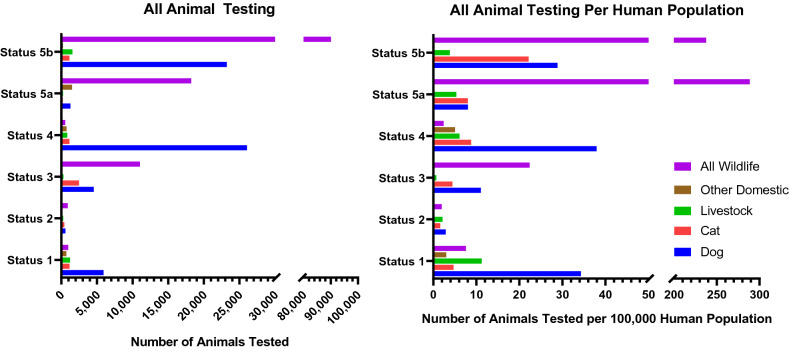
Historical targets for country-level animal rabies testing volumes were abandoned due to ethical and welfare concerns, and interpretation challenges of testing healthy animals. To-date, no quantitative threshold has been established for evaluating adequate surveillance capacity specific to suspected rabid animals. The purpose here is to establish quantitative testing thresholds for rabies suspected animals to assess a country's rabies surveillance capacity. Animal rabies testing data was obtained from official and unofficial rabies surveillance platforms from 2010 to 2019 and supplemented with official country reports and published literature. Testing rates were determined for all-animal and domestic animals, and standardized per 100,000 estimated human population; the domestic animal rate was also standardized per 100,000 estimated dog population. There were 113 countries that reported surveillance data eligible for analysis. Countries reporting the most data were under WHO categories as having endemic human rabies or no dog rabies. The annual median all-animal testing rate for all countries was 1.53 animals/100,000 human population (IQR 0.27-8.78). Three proposed testing rate thresholds are an all-animal rate of 1.9 animals/100,000 humans, a domestic animal per human rate of 0.8 animals/100,000 humans, and a domestic animal per dog rate of 6.6 animals/100,000 dogs. These three peer-derived rabies testing thresholds for passive surveillance can be used to facilitate assessment of a country's rabies surveillance capacity.

摘要

由于伦理和福利问题以及对健康动物检测的解释挑战,国家级动物狂犬病检测量的历史目标已被放弃。迄今为止,尚未为评估特定于疑似狂犬病动物的充分监测能力建立适当的定量阈值。本研究旨在为疑似狂犬病动物建立定量检测阈值,以评估一个国家的狂犬病监测能力。从 2010 年至 2019 年,从官方和非官方狂犬病监测平台获取动物狂犬病检测数据,并辅以官方国家报告和已发表的文献。确定了所有动物和家畜的检测率,并按每 10 万估计人口标准化;还按每 10 万估计犬只数量标准化了家畜的检测率。有 113 个国家报告了符合分析条件的监测数据。报告数据最多的国家属于世界卫生组织规定的人类狂犬病地方性流行或无犬狂犬病的类别。所有国家的年度中位数全动物检测率为 1.53 只/10 万人口(IQR 0.27-8.78)。提出了三个检测率阈值,即全动物率为 1.9 只/10 万人口,每 10 万人口的家畜率为 0.8 只/10 万人口,以及每 10 万只犬的家畜率为 6.6 只/10 万只犬。这三个基于同行的狂犬病被动监测检测阈值可用于促进对一个国家狂犬病监测能力的评估。
https://cdn.ncbi.nlm.nih.gov/pmc/blobs/24e0/9998440/c85c9dc66428/41598_2023_30984_Fig3_HTML.jpg
https://cdn.ncbi.nlm.nih.gov/pmc/blobs/24e0/9998440/19f81d43b92a/41598_2023_30984_Fig1_HTML.jpg
https://cdn.ncbi.nlm.nih.gov/pmc/blobs/24e0/9998440/7e84640a1bee/41598_2023_30984_Fig2_HTML.jpg
https://cdn.ncbi.nlm.nih.gov/pmc/blobs/24e0/9998440/c85c9dc66428/41598_2023_30984_Fig3_HTML.jpg
https://cdn.ncbi.nlm.nih.gov/pmc/blobs/24e0/9998440/19f81d43b92a/41598_2023_30984_Fig1_HTML.jpg
https://cdn.ncbi.nlm.nih.gov/pmc/blobs/24e0/9998440/7e84640a1bee/41598_2023_30984_Fig2_HTML.jpg
https://cdn.ncbi.nlm.nih.gov/pmc/blobs/24e0/9998440/c85c9dc66428/41598_2023_30984_Fig3_HTML.jpg

相似文献

1
Analysis of available animal testing data to propose peer-derived quantitative thresholds for determining adequate surveillance capacity for rabies.分析现有动物测试数据,提出同行衍生的定量阈值,以确定狂犬病充分监测能力。
Sci Rep. 2023 Mar 9;13(1):3986. doi: 10.1038/s41598-023-30984-3.
2
The rabies situation in Western Europe.西欧的狂犬病疫情
Dev Biol (Basel). 2008;131:19-25.
3
Rabies surveillance-response in Mali in the past 18 years and requirements for the future.过去 18 年马里的狂犬病监测与应对情况以及未来的需求。
Acta Trop. 2020 Oct;210:105526. doi: 10.1016/j.actatropica.2020.105526. Epub 2020 May 22.
4
[Situation of endemic rabies in Madagascar].[马达加斯加的地方性狂犬病情况]
Arch Inst Pasteur Madagascar. 1993;60(1-2):5-8.
5
Rabies surveillance in the United States during 2009.2009年美国的狂犬病监测
J Am Vet Med Assoc. 2010 Sep 15;237(6):646-57. doi: 10.2460/javma.237.6.646.
6
Rabies surveillance in the United States during 2011.2011年美国的狂犬病监测
J Am Vet Med Assoc. 2012 Sep 15;241(6):712-22. doi: 10.2460/javma.241.6.712.
7
Reconciling surveillance systems with limited resources: an evaluation of passive surveillance for rabies in an endemic setting.利用有限资源协调监测系统:对狂犬病地方性流行地区被动监测的评估
Prev Vet Med. 2015 Oct 1;121(3-4):206-14. doi: 10.1016/j.prevetmed.2015.06.016. Epub 2015 Jul 7.
8
Reemerging rabies and lack of systemic surveillance in People's Republic of China.中华人民共和国狂犬病再度出现及缺乏系统性监测
Emerg Infect Dis. 2009 Aug;15(8):1159-64. doi: 10.3201/eid1508.081426.
9
Rabies surveillance in the United States during 2006.2006年美国的狂犬病监测
J Am Vet Med Assoc. 2007 Aug 15;231(4):540-56. doi: 10.2460/javma.231.4.540.
10
Epidemiology of rabies in skunks in Texas.德克萨斯州臭鼬狂犬病的流行病学
J Am Vet Med Assoc. 2009 Mar 1;234(5):616-20. doi: 10.2460/javma.234.5.616.

引用本文的文献

1
A logistic regression model to predict the next rabies virus host-shift event.一个用于预测下一次狂犬病病毒宿主转换事件的逻辑回归模型。
Sci Rep. 2025 Jun 2;15(1):19306. doi: 10.1038/s41598-025-98986-x.
2
Documenting challenges in achieving rabies elimination by 2030 in low-middle income countries; a Kenyan case study from Lamu County, 2020-2022: mixed methods approach.记录低收入和中等收入国家在2030年前实现狂犬病消除目标过程中面临的挑战;2020 - 2022年来自肯尼亚拉穆县的案例研究:混合方法研究
One Health Outlook. 2025 Feb 10;7(1):6. doi: 10.1186/s42522-024-00129-1.
3
A Perspective of the Epidemiology of Rabies in South Africa, 1998-2019.

本文引用的文献

1
United Against Rabies Forum: The One Health Concept at Work.联合抗狂犬病论坛:发挥同一健康理念的作用。
Front Public Health. 2022 Apr 13;10:854419. doi: 10.3389/fpubh.2022.854419. eCollection 2022.
2
A country classification system to inform rabies prevention guidelines and regulations.一种用于指导狂犬病预防准则和法规的国家分类系统。
J Travel Med. 2022 Jul 14;29(4). doi: 10.1093/jtm/taac046.
3
Prioritizing zoonotic diseases using a multisectoral, One Health approach for The Economic Community of West African States (ECOWAS).
1998 - 2019年南非狂犬病流行病学透视
Trop Med Infect Dis. 2024 May 22;9(6):122. doi: 10.3390/tropicalmed9060122.
4
Dog ecology and rabies knowledge, attitude and practice (KAP) in the Northern Communal Areas of Namibia.纳米比亚北方社区的狗生态学和狂犬病知识、态度和实践(KAP)。
PLoS Negl Trop Dis. 2024 Feb 5;18(2):e0011631. doi: 10.1371/journal.pntd.0011631. eCollection 2024 Feb.
5
Spatio-temporal investigation of reported cases of animal rabies in Ghana from 2010 to 2017.加纳 2010 年至 2017 年动物狂犬病报告病例的时空调查。
Vet Med Sci. 2023 Nov;9(6):2559-2565. doi: 10.1002/vms3.1282. Epub 2023 Sep 23.
6
Rabies in a postpandemic world: resilient reservoirs, redoubtable riposte, recurrent roadblocks, and resolute recidivism.大流行后世界中的狂犬病:坚韧的储存宿主、强大的反击、反复出现的障碍以及顽固的复发
Anim Dis. 2023;3(1):15. doi: 10.1186/s44149-023-00078-8. Epub 2023 May 19.
采用多部门“同一健康”方法为西非国家经济共同体(ECOWAS)确定人畜共患病的优先次序。
One Health Outlook. 2021 Nov 23;3(1):24. doi: 10.1186/s42522-021-00055-6.
4
Rabies and the pandemic: lessons for One Health.狂犬病与大流行:对同一健康的启示。
Trans R Soc Trop Med Hyg. 2022 Mar 2;116(3):197-200. doi: 10.1093/trstmh/trab123.
5
The impact of the COVID-19 pandemic on rabies reemergence in Latin America: The case of Arequipa, Peru.COVID-19 大流行对拉丁美洲狂犬病再现的影响:秘鲁阿雷基帕案例。
PLoS Negl Trop Dis. 2021 May 21;15(5):e0009414. doi: 10.1371/journal.pntd.0009414. eCollection 2021 May.
6
An evaluation of Brazil's surveillance and prophylaxis of canine rabies between 2008 and 2017.巴西 2008-2017 年犬狂犬病监测与预防评估。
PLoS Negl Trop Dis. 2019 Aug 5;13(8):e0007564. doi: 10.1371/journal.pntd.0007564. eCollection 2019 Aug.
7
Rabies diagnosis and surveillance in animals in the era of rabies elimination.狂犬病消除时代的动物狂犬病诊断与监测
Rev Sci Tech. 2018 Aug;37(2):359-370. doi: 10.20506/rst.37.2.2807.
8
Prioritizing Zoonoses for Global Health Capacity Building-Themes from One Health Zoonotic Disease Workshops in 7 Countries, 2014-2016.优先考虑全球卫生能力建设中的人畜共患病——2014-2016 年 7 个国家开展的“One Health 人畜共患病”研讨会的主题。
Emerg Infect Dis. 2017 Dec;23(13):S55-64. doi: 10.3201/eid2313.170418.
9
The Road to Dog Rabies Control and Elimination-What Keeps Us from Moving Faster?犬类狂犬病防控与消除之路——是什么阻碍我们更快前行?
Front Public Health. 2017 May 15;5:103. doi: 10.3389/fpubh.2017.00103. eCollection 2017.
10
Elimination of Dog-Mediated Human Rabies Deaths by 2030: Needs Assessment and Alternatives for Progress Based on Dog Vaccination.到2030年消除犬介导的人类狂犬病死亡:基于犬类疫苗接种的需求评估与进展方案
Front Vet Sci. 2017 Feb 10;4:9. doi: 10.3389/fvets.2017.00009. eCollection 2017.