Department of Cell Death and Proliferation, Institut d'Investigacions Biomèdiques de Barcelona, Consejo Superior de Investigaciones Científicas (CSIC), Institut d'Investigacions Biomèdiques August Pi I Sunyer (IDIBAPS), Barcelona, Spain.
Centro de Investigación Biomédica en Red Sobre Enfermedades Neurodegenerativas (CIBERNED), Madrid, Spain.
Transl Neurodegener. 2023 Mar 9;12(1):10. doi: 10.1186/s40035-023-00343-3.
Persistent inflammatory response in the brain can lead to tissue damage and neurodegeneration. In Alzheimer's disease (AD), there is an aberrant activation of inflammasomes, molecular platforms that drive inflammation through caspase-1-mediated proteolytic cleavage of proinflammatory cytokines and gasdermin D (GSDMD), the executor of pyroptosis. However, the mechanisms underlying the sustained activation of inflammasomes in AD are largely unknown. We have previously shown that high brain cholesterol levels promote amyloid-β (Aβ) accumulation and oxidative stress. Here, we investigate whether these cholesterol-mediated changes may regulate the inflammasome pathway.
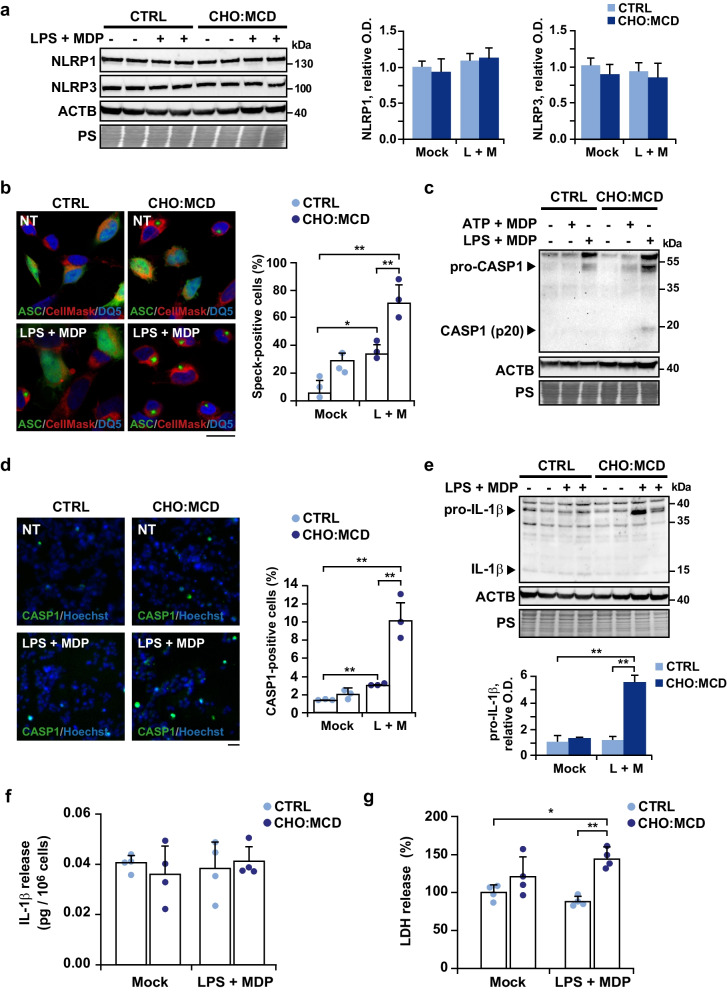
SIM-A9 microglia and SH-SY5Y neuroblastoma cells were cholesterol-enriched using a water-soluble cholesterol complex. After exposure to lipopolysaccharide (LPS) plus muramyl dipeptide or Aβ, activation of the inflammasome pathway was analyzed by immunofluorescence, ELISA and immunoblotting analysis. Fluorescently-labeled Aβ was employed to monitor changes in microglia phagocytosis. Conditioned medium was used to study how microglia-neuron interrelationship modulates the inflammasome-mediated response.
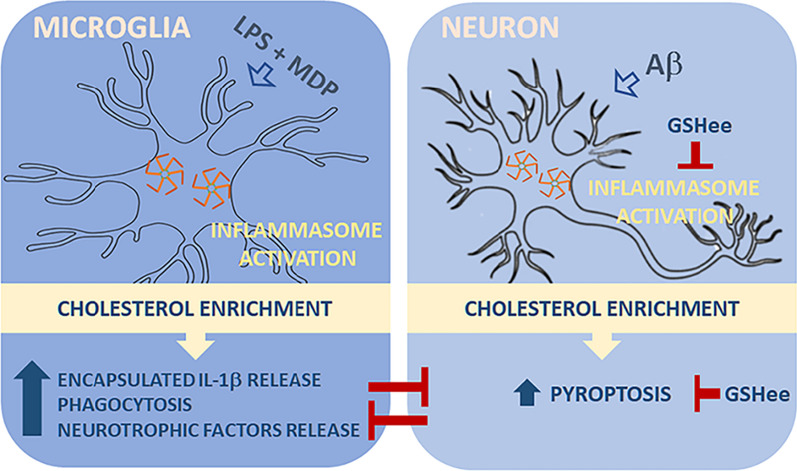
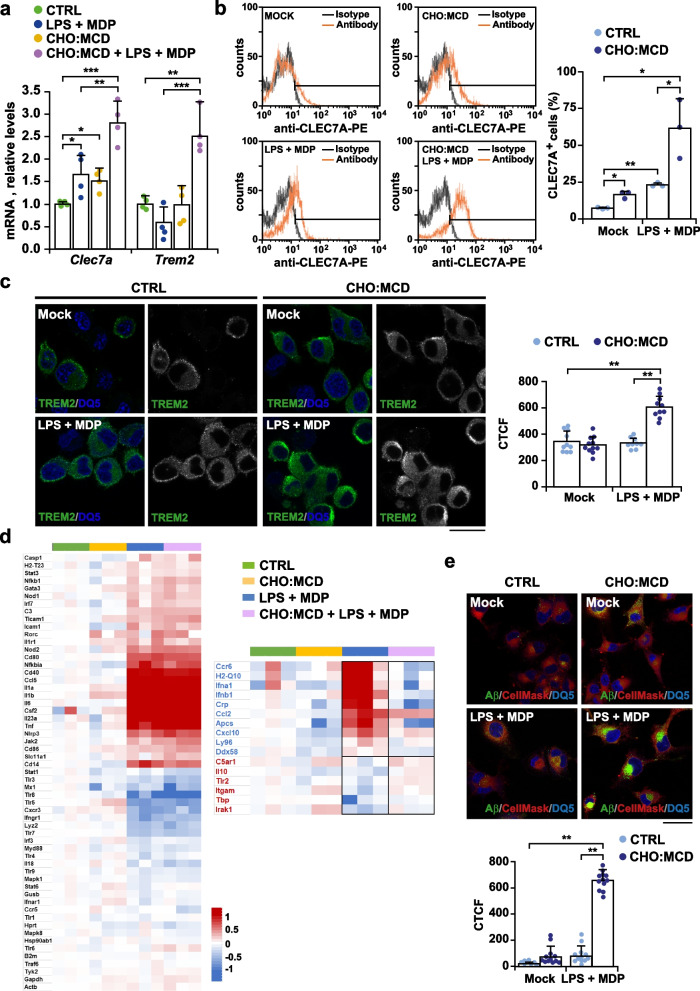
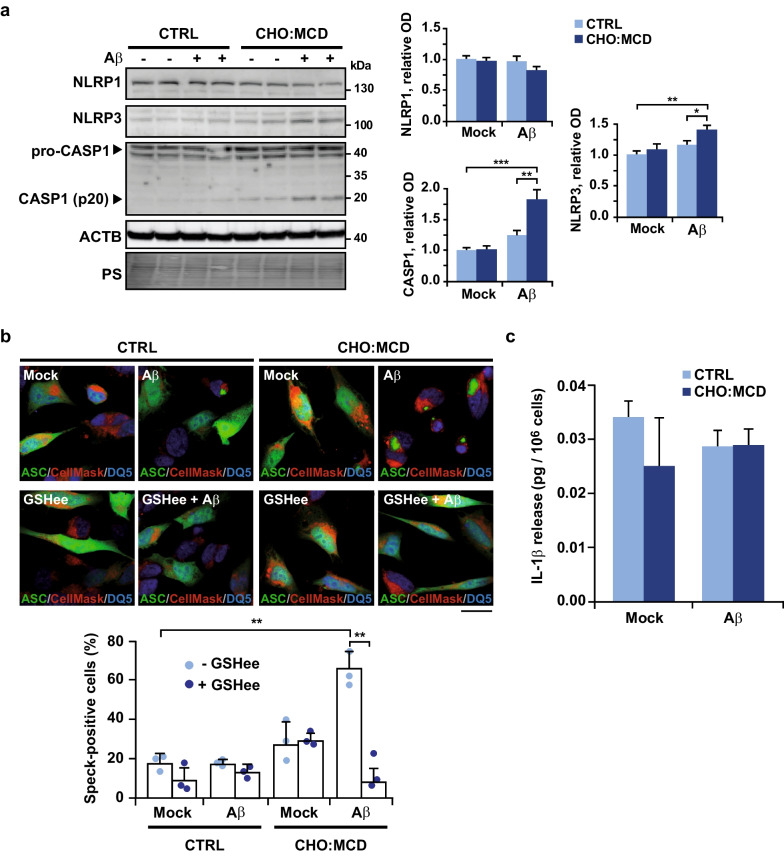
In activated microglia, cholesterol enrichment promoted the release of encapsulated IL-1β accompanied by a switch to a more neuroprotective phenotype, with increased phagocytic capacity and release of neurotrophic factors. In contrast, in SH-SY5Y cells, high cholesterol levels stimulated inflammasome assembly triggered by both bacterial toxins and Aβ peptides, resulting in GSDMD-mediated pyroptosis. Glutathione (GSH) ethyl ester treatment, which recovered the cholesterol-mediated depletion of mitochondrial GSH levels, significantly reduced the Aβ-induced oxidative stress in the neuronal cells, resulting in lower inflammasome activation and cell death. Furthermore, using conditioned media, we showed that neuronal pyroptosis affects the function of the cholesterol-enriched microglia, lowering its phagocytic activity and, therefore, the ability to degrade extracellular Aβ.
Changes in intracellular cholesterol levels differentially regulate the inflammasome-mediated immune response in microglia and neuronal cells. Given the microglia-neuron cross-talk in the brain, cholesterol modulation should be considered a potential therapeutic target for AD treatment, which may help to block the aberrant and chronic inflammation observed during the disease progression.
大脑中持续的炎症反应会导致组织损伤和神经退行性变。在阿尔茨海默病(AD)中,存在炎症小体的异常激活,炎症小体是一种分子平台,通过半胱天冬酶-1 介导的促炎细胞因子和 Gasdermin D(GSDMD)的蛋白水解切割驱动炎症反应,GSDMD 是细胞焦亡的执行者。然而,AD 中炎症小体持续激活的机制在很大程度上尚不清楚。我们之前已经表明,大脑中高胆固醇水平会促进淀粉样蛋白-β(Aβ)的积累和氧化应激。在这里,我们研究了这些胆固醇介导的变化是否可能调节炎症小体途径。
使用水溶性胆固醇复合物使 SIM-A9 小胶质细胞和 SH-SY5Y 神经母细胞瘤细胞富含胆固醇。在用脂多糖(LPS)加 muramyl dipeptide 或 Aβ 孵育后,通过免疫荧光、ELISA 和免疫印迹分析来分析炎症小体途径的激活。使用荧光标记的 Aβ 来监测小胶质细胞吞噬作用的变化。使用条件培养基来研究小胶质细胞-神经元相互作用如何调节炎症小体介导的反应。
在激活的小胶质细胞中,胆固醇富集促进了包裹的 IL-1β的释放,同时伴随着向更具神经保护表型的转变,吞噬能力增强和神经营养因子释放增加。相比之下,在 SH-SY5Y 细胞中,高胆固醇水平刺激了由细菌毒素和 Aβ 肽引发的炎症小体组装,导致 GSDMD 介导的细胞焦亡。谷胱甘肽(GSH)乙酯处理,恢复了胆固醇介导的线粒体 GSH 水平耗竭,显著降低了神经元细胞中 Aβ 诱导的氧化应激,从而降低了炎症小体的激活和细胞死亡。此外,使用条件培养基,我们表明神经元细胞焦亡会影响富含胆固醇的小胶质细胞的功能,降低其吞噬活性,从而降低降解细胞外 Aβ 的能力。
细胞内胆固醇水平的变化差异调节小胶质细胞和神经元细胞中炎症小体介导的免疫反应。鉴于大脑中小胶质细胞和神经元之间的相互作用,胆固醇调节应被视为 AD 治疗的潜在治疗靶点,这可能有助于阻断疾病进展过程中观察到的异常和慢性炎症。