Korde Neha, Tavitian Elizabet, Mastey Donna, Lengfellner Joseph, Hevroni Gil, Zarski Andrew, Salcedo Meghan, Mailankody Sham, Hassoun Hani, Smith Eric L, Hultcrantz Malin, Shah Urvi, Tan Carlyn, Diamond Benjamin, Shah Gunjan, Scordo Michael, Lahoud Oscar, Chung David J, Landau Heather, Giralt Sergio, Derkach Andriy, Atkinson Thomas M, Sabbatini Paul, König Francesca, Usmani Saad Z, Landgren Ola, Lesokhin Alexander M
Myeloma Service, Department of Medicine, Memorial Sloan Kettering Cancer Center, New York, NY, USA.
Research and Technology Management, Memorial Sloan Kettering Cancer Center, New York, NY, USA.
EClinicalMedicine. 2023 Feb 27;57:101854. doi: 10.1016/j.eclinm.2023.101854. eCollection 2023 Mar.
Due to the nature of their disease, patients with multiple myeloma (MM) often have bone disease-related pain that limits physical activity and diminishes health-related quality of life (HRQOL). Digital health technology with wearables and electronic patient reported outcome (ePRO) tools can provide insights into MM HRQoL.
In this prospective observational cohort study conducted at Memorial Sloan Kettering Cancer in NY, NY, USA, patients with newly diagnosed MM (n = 40) in two cohorts (Cohort A - patients <65 years; Cohort B - patients ≥65 years) were passively remote-monitored for physical activity at baseline and continuously for up to 6 cycles of induction therapy from Feb 20, 2017 to Sep 10, 2019. The primary endpoint of the study was to determine feasibility of continuous data capture, defined as 13 or more patients of each 20-patient cohort compliant with capturing data for ≥16 h of a 24-hr period in ≥60% of days of ≥4 induction cycles. Secondary aims explored activity trends with treatment and association to ePRO outcomes. Patients completed ePRO surveys (EORTC - QLQC30 and MY20) at baseline and after each cycle. Associations between physical activity measurements, QLQC30 and MY20 scores, and time from the start of treatment were estimated using a linear mixed model with a random intercept.
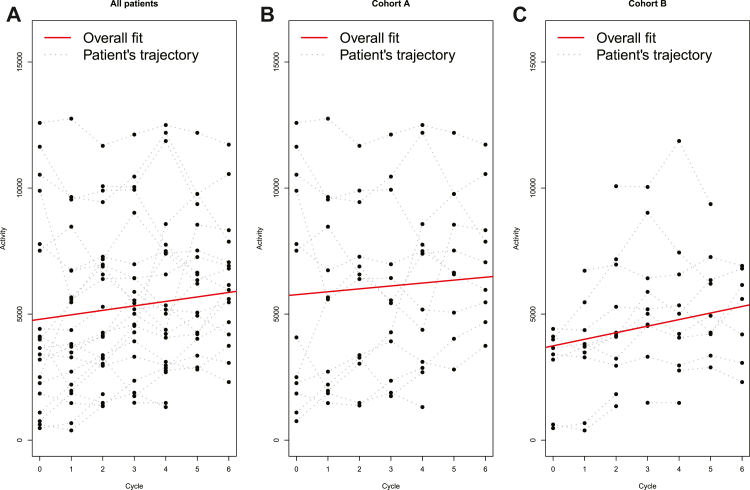
Forty patients were enrolled onto study, and activity bioprofiles were compiled among 24/40 (60%) wearable user participants (wearing the device for at least one cycle). In an intention to treat feasibility analysis, 21/40 (53%) patients [12/20 (60%) Cohort A; 9/20 (45%) Cohort B] had continuous data capture. Among data captured, overall activity trended upward cycle over cycle for the entire study cohort (+179 steps/24 h per cycle; p = 0.0014, 95% CI: 68-289). Older patients (age ≥65 years) had higher increases in activity (+260 steps/24 h per cycle; p < 0.0001, 95% CI: -154 to 366) compared to younger patients (+116 steps/24 h per cycle; p = 0.21, 95% CI: -60 to 293). Activity trends associated with improvement of ePRO domains, including physical functioning scores (p < 0.0001), global health scores (p = 0.02), and declining disease burden symptom scores (p = 0.042).
Our study demonstrates that feasibility of passive wearable monitoring is challenging in a newly diagnosed MM patient population due to patient use. However, overall continuous data capture monitoring remains high among willing user participants. As therapy is initiated, we show improving activity trends, mainly in older patients, and that activity bioprofiles correlate with traditional HRQOL measurements.
Grants -National Institutes of HealthP30 CA 008748, Awards - Kroll Award 2019.
由于疾病的性质,多发性骨髓瘤(MM)患者常伴有与骨病相关的疼痛,这限制了他们的身体活动,并降低了健康相关生活质量(HRQOL)。可穿戴设备和电子患者报告结局(ePRO)工具等数字健康技术能够为MM患者的HRQoL提供深入了解。
在美国纽约市纪念斯隆凯特琳癌症中心进行的这项前瞻性观察性队列研究中,两个队列(队列A - 年龄<65岁的患者;队列B - 年龄≥65岁的患者)中40例新诊断的MM患者在基线时接受身体活动的被动远程监测,并从2017年2月20日至2019年9月10日在诱导治疗的多达6个周期内持续监测。该研究的主要终点是确定连续数据采集的可行性,定义为每个20例患者的队列中有13名或更多患者在≥4个诱导周期的≥60%的天数内符合在24小时内采集数据≥16小时的要求。次要目标是探索治疗期间的活动趋势以及与ePRO结局的关联。患者在基线时以及每个周期后完成ePRO调查(欧洲癌症研究与治疗组织 - QLQC30和MY20)。使用具有随机截距的线性混合模型估计身体活动测量值、QLQC30和MY20评分以及从治疗开始的时间之间的关联。
40例患者入组研究,在24/40(60%)可穿戴设备用户参与者(佩戴设备至少一个周期)中编制了活动生物特征档案。在意向性治疗可行性分析中,21/40(53%)患者[12/20(60%)队列A;9/20(45%)队列B]有连续数据采集。在采集的数据中,整个研究队列的总体活动在各个周期呈上升趋势(每个周期增加179步/24小时;p = 0.0014,95% CI:68 - 289)。与年轻患者(每个周期增加116步/24小时;p = 0.21,95% CI:-60至293)相比,老年患者(年龄≥65岁)的活动增加幅度更大(每个周期增加260步/24小时;p < 0.0001,95% CI:-154至366)。活动趋势与ePRO领域的改善相关,包括身体功能评分(p < 0.0001)、总体健康评分(p = 0.02)以及疾病负担症状评分下降(p = 0.042)。
我们的研究表明,由于患者使用情况,在新诊断的MM患者群体中进行被动可穿戴设备监测的可行性具有挑战性。然而,在愿意参与的用户参与者中,总体连续数据采集监测率仍然很高。随着治疗的开始,我们发现活动趋势有所改善,主要是在老年患者中,并且活动生物特征档案与传统的HRQOL测量相关。
美国国立卫生研究院资助 - P30 CA 008748,奖项 - 2019年克罗尔奖。