Topham James T, Renouf Daniel J, Schaeffer David F
Pancreas Centre BC, Vancouver, BC, Canada.
Division of Medical Oncology, BC Cancer, Vancouver, BC, Canada.
Ther Adv Med Oncol. 2023 Mar 4;15:17588359231157651. doi: 10.1177/17588359231157651. eCollection 2023.
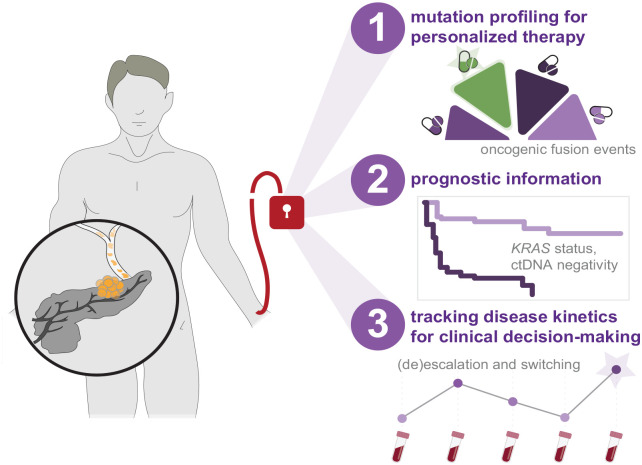
Over a decade of sequencing-based genomics research has unveiled a diverse somatic mutation landscape across patients with pancreatic ductal adenocarcinoma (PDAC), and the identification of druggable mutations has aligned with the development of novel targeted therapeutics. However, despite these advances, direct translation of years of PDAC genomics research into the clinical care of patients remains a critical and unmet need. Technologies that enabled the initial mapping of the PDAC mutation landscape, namely whole-genome and transcriptome sequencing, remain overly expensive in terms of both time and financial resources. Consequentially, dependence on these technologies to identify the relatively small subset of patients with actionable PDAC alterations has greatly impeded enrollment for clinical trials testing novel targeted therapies. Liquid biopsy tumor profiling using circulating tumor DNA (ctDNA) generates new opportunities by overcoming these challenges while further addressing issues particularly relevant to PDAC, namely, difficulty of obtaining tumor tissue via fine-needle biopsy and the need for faster turnaround time due to rapid disease progression. Meanwhile, ctDNA-based approaches for tracking disease kinetics with respect to surgical and therapeutic interventions offer a means to elevate the current clinical management of PDAC toward higher granularity and accuracy. This review provides a clinically focused summary of ctDNA advances, limitations, and opportunities in PDAC and postulates ctDNA sequencing technology as a catalyst for evolving the clinical decision-making paradigm of this disease.
十多年基于测序的基因组学研究揭示了胰腺导管腺癌(PDAC)患者多样化的体细胞突变图谱,可靶向治疗突变的识别与新型靶向治疗方法的开发同步进行。然而,尽管取得了这些进展,但将多年的PDAC基因组学研究直接转化为患者的临床护理仍然是一项关键且未得到满足的需求。促成PDAC突变图谱初步绘制的技术,即全基因组和转录组测序,在时间和财力方面仍然过于昂贵。因此,依赖这些技术来识别可采取行动的PDAC改变的相对较小患者子集,极大地阻碍了新型靶向治疗临床试验的入组。使用循环肿瘤DNA(ctDNA)进行液体活检肿瘤分析通过克服这些挑战创造了新机会,同时进一步解决了与PDAC特别相关的问题,即通过细针活检获取肿瘤组织的困难以及由于疾病快速进展而需要更快周转时间的问题。与此同时,基于ctDNA的方法用于跟踪手术和治疗干预方面的疾病动力学,提供了一种手段,可将当前PDAC的临床管理提升到更高的精细度和准确性。本综述提供了一个以临床为重点的总结,介绍了ctDNA在PDAC中的进展、局限性和机会,并假设ctDNA测序技术是推动该疾病临床决策模式发展的催化剂。