Intervention and Cell Therapy Center, Peking University Shenzhen Hospital, Shenzhen, Guangdong 518036, P.R. China.
Department of Scientific and Research, Peking University Shenzhen Hospital, Shenzhen, Guangdong 518036, P.R. China.
Int J Oncol. 2023 Apr;62(4). doi: 10.3892/ijo.2023.5501. Epub 2023 Mar 10.
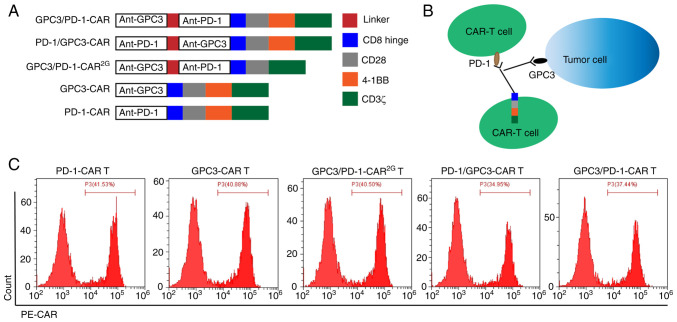
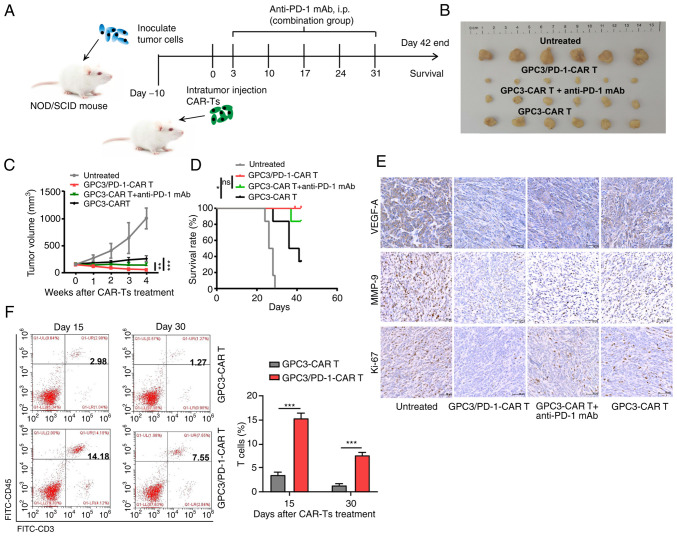
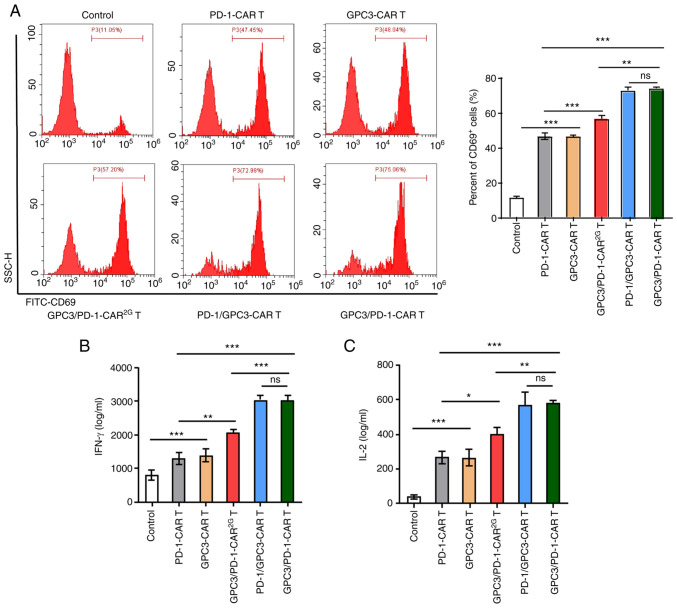
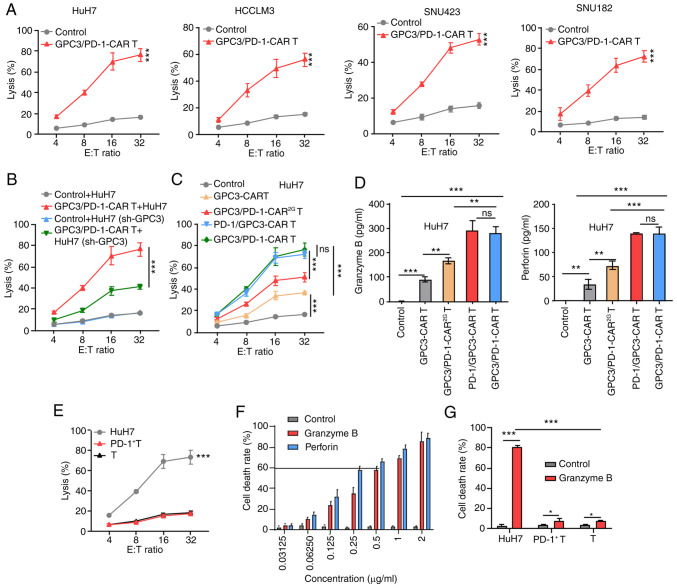
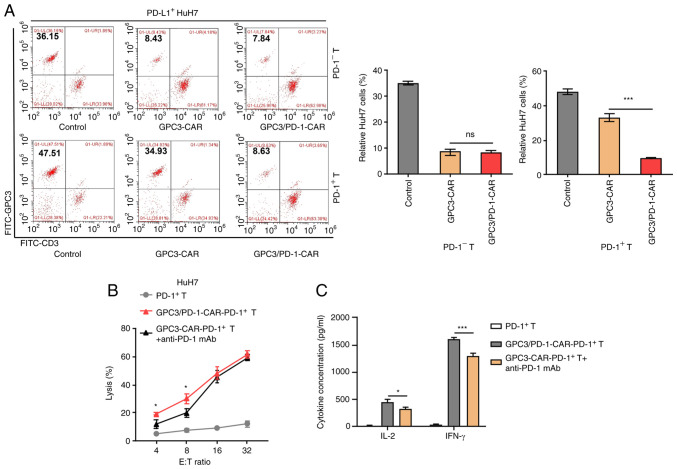
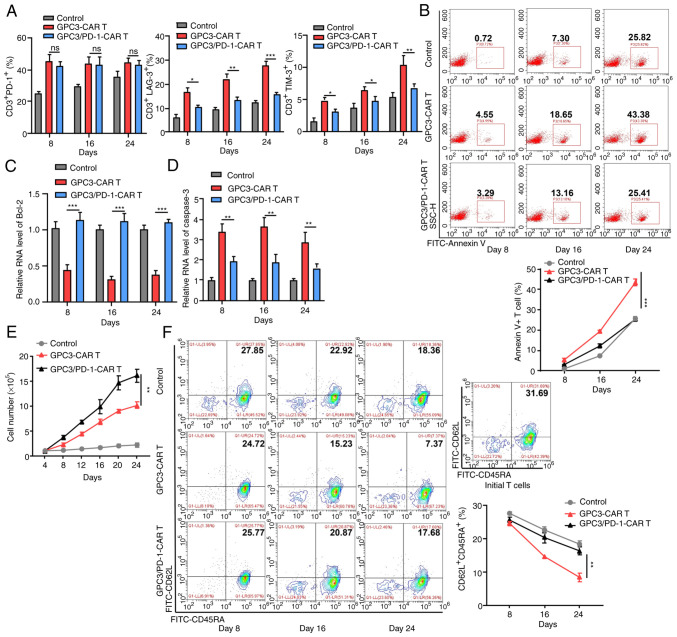
Constantly stimulated by the tumor microenvironment (TME), programmed death 1 (PD‑1) is elevated, and it interacts with PD ligand 1 (PD‑L1), rendering chimeric antigen receptor (CAR)‑T cells dysfunctional. Hence, CAR‑T cells immune to PD‑1‑induced immunosuppression were constructed to improve the function of CAR‑T cells in hepatocellular carcinoma (HCC). Double‑target CAR‑T cells, targeting glypican‑3 (GPC3) [a tumour-associated antigen (TAA)] and hindering PD‑1‑PD‑L1 binding, were established. The expression of GPC3, PD‑L1, and inhibitory receptors was measured using flow cytometry. The cytotoxicity, cytokine release, and differentiation level of CAR‑T cells were determined using lactate dehydrogenase release assay, enzyme‑linked immunosorbent assay, and flow cytometry, respectively. HCC cells were targeted and eliminated by double‑target CAR‑T cells. These double‑target CAR‑T cells limit PD‑1‑PD‑L1 binding and sustain cytotoxicity to PD‑L1 HCC cells. The relatively low IR expression and differentiation level in double‑target CAR‑T cells in tumour tissues induced tumour‑suppression and extended survival in PD‑L1 HCC TX models, as opposed to their single‑target counterparts. The results of the present study suggested that the newly constructed double‑target CAR‑T cells exhibit stronger tumour‑suppressing effects in HCC than their single‑target counterparts, which are common, suggesting the potential of strengthening CAR‑T cell activity in HCC treatment.
持续受到肿瘤微环境 (TME) 的刺激,程序性死亡受体 1 (PD-1) 上调,并与 PD 配体 1 (PD-L1) 相互作用,使嵌合抗原受体 (CAR) -T 细胞功能失调。因此,构建了对 PD-1 诱导的免疫抑制具有免疫作用的 CAR-T 细胞,以改善 CAR-T 细胞在肝细胞癌 (HCC) 中的功能。构建了靶向磷脂酰聚糖-3 (GPC3) [一种肿瘤相关抗原 (TAA)] 并阻碍 PD-1-PD-L1 结合的双靶点 CAR-T 细胞。使用流式细胞术测量 GPC3、PD-L1 和抑制性受体的表达。使用乳酸脱氢酶释放测定法、酶联免疫吸附测定法和流式细胞术分别测定 CAR-T 细胞的细胞毒性、细胞因子释放和分化水平。双靶点 CAR-T 细胞靶向并消除 HCC 细胞。这些双靶点 CAR-T 细胞限制 PD-1-PD-L1 结合并维持对 PD-L1 HCC 细胞的细胞毒性。与单靶点 CAR-T 细胞相比,双靶点 CAR-T 细胞在肿瘤组织中相对较低的 IR 表达和分化水平诱导肿瘤抑制并延长 PD-L1 HCC TX 模型中的存活。本研究结果表明,与单靶点 CAR-T 细胞相比,新构建的双靶点 CAR-T 细胞在 HCC 中具有更强的肿瘤抑制作用,这表明在 HCC 治疗中增强 CAR-T 细胞活性的潜力。