Reiß Franziska, Napp Ann-Kathrin, Erhart Michael, Devine Janine, Dadaczynski Kevin, Kaman Anne, Ravens-Sieberer Ulrike
Zentrum für Psychosoziale Medizin, Klinik für Kinder- und Jugendpsychiatrie, -psychotherapie und -psychosomatik, Universitätsklinikum Hamburg-Eppendorf, Hamburg, Deutschland.
Alice Salomon Hochschule, Berlin, Deutschland.
Bundesgesundheitsblatt Gesundheitsforschung Gesundheitsschutz. 2023 Apr;66(4):391-401. doi: 10.1007/s00103-023-03674-8. Epub 2023 Mar 10.
The COVID-19 pandemic has impacted the learning and health of children and adolescents. The aim of this paper is to examine school students' mental health problems, family burden, and support needs during the pandemic depending on the type of school. Approaches to school-based prevention and health promotion are discussed.
Findings are based on data from the population-based COPSY study (T1: 05/2020 - T4: 02/2022) and the BELLA study (T0, pre-pandemic comparison). Approximately 1600 families with children aged 7 to 19 years were surveyed at each measurement point (T). Mental health problems were assessed using the SDQ, while family burden and support needs were captured with individual items in the parent report.
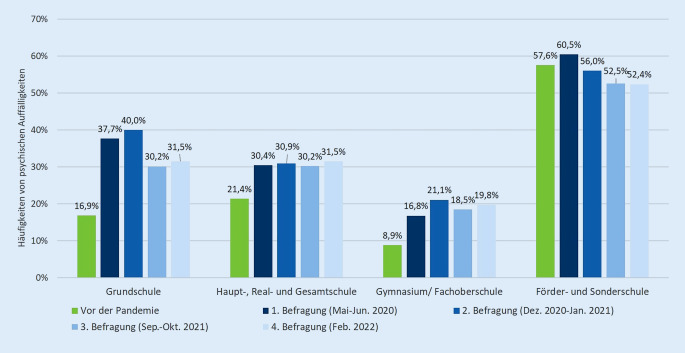
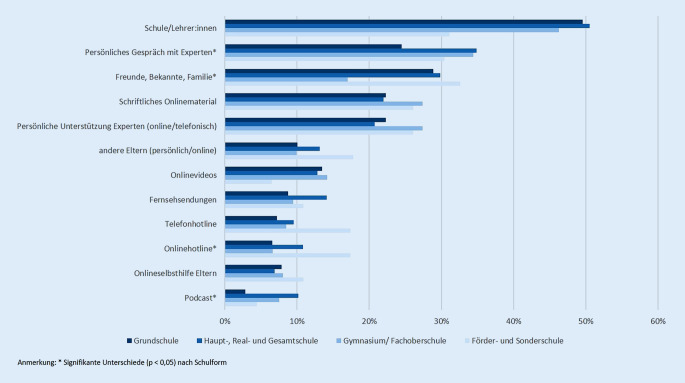
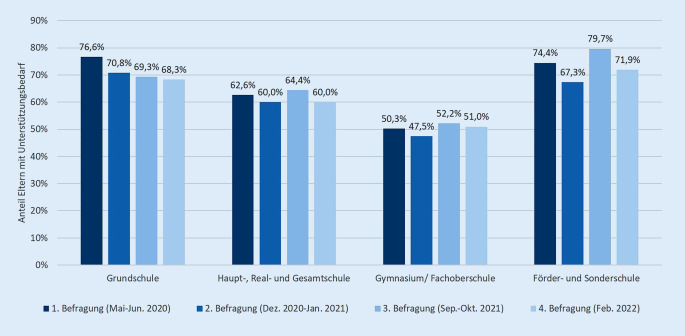
Mental health problems increased among students in all school types at the beginning of the pandemic and have stabilized at a high level. Elementary school students are particularly affected (increase from 16.9% pre-pandemic to 40.0% at T2), especially in behavioral problems (11.7% to 24.6%) and hyperactivity (13.9% to 34.0%). Secondary school students also show higher levels of mental health problems (21.4% to 30.4%). Pandemic-related burden is consistently high, as is the need for family support received from schools/teachers and experts.
There is a high need for mental health promotion and prevention measures in the school setting. These should start at primary school age in the sense of a "whole school approach" at different levels and include external stakeholders. In addition, binding legal requirements are needed in all federal states to create framework conditions and structures for school-based health promotion and prevention, including access to necessary resources.
新冠疫情对儿童和青少年的学习与健康产生了影响。本文旨在根据学校类型,研究疫情期间在校学生的心理健康问题、家庭负担及支持需求。文中还讨论了基于学校的预防和健康促进方法。
研究结果基于以人群为基础的COPSY研究(T1:2020年5月 - T4:2022年2月)以及BELLA研究(T0,疫情前对照)的数据。在每个测量点(T)对约1600个有7至19岁孩子的家庭进行了调查。使用SDQ评估心理健康问题,同时通过家长报告中的个别项目获取家庭负担和支持需求信息。
在疫情开始时,各类学校的学生心理健康问题均有所增加,并在高水平上趋于稳定。小学生受影响尤为严重(从疫情前的16.9%增至T2时的40.0%),尤其是在行为问题(从11.7%增至24.6%)和多动方面(从13.9%增至34.0%)。中学生的心理健康问题水平也较高(从21.4%增至30.4%)。与疫情相关的负担一直很高,对学校/教师及专家提供家庭支持的需求也是如此。
在学校环境中,对心理健康促进和预防措施有很高需求。这些措施应从小学阶段开始,在不同层面采取“全校参与方法”,并纳入外部利益相关者。此外,所有联邦州都需要有具有约束力的法律要求,以创造基于学校的健康促进和预防的框架条件及结构,包括获取必要资源的途径。