• 文献检索
  • 文档翻译
  • 深度研究
  • 学术资讯
  • Suppr Zotero 插件Zotero 插件
  • 邀请有礼
  • 套餐&价格
  • 历史记录
应用&插件
Suppr Zotero 插件Zotero 插件浏览器插件Mac 客户端Windows 客户端微信小程序
定价
高级版会员购买积分包购买API积分包
服务
文献检索文档翻译深度研究API 文档MCP 服务
关于我们
关于 Suppr公司介绍联系我们用户协议隐私条款
关注我们

Suppr 超能文献

核心技术专利:CN118964589B侵权必究
粤ICP备2023148730 号-1Suppr @ 2026

文献检索

告别复杂PubMed语法,用中文像聊天一样搜索,搜遍4000万医学文献。AI智能推荐,让科研检索更轻松。

立即免费搜索

文件翻译

保留排版,准确专业,支持PDF/Word/PPT等文件格式,支持 12+语言互译。

免费翻译文档

深度研究

AI帮你快速写综述,25分钟生成高质量综述,智能提取关键信息,辅助科研写作。

立即免费体验

[儿童和青少年心理健康状况的流行病学。新冠疫情之前及期间三项流行病学研究的结果]

[Epidemiology of mental well-being in childhood and adolescence. Results from three epidemiological studies before and during the COVID-19 pandemic].

作者信息

Reiß Franziska, Kaman Anne, Napp Ann-Kathrin, Devine Janine, Li Lydia Y, Strelow Lisa, Erhart Michael, Hölling Heike, Schlack Robert, Ravens-Sieberer Ulrike

机构信息

Zentrum für Psychosoziale Medizin, Klinik für Kinder- und Jugendpsychiatrie, -psychotherapie und -psychosomatik, Universitätsklinikum Hamburg-Eppendorf, Martinistraße 52, 20246, Hamburg, Deutschland.

Alice Salomon Hochschule, Berlin, Deutschland.

出版信息

Bundesgesundheitsblatt Gesundheitsforschung Gesundheitsschutz. 2023 Jul;66(7):727-735. doi: 10.1007/s00103-023-03720-5. Epub 2023 May 30.

DOI:10.1007/s00103-023-03720-5
PMID:37249582
原文链接:https://pmc.ncbi.nlm.nih.gov/articles/PMC10227816/
Abstract

BACKGROUND

Continuous nationwide health monitoring is important to track the well-being of children and adolescents and to map developmental trajectories. Based on the results of three selected epidemiological studies, developments in child well-being over the past 20 years are presented.

METHODS

Data are based on (1) the mental health module of the German National Health Interview and Examination Survey among Children and Adolescents (BELLA study, 2003-2017, N = 1500 to 3000), which is a module of the KiGGS study; (2) the COvid-19 and PSYchological Health Study (COPSY, 2020-2022, N = 1600-1700), which is based on the BELLA Study; and (3) the International Health-Behaviour in School-aged Children Study (HBSC, 2002-2018, N = 4300-7300). Well-being was assessed in 7‑ to 17-year-olds using indicators of health-related quality of life (KIDSCREEN-10), life satisfaction (Cantril Ladder), and mental health problems (Strenghts and Difficulties Questionnaire (SDQ), Screen for Child Anxiety Related Emotional Disorders (SCARED), and Center for Epidemiological Studies Depression Scale for Children (CES-DC)).

RESULTS

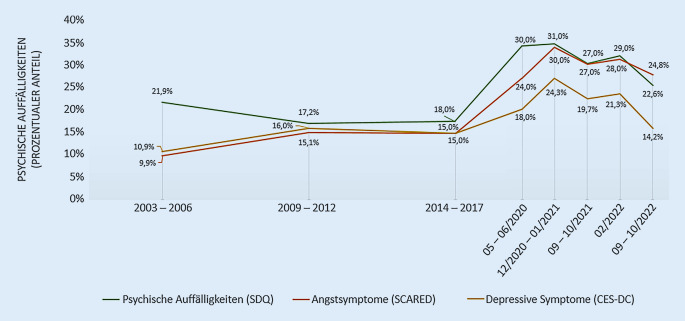
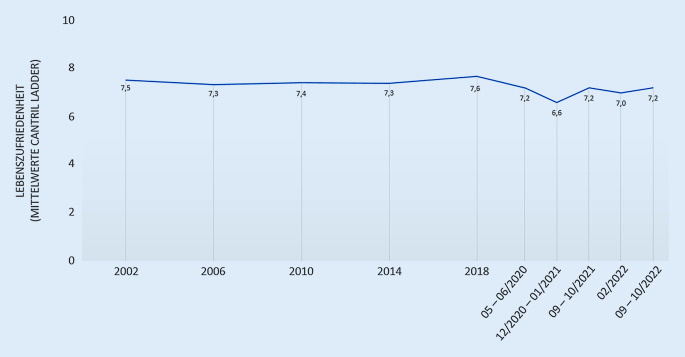
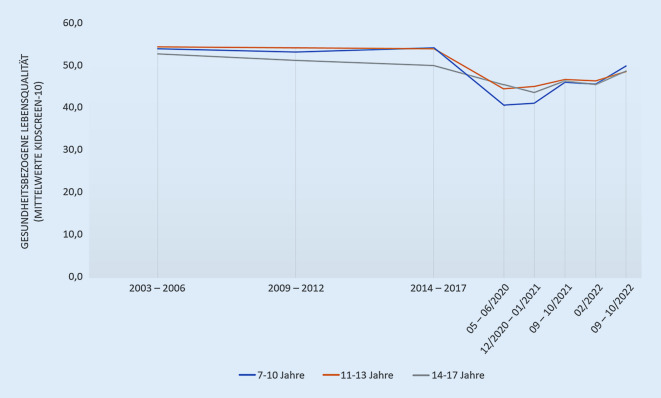
Overall, children and adolescents show consistently high health-related quality of life and high overall life satisfaction pre-pandemic (2002-2018), which initially worsened with the onset of the 2020 COVID-19-pandemic. Two years later, improvements are evident but have not yet reached baseline levels. Psychological problems, as well as symptoms of anxiety and depression, increased by up to 12 percentage points at the beginning of the pandemic and are still higher two years after the onset of the pandemic compared to pre-pandemic studies.

CONCLUSION

The epidemiology of child well-being provides a necessary data basis to assess the support needs of children and adolescents and to use this as a basis for developing measures of health promotion, prevention, and intervention.

摘要

背景

持续的全国性健康监测对于追踪儿童和青少年的健康状况以及描绘发育轨迹至关重要。基于三项选定的流行病学研究结果,呈现了过去20年儿童健康状况的发展情况。

方法

数据基于以下三项研究:(1)德国儿童和青少年全国健康访谈与检查调查的心理健康模块(BELLA研究,2003 - 2017年,N = 1500至3000),这是KiGGS研究的一个模块;(2)新冠疫情与心理健康研究(COPSY,2020 - 2022年,N = 1600 - 1700),该研究基于BELLA研究;(3)国际学龄儿童健康行为研究(HBSC,2002 - 2018年,N = 4300 - 7300)。使用与健康相关的生活质量指标(儿童生活质量量表 - 10)、生活满意度(坎特里尔阶梯量表)以及心理健康问题指标(长处与困难问卷(SDQ)、儿童焦虑相关情绪障碍筛查量表(SCARED)和儿童流行病学研究中心抑郁量表(CES - DC))对7至17岁儿童的健康状况进行评估。

结果

总体而言,在疫情前(2002 - 2018年),儿童和青少年的健康相关生活质量一直较高,总体生活满意度也较高,而这一情况在2020年新冠疫情爆发初期有所恶化。两年后,情况有所改善,但尚未达到基线水平。心理问题以及焦虑和抑郁症状在疫情开始时增加了多达12个百分点,与疫情前的研究相比,疫情爆发两年后这些症状仍然更高。

结论

儿童健康状况的流行病学为评估儿童和青少年的支持需求提供了必要的数据基础,并以此为依据制定健康促进、预防和干预措施。
https://cdn.ncbi.nlm.nih.gov/pmc/blobs/1119/10329085/27867586782d/103_2023_3720_Fig3_HTML.jpg
https://cdn.ncbi.nlm.nih.gov/pmc/blobs/1119/10329085/26166b3c87f4/103_2023_3720_Fig1_HTML.jpg
https://cdn.ncbi.nlm.nih.gov/pmc/blobs/1119/10329085/aced75a29183/103_2023_3720_Fig2_HTML.jpg
https://cdn.ncbi.nlm.nih.gov/pmc/blobs/1119/10329085/27867586782d/103_2023_3720_Fig3_HTML.jpg
https://cdn.ncbi.nlm.nih.gov/pmc/blobs/1119/10329085/26166b3c87f4/103_2023_3720_Fig1_HTML.jpg
https://cdn.ncbi.nlm.nih.gov/pmc/blobs/1119/10329085/aced75a29183/103_2023_3720_Fig2_HTML.jpg
https://cdn.ncbi.nlm.nih.gov/pmc/blobs/1119/10329085/27867586782d/103_2023_3720_Fig3_HTML.jpg

相似文献

1
[Epidemiology of mental well-being in childhood and adolescence. Results from three epidemiological studies before and during the COVID-19 pandemic].[儿童和青少年心理健康状况的流行病学。新冠疫情之前及期间三项流行病学研究的结果]
Bundesgesundheitsblatt Gesundheitsforschung Gesundheitsschutz. 2023 Jul;66(7):727-735. doi: 10.1007/s00103-023-03720-5. Epub 2023 May 30.
2
Quality of life and mental health in children and adolescents during the first year of the COVID-19 pandemic: results of a two-wave nationwide population-based study.儿童和青少年在 COVID-19 大流行的第一年的生活质量和心理健康:一项基于全国人口的两波研究结果。
Eur Child Adolesc Psychiatry. 2023 Apr;32(4):575-588. doi: 10.1007/s00787-021-01889-1. Epub 2021 Oct 12.
3
Impact of the COVID-19 pandemic on quality of life and mental health in children and adolescents in Germany.COVID-19 大流行对德国儿童和青少年生活质量和心理健康的影响。
Eur Child Adolesc Psychiatry. 2022 Jun;31(6):879-889. doi: 10.1007/s00787-021-01726-5. Epub 2021 Jan 25.
4
Prevalence of mental health problems among children and adolescents in Germany: results of the BELLA study within the National Health Interview and Examination Survey.德国儿童和青少年心理健康问题的患病率:全国健康访谈与检查调查中BELLA研究的结果
Eur Child Adolesc Psychiatry. 2008 Dec;17 Suppl 1:22-33. doi: 10.1007/s00787-008-1003-2.
5
[Mental health and psychological burden of children and adolescents during the first wave of the COVID-19 pandemic-results of the COPSY study].[新冠疫情第一波期间儿童和青少年的心理健康与心理负担——COPSY研究结果]
Bundesgesundheitsblatt Gesundheitsforschung Gesundheitsschutz. 2021 Dec;64(12):1512-1521. doi: 10.1007/s00103-021-03291-3. Epub 2021 Mar 1.
6
Three years into the pandemic: results of the longitudinal German COPSY study on youth mental health and health-related quality of life.疫情三年:纵向德国 COPSY 研究青少年心理健康和健康相关生活质量的结果。
Front Public Health. 2023 Jun 15;11:1129073. doi: 10.3389/fpubh.2023.1129073. eCollection 2023.
7
Quality of Life and Mental Health in Children and Adolescents after the First Year of the COVID-19 Pandemic: A Large Population-Based Survey in South Tyrol, Italy.新冠大流行第一年之后儿童和青少年的生活质量和心理健康:意大利南蒂罗尔的一项大型基于人群的调查。
Int J Environ Res Public Health. 2022 Apr 25;19(9):5220. doi: 10.3390/ijerph19095220.
8
Child and Adolescent Mental Health During the COVID-19 Pandemic: Results of the Three-Wave Longitudinal COPSY Study.儿童和青少年在新冠疫情期间的精神卫生状况:三次纵向 COPSY 研究的结果。
J Adolesc Health. 2022 Nov;71(5):570-578. doi: 10.1016/j.jadohealth.2022.06.022. Epub 2022 Aug 18.
9
The mental health module (BELLA study) within the German Health Interview and Examination Survey of Children and Adolescents (KiGGS): study design and methods.德国儿童和青少年健康访谈与检查调查(KiGGS)中的心理健康模块(BELLA研究):研究设计与方法
Eur Child Adolesc Psychiatry. 2008 Dec;17 Suppl 1:10-21. doi: 10.1007/s00787-008-1002-3.
10
[Psychological distress and mental health problems in children and their parents during the COVID-19 pandemic (2020-2022)].[2020 - 2022年新冠疫情期间儿童及其父母的心理困扰与心理健康问题]
Z Evid Fortbild Qual Gesundhwes. 2024 Sep;189:55-62. doi: 10.1016/j.zefq.2024.06.006. Epub 2024 Aug 28.

引用本文的文献

1
Late adolescent outcomes of childhood trajectories of internalizing symptoms: an 8-year follow-up of depressive and anxiety symptoms and cognitive, emotion- and behavior-related self-regulation facets.内化症状儿童轨迹的青少年晚期结局:抑郁和焦虑症状以及认知、情绪和行为相关自我调节方面的8年随访
Child Adolesc Psychiatry Ment Health. 2025 Aug 31;19(1):101. doi: 10.1186/s13034-025-00958-6.
2
Infection Control Measures in the Classroom During and in the Aftermath of the COVID-19 Pandemic: A Multidimensional Analysis of Secondary Student Well-Being and Emotions.新冠疫情期间及之后课堂中的感染控制措施:对中学生幸福感和情绪的多维度分析
J Sch Health. 2025 Sep;95(9):686-698. doi: 10.1111/josh.70039. Epub 2025 Jul 3.
3

本文引用的文献

1
Two Years of Pandemic: the Mental Health and Quality of Life of Children and Adolescents.疫情两年:儿童和青少年的心理健康与生活质量
Dtsch Arztebl Int. 2023 Apr 14;120(15):269-270. doi: 10.3238/arztebl.m2023.0001.
2
Prevalence of mental health symptoms in children and adolescents during the COVID-19 pandemic: A meta-analysis.新冠疫情期间儿童和青少年心理健康症状的流行情况:一项荟萃分析。
Ann N Y Acad Sci. 2023 Feb;1520(1):53-73. doi: 10.1111/nyas.14947. Epub 2022 Dec 20.
3
Psychosocial Wellbeing of Schoolchildren during the COVID-19 Pandemic in Berlin, Germany, June 2020 to March 2021.
Psychosocial stress in families of young children after the pandemic: no time to rest.
疫情后幼儿家庭中的心理社会压力:无暇休息。
Child Adolesc Psychiatry Ment Health. 2025 May 3;19(1):50. doi: 10.1186/s13034-025-00905-5.
4
Scoping review: outpatient psychotherapeutic care for children and adolescents in Germany-status quo and challenges in assessment.综述:德国儿童和青少年门诊心理治疗护理——现状与评估挑战
Front Public Health. 2025 Feb 17;13:1480630. doi: 10.3389/fpubh.2025.1480630. eCollection 2025.
5
Risk and protective factors associated with health-related quality of life in children and adolescents with ADHD in Germany - Findings from the consortium project INTEGRATE-ADHD.德国多动症儿童和青少年健康相关生活质量的风险与保护因素——综合多动症(INTEGRATE-ADHD)联合项目的研究结果
J Health Monit. 2024 Sep 18;9(3):e12315. doi: 10.25646/12315. eCollection 2024 Sep.
6
Subjective health and psychosomatic complaints of children and adolescents in Germany: Results of the HBSC study 2009/10 - 2022.德国儿童和青少年的主观健康与身心问题:2009/10 - 2022年健康行为与学校生活方式调查(HBSC)研究结果
J Health Monit. 2024 Mar 4;9(1):7-22. doi: 10.25646/11868. eCollection 2024 Mar.
7
Trends in health inequalities in childhood and adolescence in Germany: Results of the HBSC study 2009/10 - 2022.德国儿童和青少年健康不平等趋势:2009/10 - 2022年健康行为和学校生活状况调查(HBSC)研究结果
J Health Monit. 2024 Mar 4;9(1):79-98. doi: 10.25646/11876. eCollection 2024 Mar.
8
School students' burdens and resources after 2 years of COVID-19 in Austria: a qualitative study using content analysis.奥地利 COVID-19 疫情两年后学生的负担和资源:一项使用内容分析法的定性研究。
Front Public Health. 2024 Feb 9;12:1327999. doi: 10.3389/fpubh.2024.1327999. eCollection 2024.
9
Health-related quality of life among adolescents with type 1 diabetes since the second wave of the COVID-19 pandemic in Germany.德国 COVID-19 疫情第二波以来,1 型糖尿病青少年的健康相关生活质量。
Fam Med Community Health. 2023 Nov;11(4). doi: 10.1136/fmch-2023-002415.
德国柏林 2020 年 6 月至 2021 年 3 月期间 COVID-19 大流行期间学童的社会心理福祉。
Int J Environ Res Public Health. 2022 Aug 16;19(16):10103. doi: 10.3390/ijerph191610103.
4
Child and Adolescent Mental Health During the COVID-19 Pandemic: Results of the Three-Wave Longitudinal COPSY Study.儿童和青少年在新冠疫情期间的精神卫生状况:三次纵向 COPSY 研究的结果。
J Adolesc Health. 2022 Nov;71(5):570-578. doi: 10.1016/j.jadohealth.2022.06.022. Epub 2022 Aug 18.
5
Youth Well-being During the COVID-19 Pandemic.青少年在新冠疫情期间的幸福感
Pediatrics. 2022 Apr 1;149(4). doi: 10.1542/peds.2021-054754.
6
Mental health and life satisfaction among 10-11-year-olds in Wales, before and one year after onset of the COVID-19 pandemic.威尔士 10-11 岁儿童在 COVID-19 大流行前后一年的心理健康和生活满意度。
BMC Public Health. 2022 Feb 23;22(1):379. doi: 10.1186/s12889-022-12752-6.
7
Climate anxiety in children and young people and their beliefs about government responses to climate change: a global survey.儿童和青少年的气候焦虑及其对政府应对气候变化措施的看法:一项全球调查。
Lancet Planet Health. 2021 Dec;5(12):e863-e873. doi: 10.1016/S2542-5196(21)00278-3.
8
Quality of life and mental health in children and adolescents during the first year of the COVID-19 pandemic: results of a two-wave nationwide population-based study.儿童和青少年在 COVID-19 大流行的第一年的生活质量和心理健康:一项基于全国人口的两波研究结果。
Eur Child Adolesc Psychiatry. 2023 Apr;32(4):575-588. doi: 10.1007/s00787-021-01889-1. Epub 2021 Oct 12.
9
Well-being and COVID-19-related worries of German children and adolescents: A longitudinal study from pre-COVID to the end of lockdown in Spring 2020.德国儿童和青少年的幸福感以及与新冠疫情相关的担忧:一项从新冠疫情前到2020年春季封锁结束的纵向研究。
JCPP Adv. 2021 Apr;1(1):e12004. doi: 10.1111/jcv2.12004. Epub 2021 Mar 17.
10
Global Prevalence of Depressive and Anxiety Symptoms in Children and Adolescents During COVID-19: A Meta-analysis.新冠疫情期间儿童和青少年抑郁和焦虑症状的全球患病率:一项荟萃分析。
JAMA Pediatr. 2021 Nov 1;175(11):1142-1150. doi: 10.1001/jamapediatrics.2021.2482.