Ravens-Sieberer Ulrike, Kaman Anne, Otto Christiane, Adedeji Adekunle, Napp Ann-Kathrin, Becker Marcia, Blanck-Stellmacher Ulrike, Löffler Constanze, Schlack Robert, Hölling Heike, Devine Janine, Erhart Michael, Hurrelmann Klaus
Zentrum für Psychosoziale Medizin, Klinik für Kinder- und Jugendpsychiatrie, -psychotherapie und -psychosomatik, Universitätsklinikum Hamburg-Eppendorf, Martinistraße 52, 20246, Hamburg, Deutschland.
Abteilung für Epidemiologie und Gesundheitsmonitoring, Fachgebiet Psychische Gesundheit, Robert Koch-Institut, Berlin, Deutschland.
Bundesgesundheitsblatt Gesundheitsforschung Gesundheitsschutz. 2021 Dec;64(12):1512-1521. doi: 10.1007/s00103-021-03291-3. Epub 2021 Mar 1.
The drastic changes during the COVID-19 pandemic may have a negative impact on the psychological wellbeing of children and adolescents.
COPSY is the first national, representative German study to examine mental health and quality of life of children and adolescents during the pandemic. Results are compared with data of the representative longitudinal BELLA study conducted before the pandemic.
Internationally established instruments for measuring health-related quality of life and mental health (including anxiety and depressive symptoms) were administered to n = 1586 parents with 7‑ to 17-year-old children and adolescents, of whom n = 1040 11- to 17-year-olds also provided self-reports, from 26 May to 10 June 2020. Data were analyzed using descriptive statistics and bivariate tests.
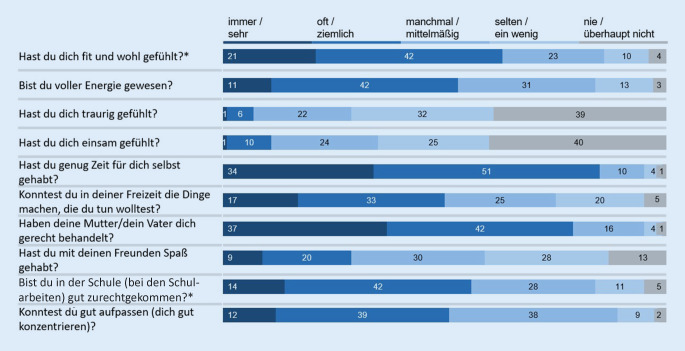
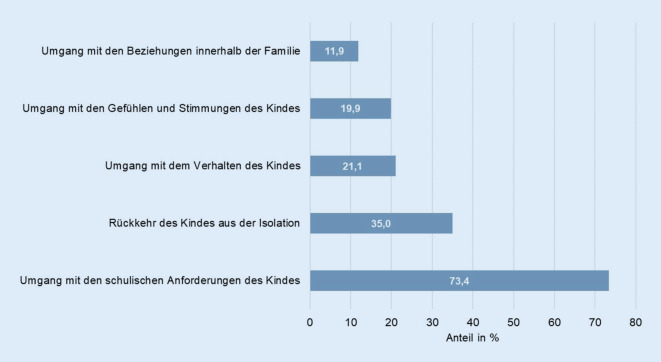
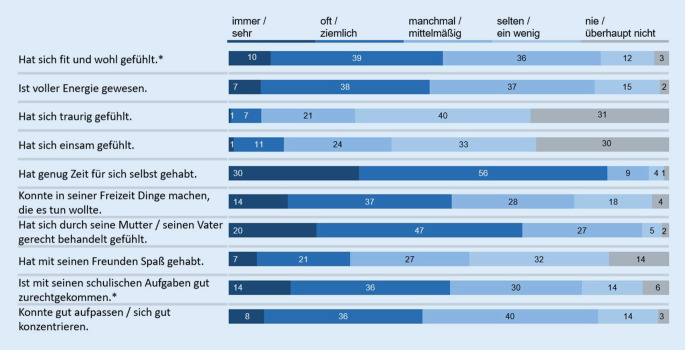
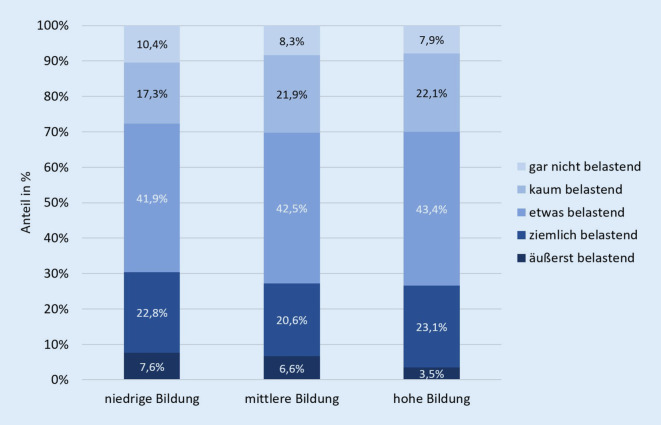
Seventy-one percent of the children and adolescents and 75% of the parents felt burdened by the first wave of the COVID-19 pandemic. Compared to the time before the pandemic, the children and adolescents reported a lower health-related quality of life, the percentage of children and adolescents with mental health problems almost doubled, and their health behavior worsened. Socially disadvantaged children felt particularly burdened by the COVID-19 pandemic. Two-thirds of the parents would like to receive support in coping with their child during the pandemic.
The COVID-19 pandemic poses a mental health risk to children and adolescents. Schools, doctors, and society are called to react by providing low-threshold and target-group-specific prevention and mental health promotion programs.
新冠疫情期间的剧烈变化可能会对儿童和青少年的心理健康产生负面影响。
COPSY是德国第一项全国性、具有代表性的研究,旨在调查疫情期间儿童和青少年的心理健康及生活质量。研究结果与疫情前进行的具有代表性的纵向BELLA研究的数据进行了比较。
2020年5月26日至6月10日,对1586名有7至17岁子女的父母进行了国际上公认的用于测量与健康相关的生活质量和心理健康(包括焦虑和抑郁症状)的工具测试,其中1040名11至17岁的青少年也提供了自我报告。数据采用描述性统计和双变量检验进行分析。
71%的儿童和青少年以及75%的父母感到受到新冠疫情第一波的影响。与疫情前相比,儿童和青少年报告的与健康相关的生活质量较低,有心理健康问题的儿童和青少年比例几乎翻了一番,他们的健康行为也有所恶化。社会处境不利的儿童尤其感到受到新冠疫情的影响。三分之二的父母希望在疫情期间在应对孩子方面得到支持。
新冠疫情对儿童和青少年构成心理健康风险。呼吁学校、医生和社会做出反应,提供低门槛、针对特定目标群体的预防和心理健康促进项目。