Department of Inorganic Chemistry, University of Santiago de Compostela, E-15702 Santiago de Compostela, Spain.
Molecules. 2023 Mar 2;28(5):2328. doi: 10.3390/molecules28052328.
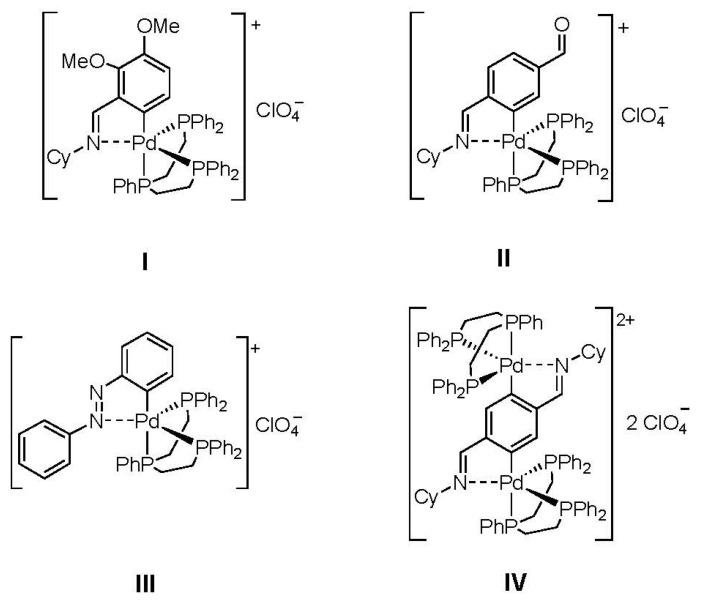
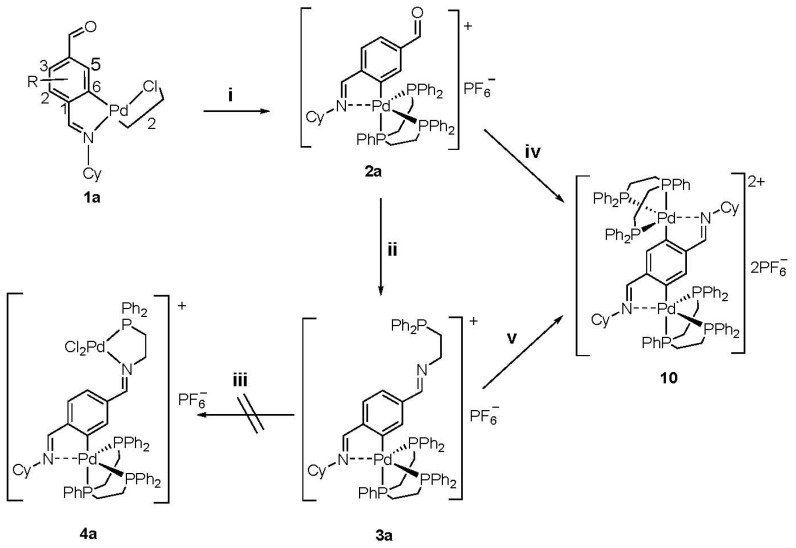
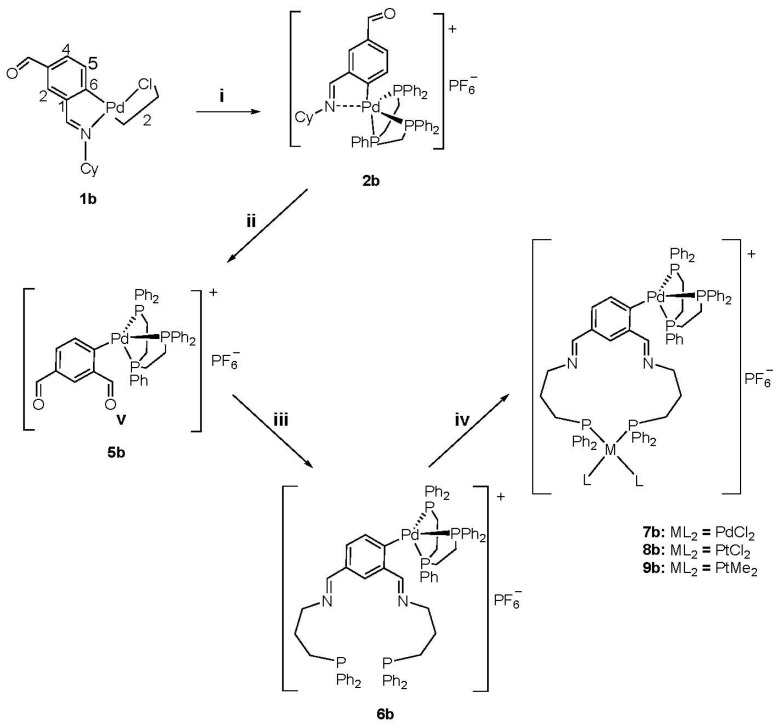
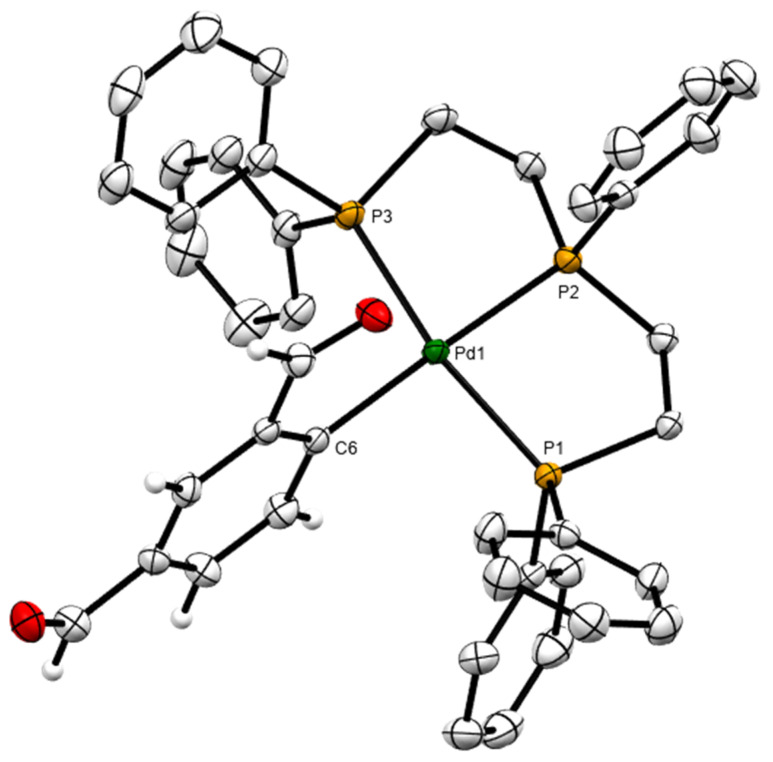
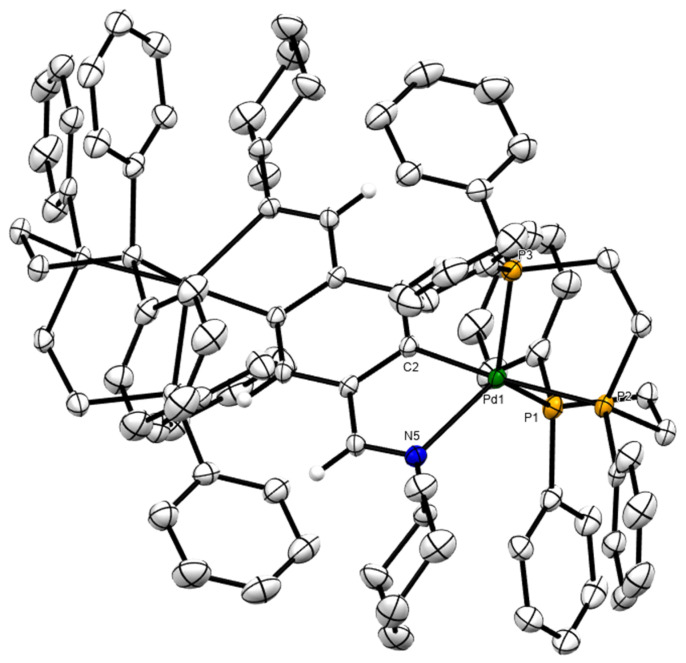
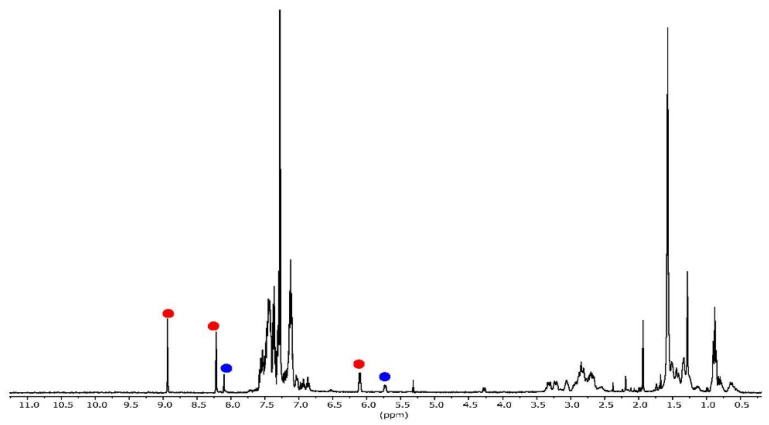
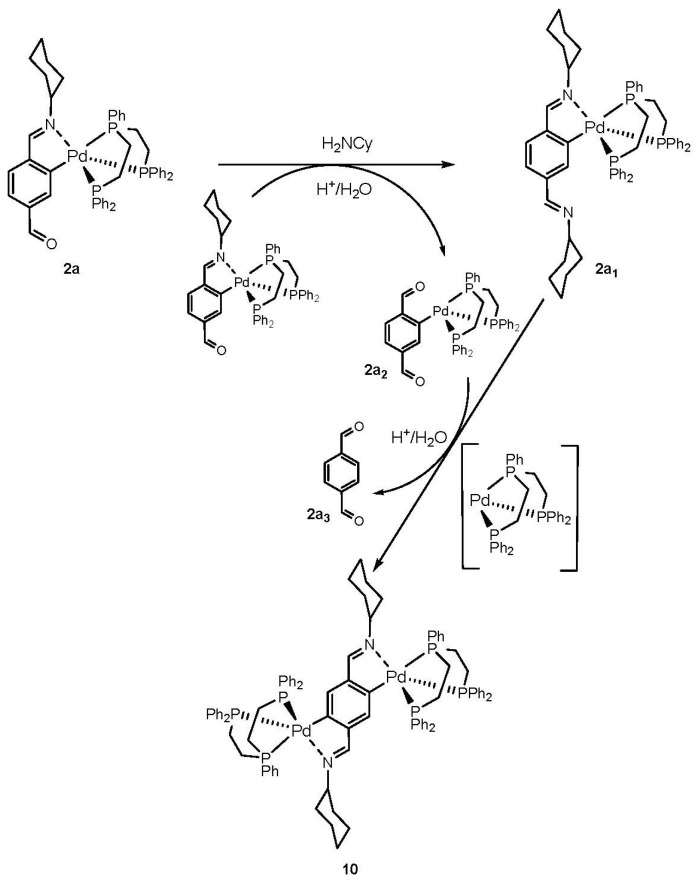
Treatment of the double nuclear complex , di-μ-cloro-bis[N-(4-formylbenzylidene)cyclohexylaminato-C6, N]dipalladium, with PhPCHCH)PPh (triphos) and NHPF gave the single nuclear species , 1-N-(cyclohexylamine)-4-N-(formyl)palladium(triphos)(hexafluorophasphate). Reaction of with PhPCHCHNH in refluxing chloroform via a condensation reaction of the amine and formyl groups to produce the C=N double bond, gave , 1-N-(cyclohexylamine)-4- N-(diphenylphosphinoethylamine)palladium(triphos)(hexafluorophasphate); a potentially bidentate [,] metaloligand. However, attempts to coordinate a second metal by treatment of 3a with [PdCl(PhCN)] were to no avail. Notwithstanding, complexes and left to stand in solution spontaneously self-transformed to give in either case the double nuclear complex , 1,4-N,N-terephthalylidene(cyclohexilamine)-3,6-[bispalladium(triphos)]di(hexafluorophosphate), after undergoing further metalation of the phenyl ring, then bearing two mutually [Pd(PhPCHCH)PPh)-,,] moieties: an unprecedented and serendipitous result indeed. On the other hand, reaction of the double nuclear complex 1b, di-μ-cloro-bis[N-(3-formylbenzylidene)cyclohexylaminato-C6, N]dipalladium, with PhPCHCH)PPh (triphos) and NHPF gave the single nuclear species , 1-N-(cyclohexylamine)-4-N-(formyl)palladium(triphos)(hexafluorophasphate), Treatment of with HO/glacial MeCOOH gave cleavage of the C=N double bond and of the Pd···N interaction, yielding , isophthalaldehyde-6-palladium(triphos)hexafluorophosphate, which then reacted with PhP(CH)NH to yield complex , N,N-(isophthalylidene(diphenylphosphinopropylamine)-6-(palladiumtriphos)di(hexafluorophosphate), with two pairs of non-coordinated nitrogen and phosphorus donor atoms. Treatment of with [PdCl(PhCN)], [PtCl(PhCN)], or [PtMe(COD)] gave the new double nuclear complexes , and , palladiumdichloro-, platinumdichloro- and platinumdimethyl[N,N-(isophthalylidene(diphenylphosphinopropylamine)-6-(palladiumtriphos)(hexafluorophosphate)-P,P], respectively, showing the behavior of as a palladated bidentate [,] metaloligand. The complexes were fully characterized by microanalysis, IR, H, and P NMR spectroscopies, as appropriate. The X-ray single-crystal analyses for compounds 10 and 5b have been previously described as the perchlorate salts by JM Vila et al.
双核配合物,二μ-氯双[N-(4-甲酰基苯亚甲基)环己基氨基甲酰基-C6,N]二钯,与 PhPCHCH)PPh(三膦)和 NH4PF6 反应,得到单核物种 1-N-(环己基胺)-4-N-(甲酰基)钯(三膦)(六氟磷酸盐)。与 PhPCHCHNH 在回流氯仿中反应,通过胺和甲酰基的缩合反应生成 C=N 双键,得到 1-N-(环己基胺)-4-N-(二苯基膦基乙基胺)钯(三膦)(六氟磷酸盐); 一种潜在的双齿 [,] 金属配体。然而,试图通过用 [PdCl(PhCN)] 处理 3a 来配位第二个金属是徒劳的。尽管如此,在溶液中放置的复合物和会自发地自我转化,在每种情况下都得到双核配合物,1,4-N,N-对苯二甲酰基(环己基胺)-3,6-[双钯(三膦)]二(六氟磷酸盐),然后对苯基环进行进一步的金属化,然后带有两个相互 [Pd(PhPCHCH)PPh)-,,] 部分:这确实是一个前所未有的意外结果。另一方面,双核配合物 1b,二μ-氯双[N-(3-甲酰基苯亚甲基)环己基氨基甲酰基-C6,N]二钯,与 PhPCHCH)PPh(三膦)和 NH4PF6 反应,得到单核物种 1-N-(环己基胺)-4-N-(甲酰基)钯(三膦)(六氟磷酸盐),用 HO/glacial MeCOOH 处理 得到 C=N 双键和 Pd···N 相互作用的断裂,生成间苯二甲醛-6-钯(三膦)六氟磷酸盐,然后与 PhP(CH)NH 反应生成配合物,N,N-(间苯二甲酰基(二苯基膦基丙基胺)-6-(钯三膦)二(六氟磷酸盐),带有两对非配位的氮和磷供体原子。用 [PdCl(PhCN)]、[PtCl(PhCN)] 或 [PtMe(COD)] 处理 得到新的双核配合物,和,钯二氯,铂二氯和铂二甲基[N,N-(间苯二甲酰基(二苯基膦基丙基胺)-6-(钯三膦)(六氟磷酸盐)-P,P],分别表现出作为钯化双齿 [,] 金属配体的行为。根据需要,通过微分析、IR、H 和 P NMR 光谱对配合物进行了充分的表征。JM Vila 等人以前曾描述过化合物 10 和 5b 的 X 射线单晶分析为高氯酸盐盐。