Department of Internal Medicine, Cleveland Clinic, Cleveland, OH, USA.
Pathology Department, Cleveland Clinic, Cleveland, OH, USA.
Oncologist. 2023 Aug 3;28(8):706-713. doi: 10.1093/oncolo/oyad031.
Immune checkpoint inhibitors (ICIs) have increased our ability to treat an ever-expanding number of cancers. We describe a case series of 25 patients who were diagnosed with gastritis following ICI therapy.
This was a retrospective study involving 1712 patients treated for malignancy with immunotherapy at Cleveland Clinic from January 2011 to June 2019 (IRB 18-1225). We searched electronic medical records using ICD-10 codes for gastritis diagnosis confirmed on endoscopy and histology within 3 months of ICI therapy. Patients with upper gastrointestinal tract malignancy or documented Helicobacter pylori-associated gastritis were excluded.
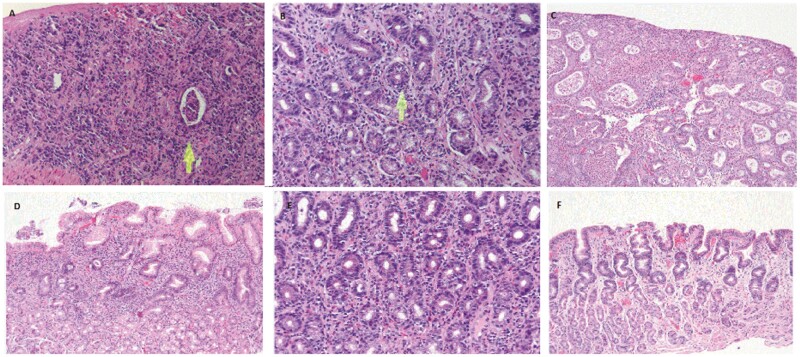
Twenty-five patients were found to meet the criteria for diagnosis of gastritis. Of these 25 patients, most common malignancies were non-small cell lung cancer (52%) and melanoma (24%). Median number of infusions preceding symptoms was 4 (1-30) and time to symptom onset 2 (0.5-12) weeks after last infusion. Symptoms experienced were nausea (80%), vomiting (52%), abdominal pain (72%), and melena (44%). Common endoscopic findings were erythema (88%), edema (52%), and friability (48%). The most common diagnosis of pathology was chronic active gastritis in 24% of patients. Ninety-six percent received acid suppression treatment and 36% of patients also received steroids with an initial median dose of prednisone 75 (20-80) mg. Within 2 months, 64% had documented complete resolution of symptoms and 52% were able to resume immunotherapy.
Patients presenting with nausea, vomiting, abdominal pain, or melena following immunotherapy should be assessed for gastritis and if other causes are excluded, may require treatment as consideration for complication of immunotherapy.
免疫检查点抑制剂(ICIs)提高了我们治疗不断扩大的癌症数量的能力。我们描述了 25 例接受 ICI 治疗后诊断为胃炎的患者的病例系列。
这是一项回顾性研究,纳入了 2011 年 1 月至 2019 年 6 月克利夫兰诊所接受免疫治疗治疗恶性肿瘤的 1712 例患者(IRB 18-1225)。我们使用 ICD-10 编码在 ICI 治疗后 3 个月内通过内镜和组织学确诊的胃炎诊断,在电子病历中进行了搜索。排除有上消化道恶性肿瘤或有记录的幽门螺杆菌相关胃炎的患者。
发现 25 例患者符合胃炎诊断标准。在这 25 例患者中,最常见的恶性肿瘤是非小细胞肺癌(52%)和黑色素瘤(24%)。症状出现前的中位输注次数为 4 次(1-30 次),最后一次输注后症状出现的时间为 2 周(0.5-12 周)。经历的症状包括恶心(80%)、呕吐(52%)、腹痛(72%)和黑便(44%)。常见的内镜表现为红斑(88%)、水肿(52%)和易碎性(48%)。24%的患者病理诊断最常见的为慢性活动性胃炎。96%的患者接受了抑酸治疗,36%的患者还接受了皮质类固醇治疗,初始泼尼松剂量中位数为 75mg(20-80mg)。在 2 个月内,64%的患者症状完全缓解,52%的患者能够恢复免疫治疗。
免疫治疗后出现恶心、呕吐、腹痛或黑便的患者应评估胃炎,如果排除其他原因,可能需要治疗,以考虑免疫治疗的并发症。