Faculty of Pharmacy and Biochemistry, University of Zagreb, Zagreb, Croatia.
Steno Diabetes Center Copenhagen, Herlev, Denmark.
Diabetologia. 2023 Jun;66(6):1071-1083. doi: 10.1007/s00125-023-05881-z. Epub 2023 Mar 13.
AIMS/HYPOTHESIS: We previously demonstrated that N-glycosylation of plasma proteins and IgGs is different in children with recent-onset type 1 diabetes compared with their healthy siblings. To search for genetic variants contributing to these changes, we undertook a genetic association study of the plasma protein and IgG N-glycome in type 1 diabetes.
A total of 1105 recent-onset type 1 diabetes patients from the Danish Registry of Childhood and Adolescent Diabetes were genotyped at 183,546 genetic markers, testing these for genetic association with variable levels of 24 IgG and 39 plasma protein N-glycan traits. In the follow-up study, significant associations were validated in 455 samples.
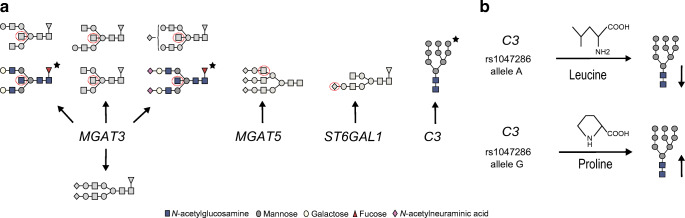
This study confirmed previously known plasma protein and/or IgG N-glycosylation loci (candidate genes MGAT3, MGAT5 and ST6GAL1, encoding beta-1,4-mannosyl-glycoprotein 4-beta-N-acetylglucosaminyltransferase, alpha-1,6-mannosylglycoprotein 6-beta-N-acetylglucosaminyltransferase and ST6 beta-galactoside alpha-2,6-sialyltransferase 1 gene, respectively) and identified novel associations that were not previously reported for the general European population. First, novel genetic associations of IgG-bound glycans were found with SNPs on chromosome 22 residing in two genomic intervals close to candidate gene MGAT3; these include core fucosylated digalactosylated disialylated IgG N-glycan with bisecting N-acetylglucosamine (GlcNAc) (p=7.65 × 10, p=8.33 × 10 for the top associated SNP rs5757680) and core fucosylated digalactosylated glycan with bisecting GlcNAc (p=2.88 × 10, p=3.03 × 10 for the top associated SNP rs137702). The most significant genetic associations of IgG-bound glycans were those with MGAT3. Second, two SNPs in high linkage disequilibrium (missense rs1047286 and synonymous rs2230203) located on chromosome 19 within the protein coding region of the complement C3 gene (C3) showed association with the oligomannose plasma protein N-glycan (p=2.43 × 10, p=8.66 × 10 for the top associated SNP rs1047286).
CONCLUSIONS/INTERPRETATION: This study identified novel genetic associations driving the distinct N-glycosylation of plasma proteins and IgGs identified previously at type 1 diabetes onset. Our results highlight the importance of further exploring the potential role of N-glycosylation and its influence on complement activation and type 1 diabetes susceptibility.
目的/假设:我们之前的研究表明,与健康的兄弟姐妹相比,初诊 1 型糖尿病患儿的血浆蛋白和 IgG 的 N-糖基化存在差异。为了寻找导致这些变化的遗传变异,我们对 1 型糖尿病患者的血浆蛋白和 IgG N-聚糖组进行了遗传关联研究。
丹麦儿童和青少年糖尿病登记处的 1105 例初诊 1 型糖尿病患者共进行了 183546 个遗传标记的基因分型,检测了这些标记与 24 种 IgG 和 39 种血浆蛋白 N-聚糖特征的可变水平的遗传关联。在后续研究中,对 455 个样本进行了显著关联验证。
本研究证实了先前已知的血浆蛋白和/或 IgG N-糖基化基因座(候选基因 MGAT3、MGAT5 和 ST6GAL1,分别编码β-1,4-甘露糖基糖蛋白 4-β-N-乙酰葡萄糖胺基转移酶、α-1,6-甘露糖基糖蛋白 6-β-N-乙酰葡萄糖胺基转移酶和 ST6β-半乳糖苷α-2,6-唾液酸转移酶 1 基因),并确定了以前未报道的与普通欧洲人群相关的新关联。首先,在 22 号染色体上发现了与候选基因 MGAT3 附近两个基因组区间内的 SNP 相关的 IgG 结合糖的新遗传关联;这些关联包括带有双分支 N-乙酰葡萄糖胺(GlcNAc)的核心岩藻糖基化二半乳糖基化二唾液酸化 IgG N-聚糖(p=7.65×10,p=8.33×10,与 top 关联 SNP rs5757680 相关)和带有双分支 GlcNAc 的核心岩藻糖基化二半乳糖基化聚糖(p=2.88×10,p=3.03×10,与 top 关联 SNP rs137702 相关)。与 IgG 结合的糖的最显著遗传关联是与 MGAT3 的关联。其次,19 号染色体上位于补体 C3 基因(C3)蛋白编码区的两个高度连锁不平衡(错义 rs1047286 和同义 rs2230203)的 SNP 与寡甘露糖血浆蛋白 N-聚糖有关(与 top 关联 SNP rs1047286 相关的 p=2.43×10,p=8.66×10)。
结论/解释:本研究确定了新的遗传关联,这些关联导致了我们之前在 1 型糖尿病发病时发现的血浆蛋白和 IgG 独特的 N-糖基化。我们的研究结果强调了进一步探索 N-糖基化的潜在作用及其对补体激活和 1 型糖尿病易感性的影响的重要性。