Amino Mari, Kabuki Shigeto, Kunieda Etsuo, Hashimoto Jun, Sugawara Akitomo, Sakai Tetsuri, Sakama Susumu, Ayabe Kengo, Ohno Yohei, Yagishita Atsuhiko, Kobayashi Yoshinori, Ikari Yuji, Yoshioka Koichiro
Department of Cardiology, Tokai University Isehara Japan.
National Institute for Quantum and Radiological Science and Technology Chiba Japan.
Circ Rep. 2023 Feb 9;5(3):69-79. doi: 10.1253/circrep.CR-23-0003. eCollection 2023 Mar 10.
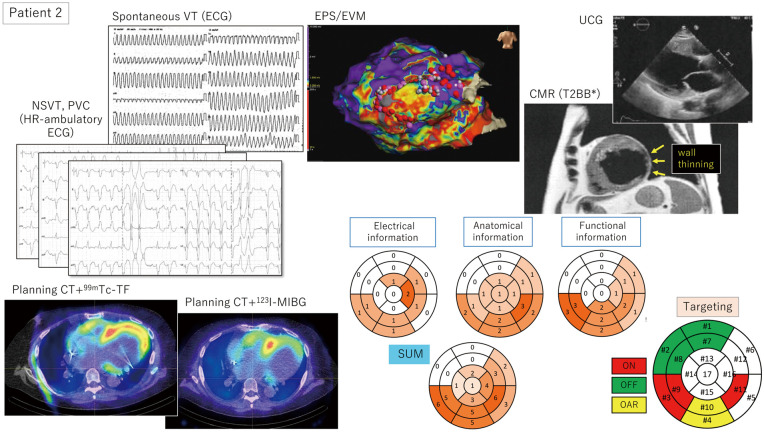
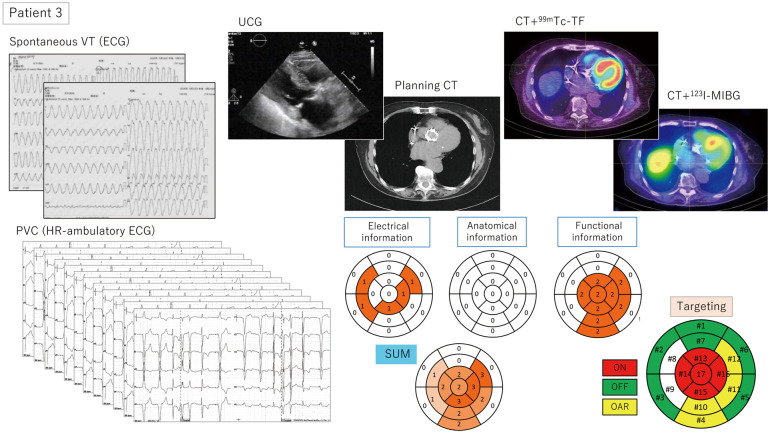
Cardiac radiotherapy using stereotactic body radiation therapy (SBRT) has attracted attention as a minimally invasive treatment for refractory ventricular tachycardia. However, a standardized protocol and software program for determining the irradiation target have not been established. Here, we report the first preclinical stereotactic radioregulation antiarrhythmic therapy trial in Japan, focused on the target-setting process. From 2019 onwards, 3 patients (age range 60-91 years) presenting with ischemic or non-ischemic cardiomyopathy were enrolled. Two patients were extremely serious and urgent, and were followed up for 6 and 30 months. To determine the irradiation targets, we aggregated electrophysiological, structural, and functional data and reflected them in an American Heart Association 17-segment model, as per the current recommendations. However, in all 3 patients, invasive electrophysiological study, phase-contrast computed tomography, and magnetic resonance imaging could not be performed; therefore, electrophysiological and structural information was limited. As alternatives, high-resolution ambulatory electrocardiography and nuclear medicine studies were useful in assessing arrhythmic substrates; however, concerns regarding test weighting and multiple scoring remain. Risks to surrounding organs were fully taken into account. In patients requiring cardiac SBRT, the information needed for target planning is sometimes limited to minimally invasive tests. Although there are issues to be resolved, this is a promising option for the life-saving treatment of patients in critical situations.
使用立体定向体部放射治疗(SBRT)进行心脏放疗作为难治性室性心动过速的一种微创治疗方法已引起关注。然而,尚未建立用于确定照射靶点的标准化方案和软件程序。在此,我们报告日本首例临床前立体定向放射调节抗心律失常治疗试验,重点关注靶点设定过程。从2019年起,招募了3例患有缺血性或非缺血性心肌病的患者(年龄范围60 - 91岁)。其中2例病情极其严重且紧急,分别进行了6个月和30个月的随访。为了确定照射靶点,我们汇总了电生理、结构和功能数据,并根据当前建议将其反映在美国心脏协会17节段模型中。然而,在所有3例患者中,均无法进行有创电生理研究、相位对比计算机断层扫描和磁共振成像;因此,电生理和结构信息有限。作为替代方法,高分辨率动态心电图和核医学研究在评估心律失常基质方面很有用;然而,关于测试权重和多重评分仍存在担忧。充分考虑了对周围器官的风险。在需要进行心脏SBRT的患者中,靶点规划所需的信息有时仅限于微创检查。尽管存在有待解决的问题,但这对于危急情况下患者的挽救生命治疗是一个有前景的选择。