Al-Ani Mohammad A, Bai Chen, Hashky Amal, Parker Alex M, Vilaro Juan R, Aranda Juan M, Shickel Benjamin, Rashidi Parisa, Bihorac Azra, Ahmed Mustafa M, Mardini Mamoun T
Division of Cardiovascular Medicine, University of Florida, Gainesville, FL, United States.
Department of Health Outcomes and Biomedical Informatics, University of Florida, Gainesville, FL, United States.
Front Cardiovasc Med. 2023 Feb 24;10:1127716. doi: 10.3389/fcvm.2023.1127716. eCollection 2023.
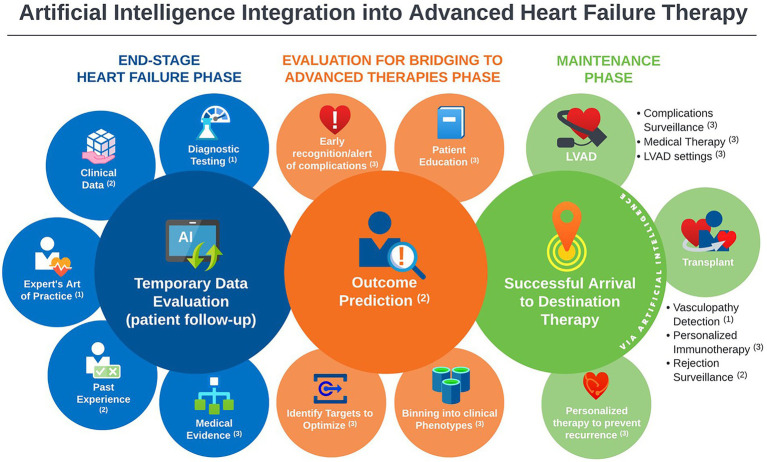
Artificial intelligence can recognize complex patterns in large datasets. It is a promising technology to advance heart failure practice, as many decisions rely on expert opinions in the absence of high-quality data-driven evidence.
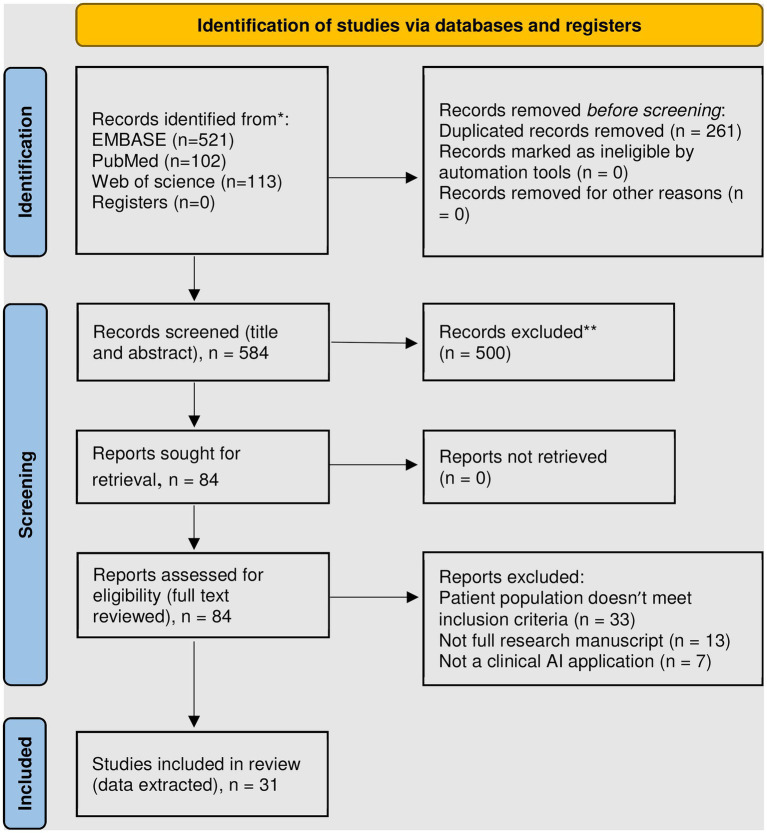
We searched Embase, Web of Science, and PubMed databases for articles containing "artificial intelligence," "machine learning," or "deep learning" and any of the phrases "heart transplantation," "ventricular assist device," or "cardiogenic shock" from inception until August 2022. We only included original research addressing post heart transplantation (HTx) or mechanical circulatory support (MCS) clinical care. Review and data extraction were performed in accordance with PRISMA-Scr guidelines.
Of 584 unique publications detected, 31 met the inclusion criteria. The majority focused on outcome prediction post HTx ( = 13) and post durable MCS ( = 7), as well as post HTx and MCS management ( = 7, = 3, respectively). One study addressed temporary mechanical circulatory support. Most studies advocated for rapid integration of AI into clinical practice, acknowledging potential improvements in management guidance and reliability of outcomes prediction. There was a notable paucity of external data validation and integration of multiple data modalities.
Our review showed mounting innovation in AI application in management of MCS and HTx, with the largest evidence showing improved mortality outcome prediction.
人工智能能够识别大型数据集中的复杂模式。由于在缺乏高质量数据驱动证据的情况下,许多决策依赖专家意见,因此它是推动心力衰竭实践的一项有前景的技术。
我们检索了Embase、科学网和PubMed数据库,查找从数据库建立至2022年8月期间包含“人工智能”“机器学习”或“深度学习”以及“心脏移植”“心室辅助装置”或“心源性休克”等任何短语的文章。我们仅纳入涉及心脏移植(HTx)后或机械循环支持(MCS)临床护理的原创研究。按照PRISMA-Scr指南进行文献综述和数据提取。
在检测到的584篇独特出版物中,31篇符合纳入标准。大多数研究聚焦于HTx后(n = 13)和长期MCS后(n = 7)的结局预测,以及HTx和MCS管理(分别为n = 7和n = 3)。一项研究涉及临时机械循环支持。大多数研究主张将人工智能迅速整合到临床实践中,认识到在管理指导和结局预测可靠性方面可能的改善。外部数据验证和多数据模式整合明显不足。
我们的综述表明,人工智能在MCS和HTx管理中的应用创新不断增加,最大的证据表明死亡率结局预测有所改善。