Zhu Ruiming, Tian Siyu Isaac Parker, Ren Zekun, Li Jiali, Buonassisi Tonio, Hippalgaonkar Kedar
Institute of Materials Research and Engineering, Agency for Science, Technology and Research (ASTAR), Singapore 138634, Singapore.
Department of Materials Science and Engineering, Nanyang Technological University, Singapore 117575, Singapore.
ACS Omega. 2023 Feb 22;8(9):8210-8218. doi: 10.1021/acsomega.2c04856. eCollection 2023 Mar 7.
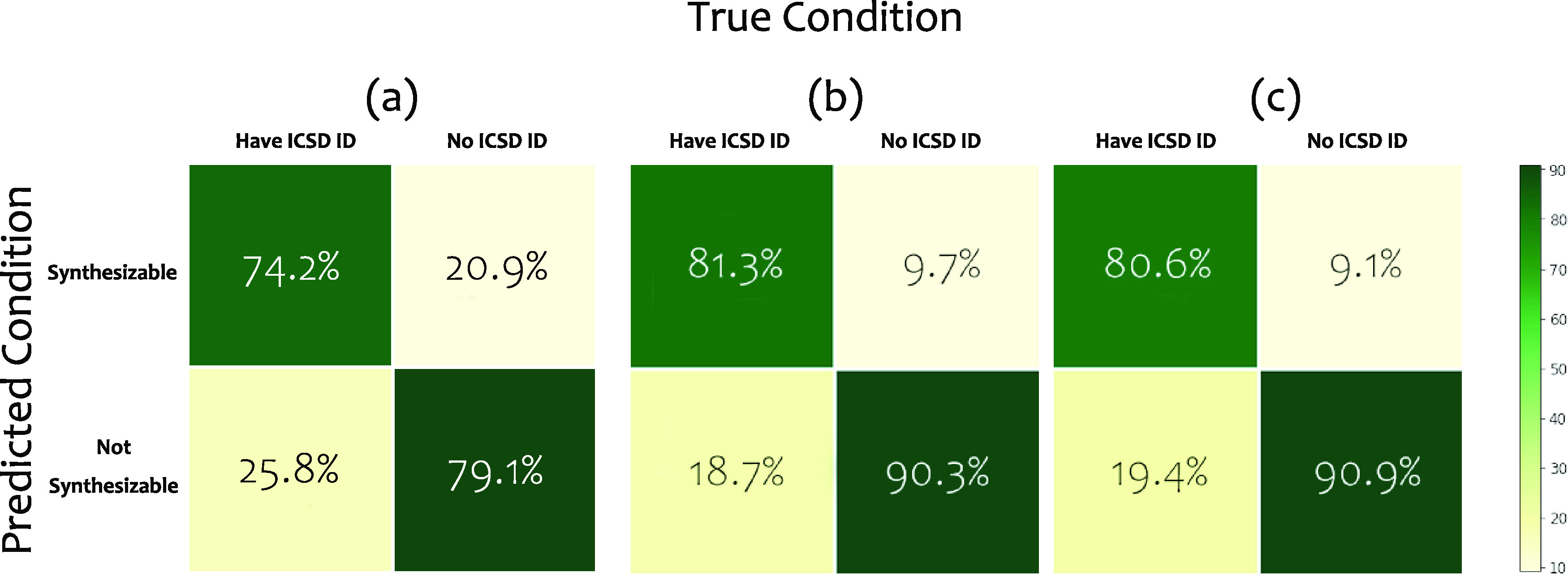
Defining the metric for synthesizability and predicting new compounds that can be experimentally realized in the realm of data-driven research is a pressing problem in contemporary materials science. The increasing computational power and advancements in machine learning (ML) algorithms provide a new avenue to solve the synthesizability challenge. In this work, using the Inorganic Crystal Structure Database (ICSD) and the Materials Project (MP) database, we represent crystal structures in Fourier-transformed crystal properties (FTCP) representation and use a deep learning model to predict synthesizability in the form of a synthesizability score (SC). Such an SC model, as a synthesizability filter for new materials, enables an efficient and accurate classification to identify promising material candidates. The SC prediction model achieved 82.6/80.6% (precision/recall) overall accuracy in predicting ternary crystal materials. We also trained the SC model by only considering compounds uploaded on the MP before 2015 as the training set and testing on multiple sets of materials uploaded after 2015. In the post-2019 test set, we obtain a high 88.60% true positive rate accuracy, coupled with 9.81% precision, indicating that newly added materials remain unexplored and have high synthesis potential. Further, we provide a list of 100 materials predicted to be synthesizable from this post-2019 dataset (highest SC) for future studies, and our SC model, as a validation filter, is beneficial for future material screening and discovery.
在数据驱动的研究领域中,定义可合成性的度量标准并预测能够通过实验实现的新化合物,是当代材料科学中一个紧迫的问题。计算能力的不断提升以及机器学习(ML)算法的进步,为解决可合成性挑战提供了一条新途径。在这项工作中,我们使用无机晶体结构数据库(ICSD)和材料项目(MP)数据库,以傅里叶变换晶体性质(FTCP)表示法来描述晶体结构,并使用深度学习模型以可合成性得分(SC)的形式预测可合成性。这样一个SC模型,作为一种新型材料的可合成性过滤器,能够进行高效且准确的分类,以识别有前景的材料候选物。该SC预测模型在预测三元晶体材料时,总体准确率达到了82.6/80.6%(精确率/召回率)。我们还仅将2015年之前上传到MP上的化合物作为训练集来训练SC模型,并对2015年之后上传的多组材料进行测试。在2019年之后的测试集中,我们获得了高达88.60%的真阳性率准确率,以及9.81%的精确率,这表明新添加的材料仍未被充分探索且具有很高的合成潜力。此外,我们提供了一份从这个2019年之后的数据集中预测出的100种可合成材料(SC最高)的列表,以供未来研究使用,并且我们的SC模型作为一种验证过滤器,对未来的材料筛选和发现是有益的。