School of Pharmacy, Shanghai University of Traditional Chinese Medicine, Shanghai, 201203, China.
Sci Rep. 2023 Mar 13;13(1):4172. doi: 10.1038/s41598-023-30582-3.
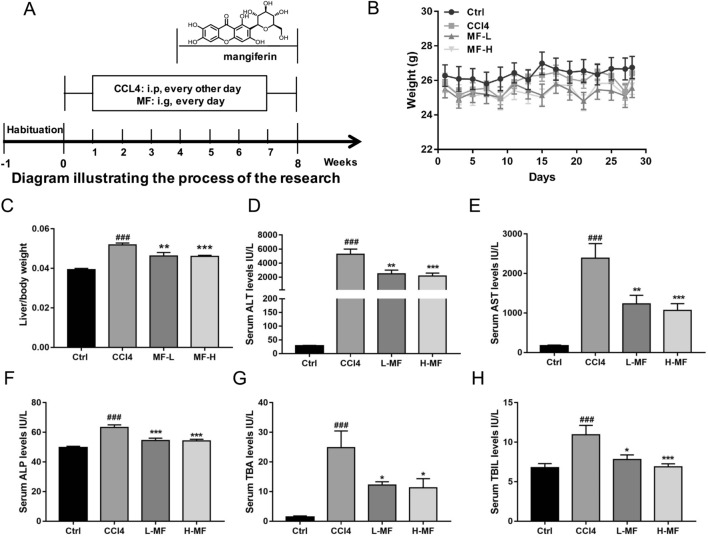
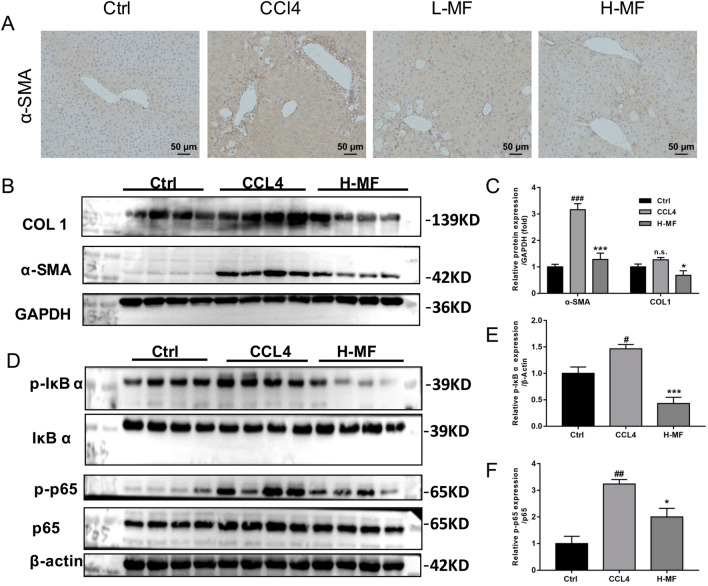
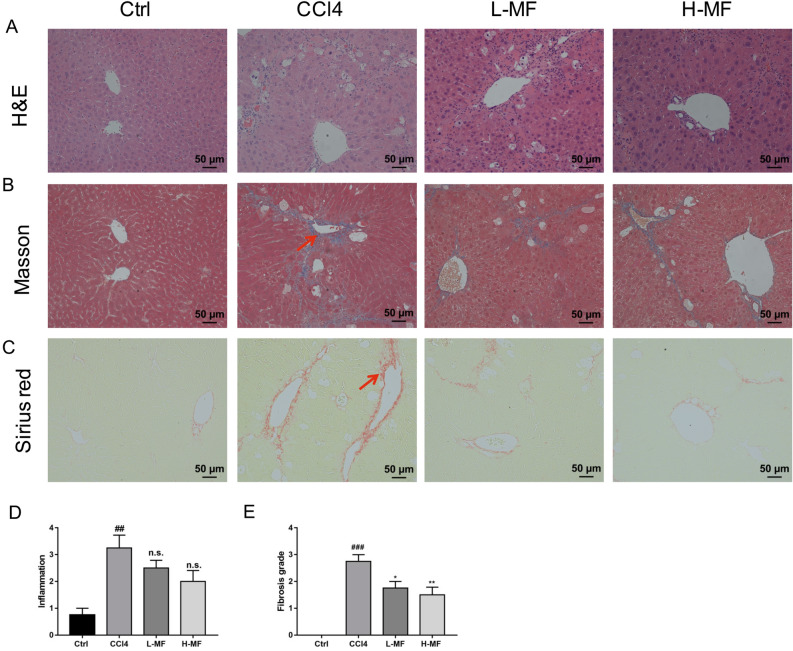
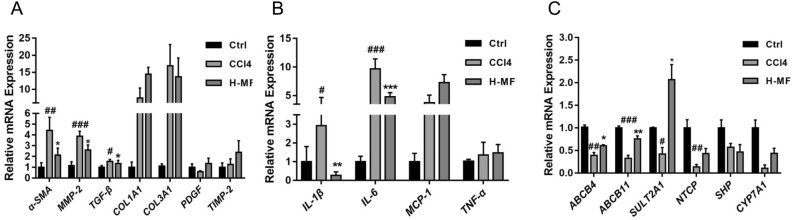
Hepatic fibrosis is a late stage process of many chronic liver diseases. Blocking the fibrosis process will be beneficial to the treatment and recovery of the diseases. Mangiferin has many pharmacological activities. Recently, it has been reported that mangiferin may relieve tissue fibrosis, including renal, myocardial, pulmonary fibrosis via anti-inflammatory and anti-oxidative effects in animal models. Here, we investigate the effects of mangiferin on CCl4-induced liver fibrosis and the underlying mechanism in mice. Thirty-two male C57BL/6 mice were randomly divided into 4 groups (n = 8 in each group), injected with carbon tetrachloride (10% CCl4) for 8 weeks, and oral administrated with mangiferin (50 mg/kg or 100 mg/kg) from the fifth week. The serum levels of ALT, AST were analyzed to evaluate liver function. H&E, Masson's trichrome and Sirius red staining were used to assess liver morphology and the degree of liver fibrosis. Quantitative RT-PCR and Western blot were used to assay the gene expression and protein levels. The results showed that mangiferin alleviated the serum levels of AST, ALT, ALP, TBA and TBIL, reduced liver lesions, prevented hepatic parenchymal necrosis, and ameliorated collagen accumulation in the liver of CCl4-treated mice. Meanwhile, mangiferin inhibited the expression of inflammatory genes IL-6 and IL-1β, fibrogenic genes α-SMA, TGF-β and MMP-2 and bile acid metabolism genes ABCB4, ABCB11, SULT2A1 in the liver of CCl4-treated mice. Furthermore, mangiferin reduced collagen accumulation and HSCs activation, inhibited the p-IκB and p-p65 protein levels. Our results suggest that mangiferin could alleviate liver fibrosis in CCl4-treated mice through inhibiting NF-κB signaling, and mango consuming may have beneficial effects to hepatic fibrosis.
肝纤维化是许多慢性肝病的晚期过程。阻断纤维化过程将有利于疾病的治疗和恢复。芒果苷具有多种药理活性。最近有报道称,芒果苷可能通过在动物模型中发挥抗炎和抗氧化作用缓解包括肾、心肌、肺纤维化在内的组织纤维化。在这里,我们研究了芒果苷对 CCl4 诱导的肝纤维化的作用及其在小鼠中的作用机制。32 只雄性 C57BL/6 小鼠被随机分为 4 组(每组 8 只),连续 8 周腹腔注射四氯化碳(10% CCl4),第 5 周开始灌胃给予芒果苷(50mg/kg 或 100mg/kg)。分析血清 ALT、AST 水平以评估肝功能。采用 H&E、Masson 三色和 Sirius 红染色评估肝形态和肝纤维化程度。定量 RT-PCR 和 Western blot 用于检测基因表达和蛋白水平。结果表明,芒果苷减轻了 CCl4 处理小鼠血清 AST、ALT、ALP、TBA 和 TBIL 水平,减轻了肝脏病变,防止了肝实质坏死,并改善了 CCl4 处理小鼠肝脏胶原积累。同时,芒果苷抑制了 CCl4 处理小鼠肝脏中炎症基因 IL-6 和 IL-1β、纤维化基因 α-SMA、TGF-β和 MMP-2 以及胆汁酸代谢基因 ABCB4、ABCB11 和 SULT2A1 的表达。此外,芒果苷减少了胶原积累和 HSCs 激活,抑制了 p-IκB 和 p-p65 蛋白水平。我们的结果表明,芒果苷通过抑制 NF-κB 信号通路缓解 CCl4 处理小鼠的肝纤维化,食用芒果可能对肝纤维化有益。