Tan Xiaoli, Xu Yanghua, Ou Ningjing, Chen Yuzhuo, Xia Wanyi, Xing Emily, Mo Ren, Bo Hao, Han Zhitao, Xu Jiarong, Dong Zepeng, Dai Yingbo, Tang Yuxin, Zhao Liangyu
Department of Urology, The Fifth Affiliated Hospital, Sun Yat-sen University, Zhuhai, Guangdong, China.
Department of Traditional Chinese Medicine, The Fifth Affiliated Hospital, University of Sun Yat-sen, Zhuhai, China.
Research (Wash D C). 2025 Aug 1;8:0762. doi: 10.34133/research.0762. eCollection 2025.
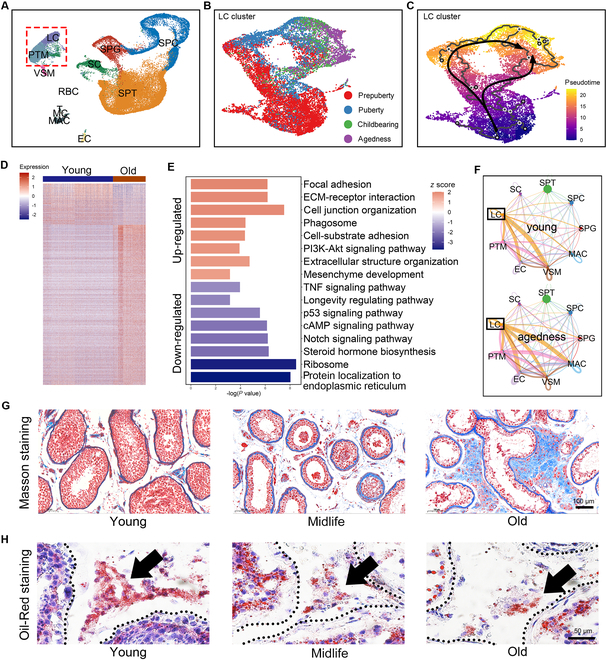
Leydig cells' (LCs') senescence is an important reason for the decline of testicular function in elderly men. Cellular communication network factor 5 (CCN5) regulates lipid metabolism and cellular fibrosis through multiple mechanisms. However, its role in LCs' aging and the underlying molecular mechanisms remain unclear. This study aimed to elucidate the effects and molecular mechanisms by which CCN5 drives aging phenotypes in LCs and to evaluate the potential of targeting CCN5 as a therapeutic strategy for testicular aging. CCN5 expression was located in LCs and elevated in aged testis. Overexpression of CCN5 led to LCs' aging and testis dysfunction. Extracellularly, CCN5 activated β-catenin and SMAD2/3 phosphorylation, promoting the expression of fibrosis-related genes. Intracellularly, CCN5 did not affect de novo cholesterol synthesis-related genes but changed the balance of cholesterol transporters. CCN5 bound to and reduced ring finger protein 213 (RNF213) protein levels. RNF213 knockdown activated forkhead box O, p16, and p21, resulting in SA-β-gal activation, reduced cell proliferation, and lipid droplet loss. In aged mice, CCN5 knockdown improved testicular atrophy, restored lipid droplet content and testosterone synthesis, and enhanced physical endurance and sexual behavior. In summary, CCN5 drives LCs' aging and testicular dysfunction maybe via promoting fibrosis and lipid droplet loss. Targeting CCN5 offers a promising strategy to treat testicular aging and associated reproductive endocrine disorders.
睾丸间质细胞(LCs)的衰老 是老年男性睾丸功能衰退的一个重要原因。细胞通讯网络因子5(CCN5)通过多种机制调节脂质代谢和细胞纤维化。然而,其在LCs衰老中的作用及潜在分子机制仍不清楚。本研究旨在阐明CCN5驱动LCs衰老表型的作用及分子机制,并评估靶向CCN5作为睾丸衰老治疗策略的潜力。CCN5表达定位于LCs,且在衰老睾丸中升高。CCN5的过表达导致LCs衰老和睾丸功能障碍。在细胞外,CCN5激活β-连环蛋白和SMAD2/3磷酸化,促进纤维化相关基因的表达。在细胞内,CCN5不影响从头胆固醇合成相关基因,但改变了胆固醇转运蛋白的平衡。CCN5与环指蛋白213(RNF213)结合并降低其蛋白水平。敲低RNF213激活叉头框O、p16和p21,导致衰老相关β-半乳糖苷酶(SA-β-gal)激活、细胞增殖减少和脂滴丢失。在老年小鼠中,敲低CCN5改善了睾丸萎缩,恢复了脂滴含量和睾酮合成,并增强了体力和性行为。总之,CCN5可能通过促进纤维化和脂滴丢失来驱动LCs衰老和睾丸功能障碍。靶向CCN5为治疗睾丸衰老及相关生殖内分泌疾病提供了一种有前景的策略。