Lu Jun, Yang Juan, Ma Chi, Wang Xinxin, Luo Jiangyan, Ma Xiaoying, Fu Xinnian, Zheng Sheng
Intensive Care Unit, The Second Affiliated Hospital of Soochow University, Suzhou, China.
Department of Gastroenterology, The Third People's Hospital of Yunnan Province, Kunming, China.
J Gastrointest Oncol. 2023 Feb 28;14(1):22-28. doi: 10.21037/jgo-22-1279. Epub 2023 Feb 10.
Our study analyzed the immune infiltration of esophageal adenocarcinoma (EAC) tumor cells and identified long non-coding ribonucleic acid (lncRNA) genes to construct a prognostic model of EAC to evaluate the survival prognosis of patients and explore potential therapeutic targets.
The data of 89 patients with EAC, including 11 normal tissue samples and 78 EAC of tumor tissue samples, were downloaded from The Cancer Genome Atlas public database. Perl script and R software were used to run the code, conduct the statistical analysis, calculate the risk coefficients of the patients, and conduct the Cox regression analysis, immune-related lncRNA survival analysis, risk analysis, principal component analysis (PCA), and receiver operating characteristic (ROC) curve analysis.
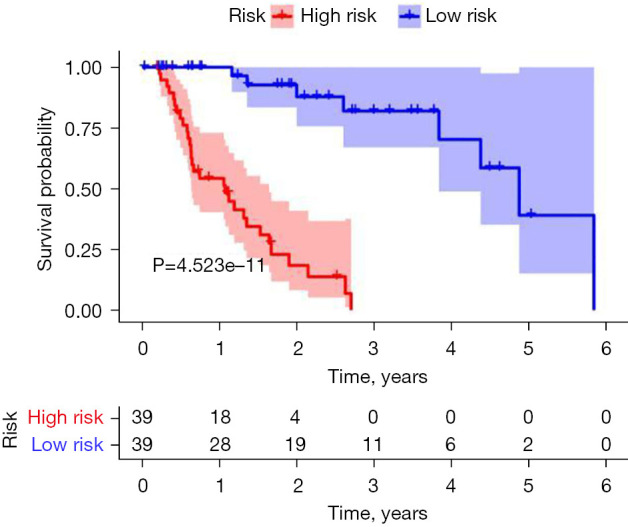
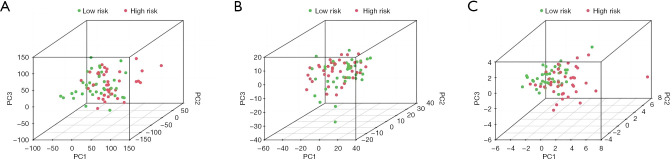
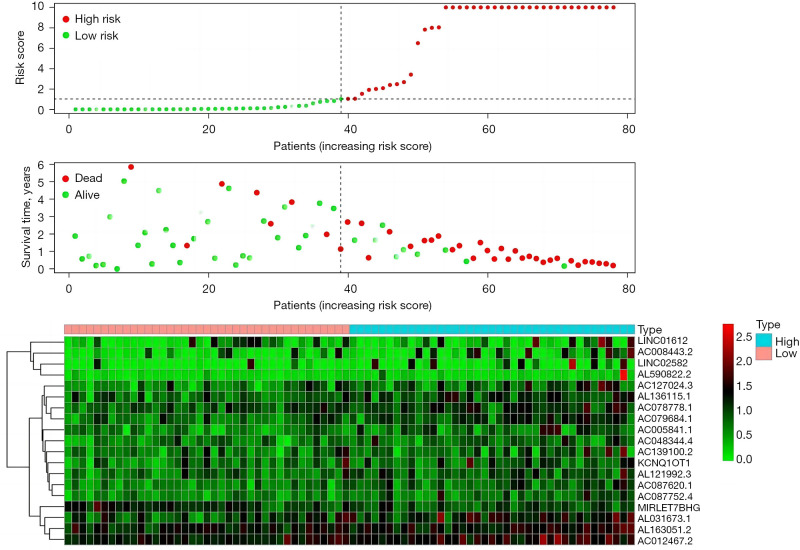
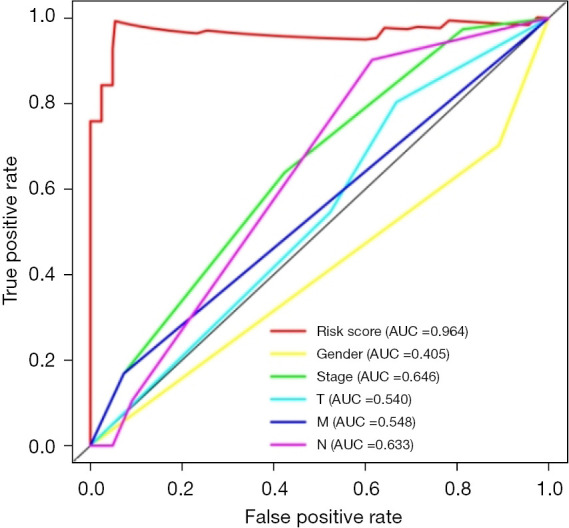
We screened and identified 19 prognostic biomarkers, including LINC01612, AC008443.2, and LINC02582, allocated the patients into high- and low-risk groups, and found significant differences in the prognosis between the high- and low-risk groups using the Kaplan-Meier survival analysis (P<0.001). A ROC curve was used to evaluate the feasibility of the prognostic model for EAC, and we found that the model had high predictability (area under the curve =0.964). A PCA analysis was performed of the complex transcriptome sequencing data and other cubes to transform the data into a 3-dimensional space constructed by feature vectors.
Our study effectively screened and identified the lncRNA genes related to the immune infiltration of EAC and successfully constructed a prognostic model. In total, 19 potential diagnostic and therapeutic target genes, including LINC01612, AC008443.2, and LINC02582, were identified that have certain significance in guiding the clinical treatment of EAC patients.
我们的研究分析了食管腺癌(EAC)肿瘤细胞的免疫浸润情况,并鉴定了长链非编码核糖核酸(lncRNA)基因,以构建EAC的预后模型,评估患者的生存预后并探索潜在的治疗靶点。
从癌症基因组图谱公共数据库下载了89例EAC患者的数据,包括11份正常组织样本和78份EAC肿瘤组织样本。使用Perl脚本和R软件运行代码、进行统计分析、计算患者的风险系数,并进行Cox回归分析、免疫相关lncRNA生存分析、风险分析、主成分分析(PCA)和受试者工作特征(ROC)曲线分析。
我们筛选并鉴定了19个预后生物标志物,包括LINC01612、AC008443.2和LINC02582,将患者分为高风险组和低风险组,并使用Kaplan-Meier生存分析发现高风险组和低风险组之间的预后存在显著差异(P<0.001)。使用ROC曲线评估EAC预后模型的可行性,我们发现该模型具有较高的预测性(曲线下面积=0.964)。对复杂的转录组测序数据和其他多维数据集进行PCA分析,将数据转换为由特征向量构建的三维空间。
我们的研究有效地筛选并鉴定了与EAC免疫浸润相关的lncRNA基因,并成功构建了预后模型。总共鉴定了19个潜在的诊断和治疗靶点基因,包括LINC01612、AC008443.2和LINC02582,它们在指导EAC患者的临床治疗方面具有一定意义。