Joint Research Unit HCL-bioMérieux, EA 7426 "Pathophysiology of Injury-Induced Immunosuppression" (Université Claude Bernard Lyon 1 - Hospices Civils de Lyon, bioMérieux), Lyon, France.
Open Innovation and Partnerships (OI&P), bioMérieux S.A., Marcy l'Etoile, France.
Crit Care Med. 2023 Jun 1;51(6):808-816. doi: 10.1097/CCM.0000000000005832. Epub 2023 Mar 14.
There is a crucial unmet need for biomarker-guided diagnostic and prognostic enrichment in clinical trials evaluating immune modulating therapies in critically ill patients. Low monocyte expression of human leukocyte antigen-DR (mHLA-DR), considered as a reference surrogate to identify immunosuppressed patients, has been proposed for patient stratification in immunostimulation approaches. However, its widespread use in clinic has been somewhat hampered by technical constraints inherent to flow cytometry technology. The objective of the present study was to evaluate the ability of a prototype multiplex polymerase chain reaction tool (immune profiling panel [IPP]) to identify immunosuppressed ICU patients characterized by a low mHLA-DR expression.
Retrospective observational cohort study.
Adult ICU in a University Hospital, Lyon, France.
Critically ill patients with various etiologies enrolled in the REAnimation Low Immune Status Marker study (NCT02638779).
None.
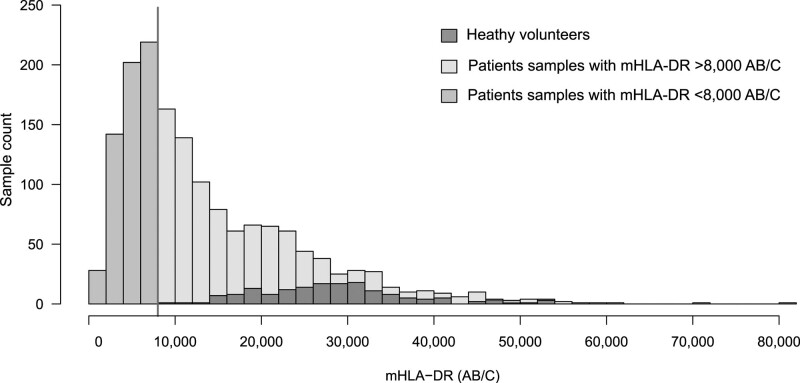
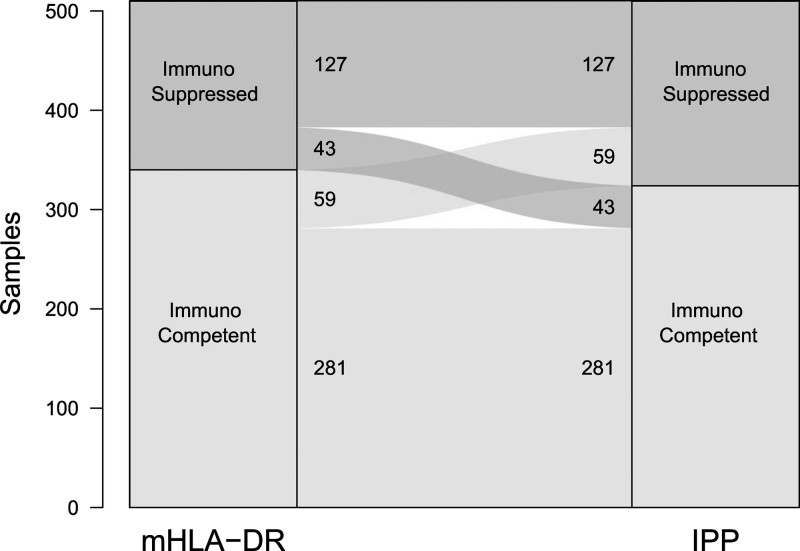
mHLA-DR and IPP data were obtained from 1,731 blood samples collected from critically ill patients with various etiologies and healthy volunteers. A partial least square regression model combining the expression levels of IPP markers was trained and used for the identification of samples from patients presenting with evidence of immunosuppression, defined here as mHLADR less than 8,000 antibodies bound per cell (AB/C). The IPP gene set had an area under the receiver operating characteristic curve (AUC) of 0.86 (95% CI 0.83-0.89) for the identification of immunosuppressed patients. In addition, when applied to the 123 patients still in the ICU at days 5-7 after admission, IPP similarly enriched the number of patients with ICU-acquired infections in the immunosuppressed group (26%), in comparison with low mHLA-DR (22%).
This study reports on the potential of the IPP gene set to identify ICU patients presenting with mHLA-DR less than 8,000 AB/C. Upon further optimization and validation, this molecular tool may help in the stratification of patients that could benefit from immunostimulation in the context of personalized medicine.
在评估免疫调节疗法对危重症患者的临床试验中,存在对生物标志物指导的诊断和预后富集的迫切需求。低单核细胞 HLA-DR 表达(mHLA-DR)被认为是识别免疫抑制患者的参考替代物,已被提议用于免疫刺激方法中的患者分层。然而,由于流式细胞术技术固有的技术限制,其在临床上的广泛应用受到了一定程度的阻碍。本研究的目的是评估原型多重聚合酶链反应工具(免疫分析面板 [IPP])识别 HLA-DR 低表达的免疫抑制 ICU 患者的能力。
回顾性观察队列研究。
法国里昂大学医院成人 ICU。
纳入了来自各种病因的危重症患者的 REAnimation Low Immune Status Marker 研究(NCT02638779)。
无。
从各种病因的危重症患者和健康志愿者采集的 1731 份血液样本中获得了 mHLA-DR 和 IPP 数据。建立并使用包含 IPP 标志物表达水平的偏最小二乘回归模型,用于识别表现出免疫抑制证据的患者样本,这里定义为 HLA-DR 小于 8000 个抗体/细胞(AB/C)。IPP 基因集对免疫抑制患者的识别具有 0.86(95%CI 0.83-0.89)的接收器操作特征曲线下面积(AUC)。此外,当应用于入院后第 5-7 天仍在 ICU 的 123 名患者时,IPP 同样富集了免疫抑制组中 ICU 获得性感染患者的数量(26%),与低 mHLA-DR 相比(22%)。
本研究报告了 IPP 基因集识别 HLA-DR 小于 8000 AB/C 的 ICU 患者的潜力。在进一步优化和验证后,该分子工具可能有助于分层那些可能受益于个性化医学背景下免疫刺激的患者。