BHF Glasgow Cardiovascular Research Centre, Institute of Cardiovascular and Medical Sciences, University of Glasgow, Glasgow, UK.
Department of Medicine, Hangzhou Normal University, Hangzhou, China.
Eur J Heart Fail. 2023 Apr;25(4):488-496. doi: 10.1002/ejhf.2818. Epub 2023 Mar 15.
Heart failure (HF) therapy trials usually exclude cancer patients. We examined the association between cancer history and outcomes in trial participants with HF and reduced (HFrEF) or preserved ejection fraction (HFpEF).
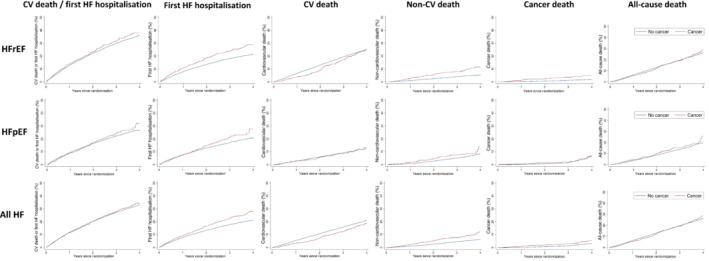
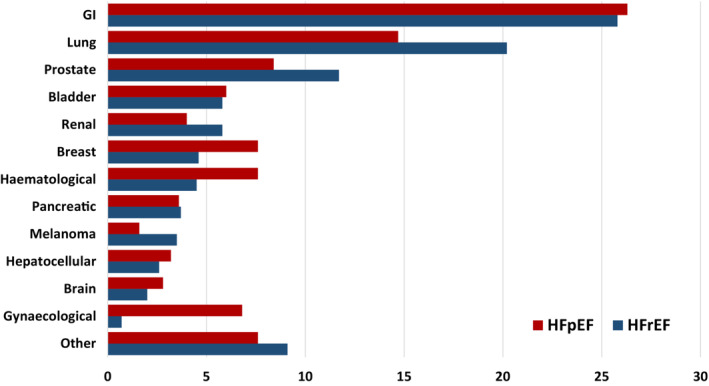
We combined PARADIGM-HF and ATMOSPHERE, which enrolled HFrEF patients (n = 15 415) and we pooled HFpEF patients (ejection fraction ≥45%) enrolled in PARAGON-HF and CHARM-Preserved (n = 7363). The associations between cancer history, cardiovascular (CV) death, HF hospitalization, non-CV and all-cause death in these trials were examined. Incident cancer diagnoses during these trials were also measured. There were 658 (4.3%) and 624 (8.5%) patients with a cancer history in the HFrEF and HFpEF trials, respectively. HFrEF patients with a cancer history had a higher risk of HF hospitalization (adjusted hazard ratio [HR] 1.28; 95% confidence interval [CI] 1.07-1.52, p = 0.007) and non-CV death (adjusted HR 1.57; 95% CI 1.16-2.12, p = 0.003) than those without. The risks of other outcomes were similar. There were no differences in the risk of any outcome in HFpEF patients with and without a cancer history. Adjusting for age and sex, the incidence of new cancer in the HFrEF and HFpEF trials was 1.09 (95% CI 0.83-1.36) and 1.07 (95% CI 0.81-1.32) per 100 person-years, respectively.
Although participants in HFrEF trials with a cancer history had higher risks of HF hospitalization and non-CV death than those without, the risks of CV and all-cause death were similar. Outcomes in HFpEF patients with and without a cancer history were similar. Incident cancer diagnoses were similar in HFrEF and HFpEF trials.
心力衰竭(HF)治疗试验通常排除癌症患者。我们研究了癌症病史与射血分数降低(HFrEF)或射血分数保留(HFpEF)HF 患者临床试验参与者结局之间的关系。
我们合并了 PARADIGM-HF 和 ATMOSPHERE 试验,纳入了 HFrEF 患者(n=15415),并汇总了 PARAGON-HF 和 CHARM-Preserved 试验中纳入的 HFpEF 患者(射血分数≥45%)(n=7363)。研究了这些试验中癌症病史与心血管(CV)死亡、HF 住院、非 CV 和全因死亡之间的关系。还测量了这些试验期间新发癌症诊断。HFrEF 和 HFpEF 试验中分别有 658(4.3%)和 624(8.5%)例患者有癌症病史。有癌症病史的 HFrEF 患者 HF 住院(校正后危险比[HR]1.28;95%置信区间[CI]1.07-1.52,p=0.007)和非 CV 死亡(校正后 HR 1.57;95% CI 1.16-2.12,p=0.003)的风险更高。其他结局的风险相似。HFpEF 患者有或无癌症病史时,任何结局的风险均无差异。校正年龄和性别后,HFrEF 和 HFpEF 试验中新发癌症的发生率分别为每 100 人年 1.09(95% CI 0.83-1.36)和 1.07(95% CI 0.81-1.32)。
尽管 HFrEF 试验中有癌症病史的参与者 HF 住院和非 CV 死亡的风险高于无癌症病史者,但 CV 和全因死亡的风险相似。HFpEF 患者有或无癌症病史时结局相似。HFrEF 和 HFpEF 试验中新发癌症的诊断相似。