Reznek Martin A, Mangolds Virginia, Kotkowski Kevin A, Samadian Kian D, Joseph James, Larkin Celine
Department of Emergency Medicine UMass Chan Medical School Worcester Massachusetts USA.
Department of Emergency Medicine UMass Memorial Health Worcester Massachusetts USA.
J Am Coll Emerg Physicians Open. 2023 Mar 13;4(2):e12923. doi: 10.1002/emp2.12923. eCollection 2023 Apr.
Accurate measurement of physicians' time spent during patient care stands to inform emergency department (ED) improvement efforts. Direct observation is time consuming and cost prohibitive, so we sought to determine if physician self-estimation of time spent during patient care was accurate.
We performed a prospective, convenience-sample study in which research assistants measured time spent by ED physicians in patient care. At the conclusion of each observed encounter, physicians estimated their time spent. Using Mann-Whitney tests and Spearman's rho, we compared physician estimates to actual time spent and assessed for associations of encounter characteristics and physician estimation.
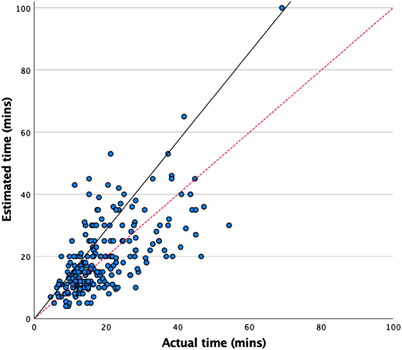
Among 214 encounters across 10 physicians, we observed a medium-sized correlation between actual and estimated time (Spearman's rho = 0.63, < 0.001), and in aggregate, physicians underestimated time spent by a median of 0.1 min. An equal number of encounters were overestimated and underestimated. Underestimated encounters were underestimated by a median of 5.1 min (interquartile range [IQR] 2.5-9.8) and overestimated encounters were overestimated by a median of 4.3 min (IQR 2.5-11.6)-26.3% and 27.9% discrepancy, respectively. In terms of actual time spent, underestimated encounters (median 19.3 min, IQR 13.5-28.3) were significantly longer than overestimated encounters (median 15.3 min, IQR 11.3-20.5) ( < 0.001).
Physician self-estimation of time spent was accurate in aggregate, providing evidence that it is a valid surrogate marker for larger-scale process improvement and research activities, but likely not at the encounter level. Investigations exploring mechanisms to augment physician self-estimation, including modeling and technological support, may yield pathways to make self-estimation valid also at the encounter level.
准确测量医生在患者护理过程中所花费的时间有助于急诊科(ED)的改进工作。直接观察既耗时又成本高昂,因此我们试图确定医生对患者护理期间所花费时间的自我估计是否准确。
我们进行了一项前瞻性的便利样本研究,研究助理测量了急诊科医生在患者护理中所花费的时间。在每次观察到的诊疗结束时,医生估计他们所花费的时间。我们使用曼-惠特尼检验和斯皮尔曼等级相关系数,将医生的估计值与实际花费时间进行比较,并评估诊疗特征与医生估计之间的关联。
在10名医生的214次诊疗中,我们观察到实际时间与估计时间之间存在中等程度的相关性(斯皮尔曼等级相关系数=0.63,P<0.001),总体而言,医生低估了所花费的时间,中位数为0.1分钟。高估和低估的诊疗次数相等。被低估的诊疗中位数低估了5.1分钟(四分位间距[IQR]为2.5 - 9.8),被高估的诊疗中位数高估了4.3分钟(IQR为2.5 - 11.6),差异分别为26.3%和27.9%。就实际花费时间而言,被低估的诊疗(中位数19.3分钟,IQR为13.5 - 28.