Moore Miranda A, Cousineau Benjamin A, Rastorguieva Krystyna, Bonnet Jonathan P, Bergquist Sharon H
Department of Family and Preventive Medicine, Emory University, Atlanta, GA, USA.
Department of Medicine, Emory University, Atlanta, GA, USA.
Nutr Metab Insights. 2023 Mar 10;16:11786388231159192. doi: 10.1177/11786388231159192. eCollection 2023.
To measure changes in micronutrient adequacy and diet quality in healthcare and university employees who underwent a 10-week teaching kitchen program.
Thirty-eight healthcare and university employees participated in a 10-week teaching kitchen program. Twenty-seven completed self-administered, 24-hour dietary recalls to measure dietary intake at baseline and 3-months. Micronutrient adequacy and diet quality was assessed using Dietary Reference Intakes (DRIs) and the Healthy Eating Index (HEI).
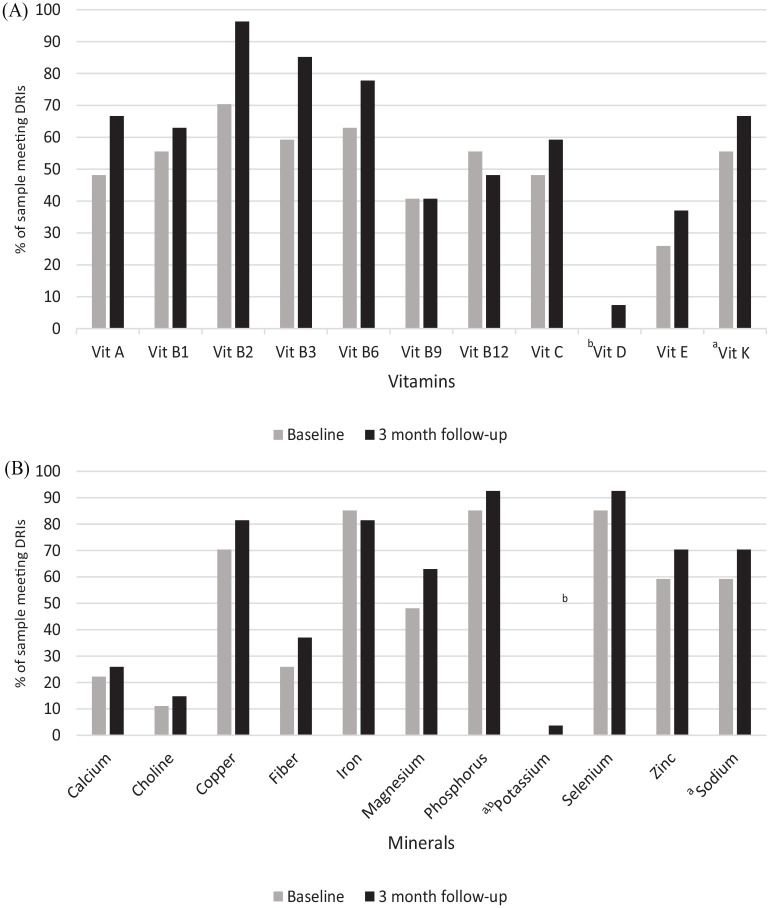
Seventy percent of participants were classified as low or moderate micronutrient adequacy at baseline. The proportion of participants with high micronutrient adequacy increased from 30% to 48% at 3-month follow-up. Total HEI and most HEI components increased at follow-up; with a statistically significant increase in seafood/plant protein score ( = .007).
Our results suggest an inadequacy in micronutrient intake in university and healthcare employees and that teaching kitchens may help improve micronutrient adequacy and diet quality.
测量参与了为期10周教学厨房项目的医护人员和大学员工微量营养素充足状况和饮食质量的变化。
38名医护人员和大学员工参与了为期10周的教学厨房项目。27人完成了自我管理的24小时饮食回顾,以测量基线时和3个月时的饮食摄入量。使用膳食参考摄入量(DRIs)和健康饮食指数(HEI)评估微量营养素充足状况和饮食质量。
70%的参与者在基线时被归类为微量营养素充足水平低或中等。在3个月的随访中,微量营养素充足水平高的参与者比例从30%增加到了48%。随访时总HEI和大多数HEI成分增加;海鲜/植物蛋白得分有统计学显著增加(=0.007)。
我们的结果表明大学员工和医护人员微量营养素摄入不足,且教学厨房可能有助于改善微量营养素充足状况和饮食质量。