Sun Tao, Krishnan Vinu, Pan Daniel C, Filippov Sergey K, Ravid Sagi, Sarode Apoorva, Kim Jayoung, Zhang Yongzhi, Power Chanikarn, Aday Sezin, Guo Junling, Karp Jeffrey M, McDannold Nathan J, Mitragotri Samir S
John A. Paulson School of Engineering and Applied Sciences Harvard University Cambridge Massachusetts USA.
Wyss Institute for Biologically Inspired Engineering, Harvard University Boston Massachusetts USA.
Bioeng Transl Med. 2022 Nov 19;8(2):e10408. doi: 10.1002/btm2.10408. eCollection 2023 Mar.
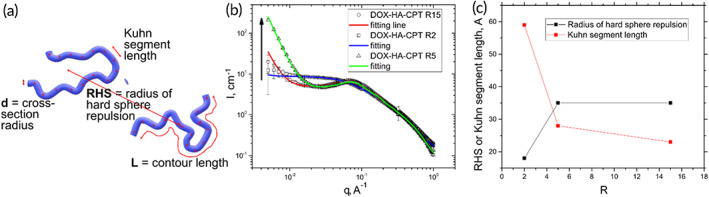
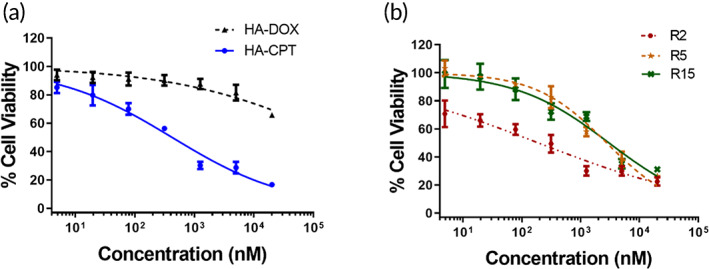
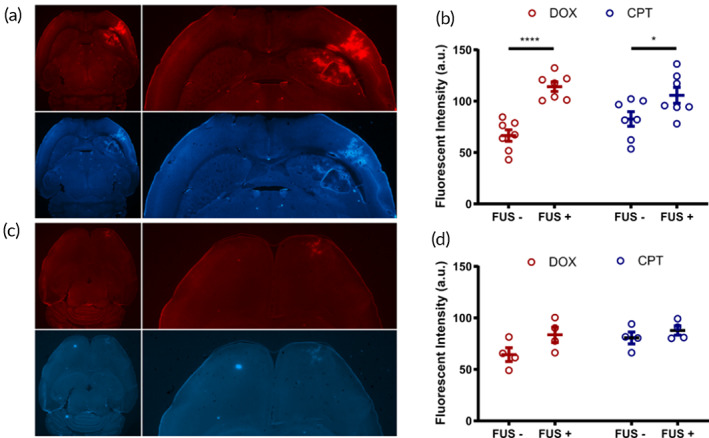
Effective chemotherapy delivery for glioblastoma multiforme (GBM) is limited by drug transport across the blood-brain barrier and poor efficacy of single agents. Polymer-drug conjugates can be used to deliver drug combinations with a ratiometric dosing. However, the behaviors and effectiveness of this system have never been well investigated in GBM models. Here, we report flexible conjugates of hyaluronic acid (HA) with camptothecin (CPT) and doxorubicin (DOX) delivered into the brain using focused ultrasound (FUS). In vitro toxicity assays reveal that DOX-CPT exhibited synergistic action against GBM in a ratio-dependent manner when delivered as HA conjugates. FUS is employed to improve penetration of DOX-HA-CPT conjugates into the brain in vivo in a murine GBM model. Small-angle x-ray scattering characterizations of the conjugates show that the DOX:CPT ratio affects the polymer chain flexibility. Conjugates with the highest flexibility yield the highest efficacy in treating mouse GBM in vivo. Our results demonstrate the association of FUS-enhanced delivery of combination chemotherapy and the drug-ratio-dependent flexibility of the HA conjugates. Drug ratio in the polymer nanocomplex may thus be employed as a key factor to modulate FUS drug delivery efficiency via controlling the polymer flexibility. Our characterizations also highlight the significance of understanding the flexibility of drug carriers in ultrasound-mediated drug delivery systems.
多形性胶质母细胞瘤(GBM)有效的化疗给药受到药物穿过血脑屏障以及单一药物疗效不佳的限制。聚合物-药物偶联物可用于按比例给药来递送药物组合。然而,该系统在GBM模型中的行为和有效性从未得到充分研究。在此,我们报告了透明质酸(HA)与喜树碱(CPT)和阿霉素(DOX)的柔性偶联物,通过聚焦超声(FUS)将其递送至脑内。体外毒性试验表明,当以HA偶联物形式递送时,DOX-CPT对GBM呈现出比例依赖性的协同作用。在小鼠GBM模型中,采用FUS来提高DOX-HA-CPT偶联物在体内进入脑内的渗透率。对偶联物的小角X射线散射表征显示,DOX:CPT比例会影响聚合物链的柔性。柔性最高的偶联物在体内治疗小鼠GBM时疗效最高。我们的结果证明了FUS增强联合化疗给药与HA偶联物的药物比例依赖性柔性之间的关联。因此,聚合物纳米复合物中的药物比例可作为一个关键因素,通过控制聚合物柔性来调节FUS药物递送效率。我们的表征还突出了理解超声介导的药物递送系统中药物载体柔性的重要性。