Ouyang Mengyuan, Song Shasha, Ma Hui, Yang Hua, Leng Jing, Zhou Ping, Teng Changjun, Ou Hongxia, Li Jijun, Liu Na, Zhang Ning
The Affiliated Nanjing Brain Hospital of Nanjing Medical University, Nanjing, China.
Department of Medical Psychology, The Affiliated Brain Hospital of Nanjing Medical University, Nanjing, China.
Front Health Serv. 2022 Aug 31;2:968025. doi: 10.3389/frhs.2022.968025. eCollection 2022.
The aim of this study was to analyze the chief complaints of psychological crisis hotlines during the coronavirus disease 2019 (COVID-19) pandemic in Jiangsu, China, and to summarize the psychological characteristics of the public during the different stages of COVID-19.
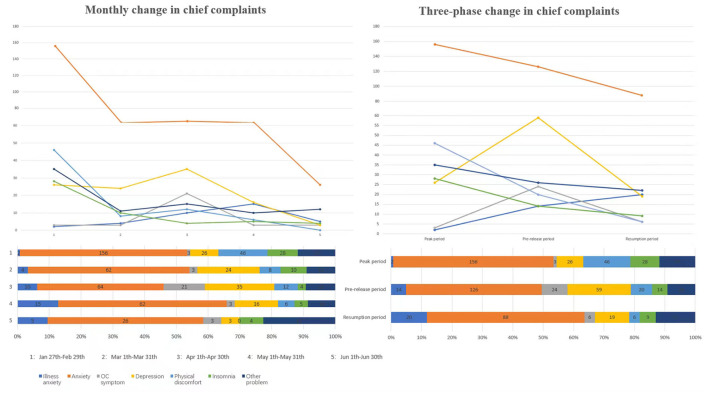
The chief complaints of calls to the psychological crisis hotline from 27 January 2020 to 30 June 2020. A total of 578 calls were extracted and grouped using thematic analysis into categories. After statistical analysis, the monthly and three-period trends were observed dynamically to determine whether there were statistical differences in the proportion of specific chief complaints over the phases.
There were a total of 495 cases of psychological problems or physical discomfort, accounting for 85.64% of the total sample number of hotline calls related to the pandemic. The numbers of callers with anxiety, depression, obsessive-compulsive symptoms, illness anxiety, insomnia, and physical discomfort were 370 (64.01%), 103 (17.99%), 33 (5.71%), 36 (6.23%), 51 (8.82%), and 72 (12.46%), respectively, and 83 (14.36%) callers consulted other problems. The monthly main complaints showed a fluctuating trend, and each main complaint peaked at different stages. The main complaints during the three stages had distinct features, respectively, and the proportions of calls for the specific complaints differed statistically over the phases.
Dynamic observation and qualitative analysis of psychological crisis hotline data might indicate dynamic changes and accordingly provide guidance for online crisis intervention when other public health crises occur.
本研究旨在分析中国江苏省2019年冠状病毒病(COVID-19)大流行期间心理危机热线的主要诉求,并总结COVID-19不同阶段公众的心理特征。
收集2020年1月27日至2020年6月30日心理危机热线的来电主要诉求。共提取578个电话,并采用主题分析法进行分类。经过统计分析,动态观察月度和三个阶段的趋势,以确定特定主要诉求在各阶段的比例是否存在统计学差异。
共有495例心理问题或身体不适,占与大流行相关的热线电话总样本数的85.64%。焦虑、抑郁、强迫症状、疾病焦虑、失眠和身体不适的来电者人数分别为370人(64.01%)、103人(17.99%)、33人(5.71%)、36人(6.23%)、51人(8.82%)和72人(12.46%),83名(14.36%)来电者咨询了其他问题。月度主要诉求呈波动趋势,各主要诉求在不同阶段达到峰值。三个阶段的主要诉求分别具有明显特征,特定诉求的来电比例在各阶段存在统计学差异。
对心理危机热线数据进行动态观察和定性分析可能显示动态变化,从而在其他公共卫生危机发生时为在线危机干预提供指导。