Hockett Sherlock Stacey, Goedken Cassie Cunningham, Balkenende Erin C, Dukes Kimberly C, Perencevich Eli N, Reisinger Heather Schacht, Forrest Graeme N, Pfeiffer Christopher D, West Katelyn A, Schweizer Marin
Center for Access and Delivery Research and Evaluation (CADRE), VA Iowa City Health Care System, Iowa City, IA, United States.
Department of Internal Medicine, Carver College of Medicine, The University of Iowa, Iowa City, IA, United States.
Front Health Serv. 2022 Aug 17;2:920830. doi: 10.3389/frhs.2022.920830. eCollection 2022.
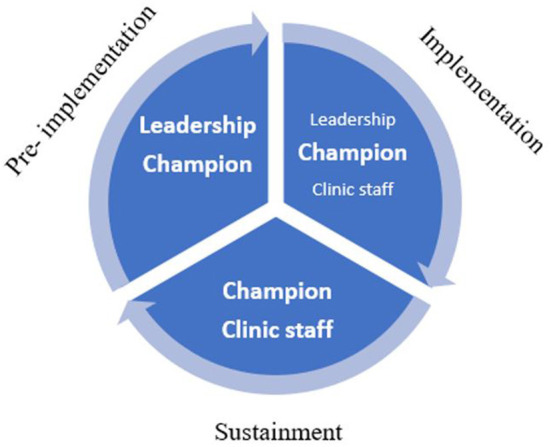
As part of a multicenter evidence-based intervention for surgical site infection prevention, a qualitative study was conducted with infection control teams and surgical staff members at three Department of Veterans Affairs Healthcare Systems in the USA. This study aimed to identify strategies used by nurses and other facility champions for the implementation of a nasal decolonization intervention. Site visit observations and field notes provided contextual information. Interview data were analyzed with inductive and deductive content analysis. Interview data was mapped to the Expert Recommendations for Implementing Change (ERIC) compilation of implementation strategies. These strategies were then considered in the context of power and relationships as factors that influence implementation. We found that implementation of this evidence-based surgical site infection prevention intervention was successful when nurse champions drove the day-to-day implementation. Nurse champions sustained implementation strategies through all phases of implementation. Findings also suggest that nurse champions leveraged the influence of their role as champion along with their understanding of social networks and relationships to help achieve implementation success. Nurse champions consciously used multiple overlapping and iterative implementation strategies, adapting and tailoring strategies to stakeholders and settings. Commonly used implementation categories included: "train and educate stakeholders," "use evaluative and iterative strategies," "adapt and tailor to context," and "develop stakeholder interrelationships." Future research should examine the social networks for evidence-based interventions by asking specifically about relationships and power dynamics within healthcare organizations. Implementation of evidence-based interventions should consider if the tasks expected of a nurse champion fit the level of influence or power held by the champion.
ClinicalTrials.gov, identifier: NCT02216227.
作为一项基于多中心循证干预预防手术部位感染的研究的一部分,在美国三个退伍军人事务部医疗系统对感染控制团队和手术工作人员开展了一项定性研究。本研究旨在确定护士和其他机构倡导者在实施鼻腔去定植干预措施时所采用的策略。现场考察观察和实地记录提供了背景信息。采用归纳和演绎内容分析法对访谈数据进行分析。将访谈数据映射到实施变革专家建议(ERIC)实施策略汇编中。然后在权力和关系的背景下考虑这些策略,将其作为影响实施的因素。我们发现,当护士倡导者推动日常实施时,这项基于循证的手术部位感染预防干预措施的实施是成功的。护士倡导者在实施的各个阶段都维持实施策略。研究结果还表明,护士倡导者利用其作为倡导者的角色影响力以及对社交网络和关系的理解来帮助实现实施成功。护士倡导者有意识地使用多种重叠和迭代的实施策略,根据利益相关者和环境调整和定制策略。常用的实施类别包括:“培训和教育利益相关者”、“使用评估和迭代策略”、“根据背景进行调整和定制”以及“发展利益相关者的相互关系”。未来的研究应通过具体询问医疗保健组织内的关系和权力动态来研究基于循证干预措施的社交网络。基于循证干预措施的实施应考虑护士倡导者所期望承担的任务是否符合其拥有的影响力或权力水平。
ClinicalTrials.gov,标识符:NCT02216227。