Center for Muscle and Joint Health, Department of Sports Science and Clinical Biomechanics, University of Southern Denmark, Odense, Denmark
Department of Radiology, Hospital Lillebælt, Vejle, Denmark.
BMJ Open. 2023 Mar 16;13(3):e065373. doi: 10.1136/bmjopen-2022-065373.
To review the available evidence on diagnostic imaging findings in knee and hip osteoarthritis (OA) as treatment effect modifiers in non-surgical OA interventions.
MEDLINE, Embase and The Cochrane Central Register of Controlled Trials were searched from the earliest records published to 22 March 2022. Studies in knee and hip OA reporting subgroup analyses in randomised controlled trials with imaging findings as potential treatment effect modifiers were included. Studies were critically appraised using the Cochrane risk of bias tool and a subgroup analysis quality assessment.
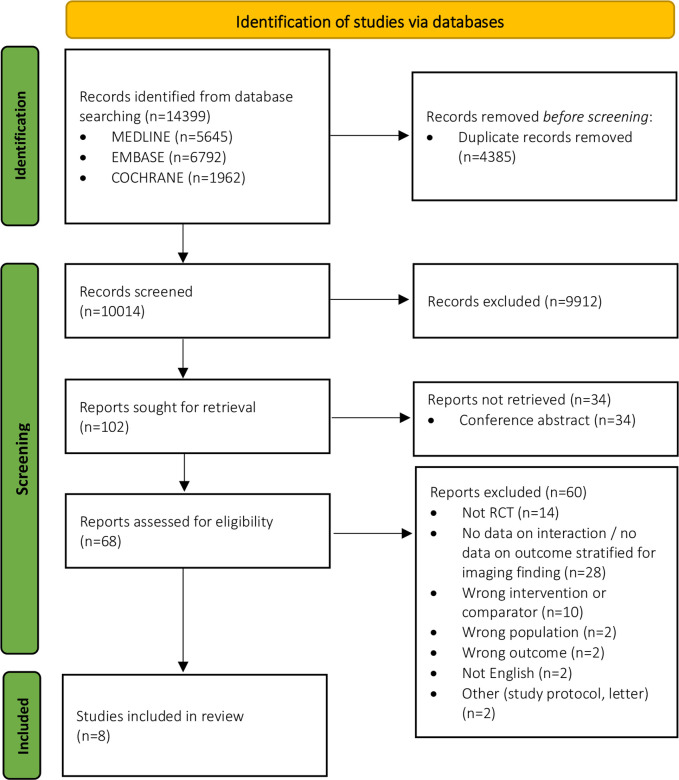
Of 10 014 titles and abstracts screened, eight studies met the inclusion criteria, six on knee OA and two on hip OA. The studies investigated effect modifiers in exercise therapy, intra-articular injections and unloading shoes. Imaging findings assessed as potential treatment effect modifiers were radiographic OA severity, hip effusion (ultrasound), bone marrow lesions and meniscal pathology (MRI). Two studies fulfilled the methodological quality criteria for assessing effect modification. One reported that radiographic knee OA severity modified the effect of unloading shoes on walking pain. Those with more severe radiographic knee OA had a greater response to shoe inserts. One reported no interaction between radiographic OA severity or joint effusion and the effect of intraarticular injections of corticosteroid or hyaluronic acid in hip OA, indicating no difference in response in people with greater hip joint effusion or radiographic OA severity compared with those with less severe joint disease.
Overall, methodological limitations and very few studies do not permit conclusions on diagnostic imaging findings as effect modifiers in non-surgical interventions in knee and hip OA.Radiographic severity of knee OA potentially modifies the effect of unloading shoes.
CRD42020181934.
综述膝关节和髋关节骨关节炎(OA)的影像学表现作为非手术 OA 干预措施的治疗效果调节剂的现有证据。
检索 MEDLINE、Embase 和 The Cochrane Central Register of Controlled Trials 数据库,检索时间截至 2022 年 3 月 22 日,纳入报告随机对照试验中影像学表现作为潜在治疗效果调节剂的亚组分析的膝关节和髋关节 OA 研究。使用 Cochrane 偏倚风险工具和亚组分析质量评估对研究进行批判性评价。
在筛选出的 10014 篇标题和摘要中,有 8 篇研究符合纳入标准,其中 6 篇研究膝关节 OA,2 篇研究髋关节 OA。这些研究调查了运动疗法、关节内注射和减压鞋的潜在治疗效果调节剂。评估为潜在治疗效果调节剂的影像学表现包括放射学 OA 严重程度、髋关节积液(超声)、骨髓病变和半月板病变(MRI)。有两项研究满足评估效果修饰的方法学质量标准。一项研究报告称,放射学膝关节 OA 严重程度改变了减压鞋对行走疼痛的治疗效果。那些放射学膝关节 OA 严重程度较高的患者对鞋垫的反应更大。一项研究报告称,髋关节 OA 中关节内注射皮质类固醇或透明质酸的效果与放射学 OA 严重程度或关节积液之间没有相互作用,这表明在关节积液或放射学 OA 严重程度较高的人群中,与关节疾病较轻的人群相比,反应没有差异。
总体而言,方法学限制和很少有研究不允许得出膝关节和髋关节 OA 的非手术干预中诊断影像学表现作为效果调节剂的结论。膝关节 OA 的放射学严重程度可能会改变减压鞋的治疗效果。
PROSPERO 注册号:CRD42020181934。