Department of Biophysics, Medical College of Wisconsin, Milwaukee, Wisconsin, United States of America.
Department of Radiology, Medical College of Wisconsin, Milwaukee, Wisconsin, United States of America.
PLoS One. 2023 Mar 16;18(3):e0278084. doi: 10.1371/journal.pone.0278084. eCollection 2023.
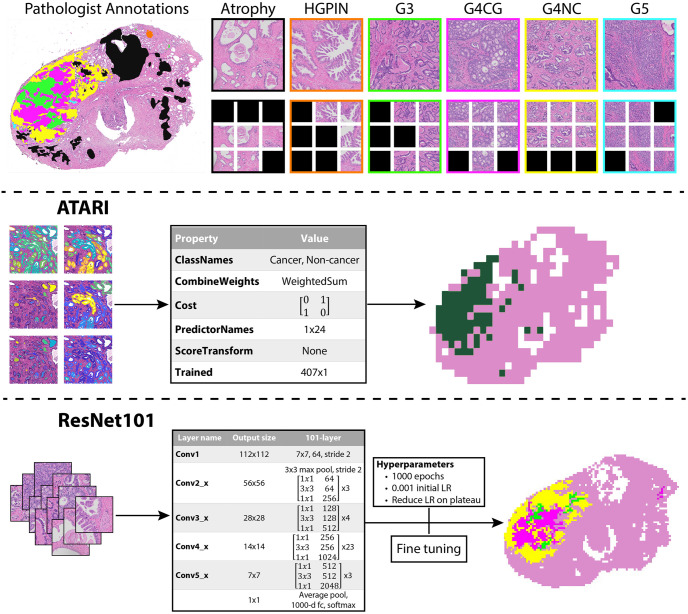
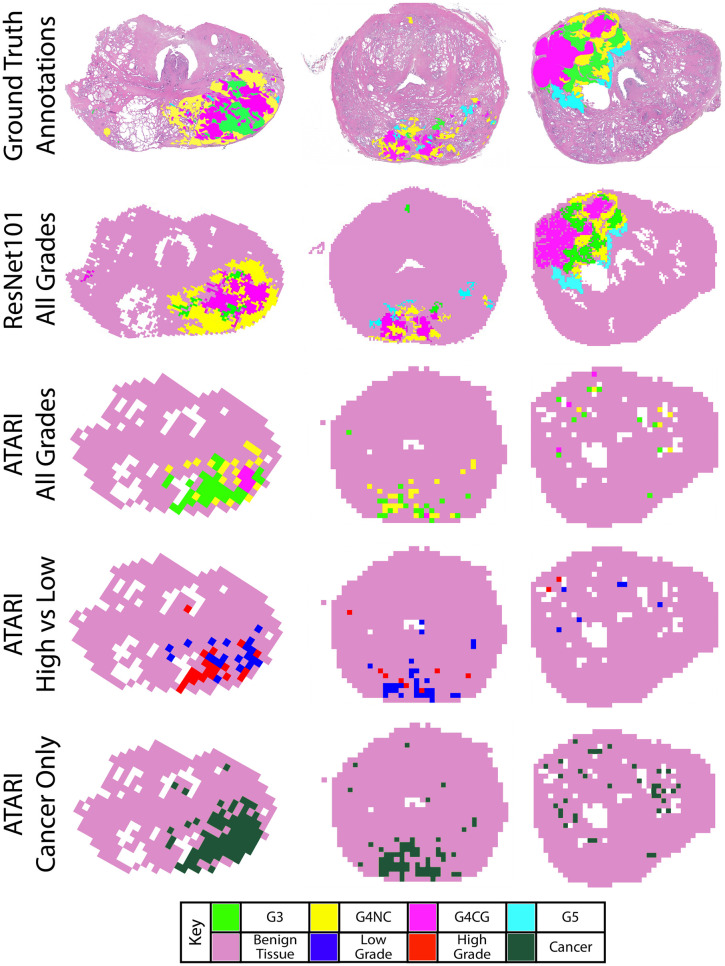
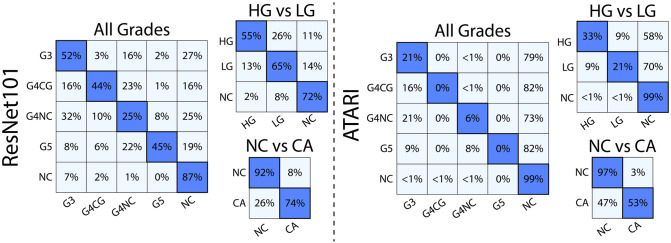
One in eight men will be affected by prostate cancer (PCa) in their lives. While the current clinical standard prognostic marker for PCa is the Gleason score, it is subject to inter-reviewer variability. This study compares two machine learning methods for discriminating between cancerous regions on digitized histology from 47 PCa patients. Whole-slide images were annotated by a GU fellowship-trained pathologist for each Gleason pattern. High-resolution tiles were extracted from annotated and unlabeled tissue. Patients were separated into a training set of 31 patients (Cohort A, n = 9345 tiles) and a testing cohort of 16 patients (Cohort B, n = 4375 tiles). Tiles from Cohort A were used to train a ResNet model, and glands from these tiles were segmented to calculate pathomic features to train a bagged ensemble model to discriminate tumors as (1) cancer and noncancer, (2) high- and low-grade cancer from noncancer, and (3) all Gleason patterns. The outputs of these models were compared to ground-truth pathologist annotations. The ensemble and ResNet models had overall accuracies of 89% and 88%, respectively, at predicting cancer from noncancer. The ResNet model was additionally able to differentiate Gleason patterns on data from Cohort B while the ensemble model was not. Our results suggest that quantitative pathomic features calculated from PCa histology can distinguish regions of cancer; however, texture features captured by deep learning frameworks better differentiate unique Gleason patterns.
八分之一的男性在一生中会受到前列腺癌(PCa)的影响。虽然目前用于 PCa 的临床标准预后标志物是 Gleason 评分,但它存在观察者间的变异性。本研究比较了两种机器学习方法,用于区分 47 名 PCa 患者的数字化组织学上的癌性区域。全幻灯片图像由经过 GU 研究员培训的病理学家对每个 Gleason 模式进行注释。从注释和未标记的组织中提取高分辨率的图块。患者分为训练集 31 名患者(队列 A,n = 9345 个图块)和测试集 16 名患者(队列 B,n = 4375 个图块)。使用队列 A 中的图块训练 ResNet 模型,并对这些图块中的腺体进行分割以计算病理特征,以训练袋装集成模型来区分肿瘤为(1)癌症和非癌,(2)高-低等级癌与非癌,以及(3)所有 Gleason 模式。将这些模型的输出与地面实况病理学家注释进行比较。整体而言,在预测非癌组织中的癌症方面,集成模型和 ResNet 模型的准确率分别为 89%和 88%。ResNet 模型还可以区分队列 B 中数据的 Gleason 模式,而集成模型则不能。我们的结果表明,从 PCa 组织学中计算出的定量病理特征可以区分癌症区域;然而,深度学习框架捕获的纹理特征可以更好地区分独特的 Gleason 模式。