Google Health, Google LLC, Mountain View, California.
now with Toyota Technological Institute Chicago, Chicago, Illinois.
JAMA Oncol. 2020 Sep 1;6(9):1372-1380. doi: 10.1001/jamaoncol.2020.2485.
For prostate cancer, Gleason grading of the biopsy specimen plays a pivotal role in determining case management. However, Gleason grading is associated with substantial interobserver variability, resulting in a need for decision support tools to improve the reproducibility of Gleason grading in routine clinical practice.
To evaluate the ability of a deep learning system (DLS) to grade diagnostic prostate biopsy specimens.
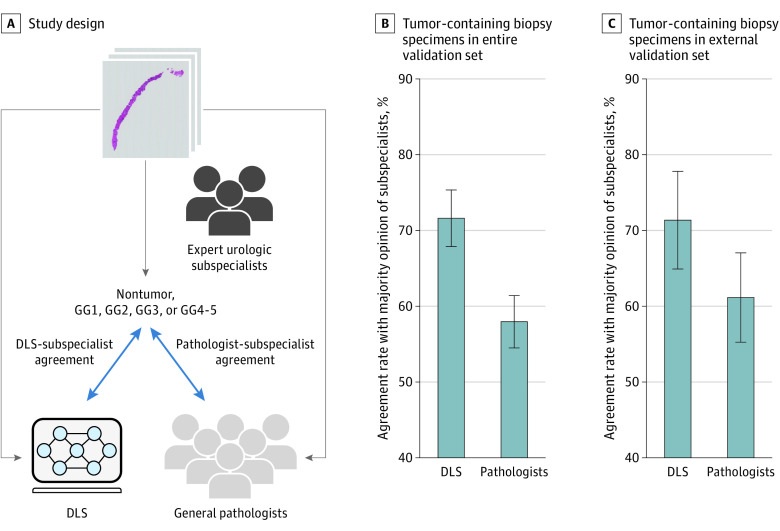
DESIGN, SETTING, AND PARTICIPANTS: The DLS was evaluated using 752 deidentified digitized images of formalin-fixed paraffin-embedded prostate needle core biopsy specimens obtained from 3 institutions in the United States, including 1 institution not used for DLS development. To obtain the Gleason grade group (GG), each specimen was first reviewed by 2 expert urologic subspecialists from a multi-institutional panel of 6 individuals (years of experience: mean, 25 years; range, 18-34 years). A third subspecialist reviewed discordant cases to arrive at a majority opinion. To reduce diagnostic uncertainty, all subspecialists had access to an immunohistochemical-stained section and 3 histologic sections for every biopsied specimen. Their review was conducted from December 2018 to June 2019.
The frequency of the exact agreement of the DLS with the majority opinion of the subspecialists in categorizing each tumor-containing specimen as 1 of 5 categories: nontumor, GG1, GG2, GG3, or GG4-5. For comparison, the rate of agreement of 19 general pathologists' opinions with the subspecialists' majority opinions was also evaluated.
For grading tumor-containing biopsy specimens in the validation set (n = 498), the rate of agreement with subspecialists was significantly higher for the DLS (71.7%; 95% CI, 67.9%-75.3%) than for general pathologists (58.0%; 95% CI, 54.5%-61.4%) (P < .001). In subanalyses of biopsy specimens from an external validation set (n = 322), the Gleason grading performance of the DLS remained similar. For distinguishing nontumor from tumor-containing biopsy specimens (n = 752), the rate of agreement with subspecialists was 94.3% (95% CI, 92.4%-95.9%) for the DLS and similar at 94.7% (95% CI, 92.8%-96.3%) for general pathologists (P = .58).
In this study, the DLS showed higher proficiency than general pathologists at Gleason grading prostate needle core biopsy specimens and generalized to an independent institution. Future research is necessary to evaluate the potential utility of using the DLS as a decision support tool in clinical workflows and to improve the quality of prostate cancer grading for therapy decisions.
对于前列腺癌,活检标本的 Gleason 分级在确定病例管理方面起着关键作用。然而,Gleason 分级与大量观察者间的变异性相关,导致需要决策支持工具来提高常规临床实践中 Gleason 分级的重现性。
评估深度学习系统 (DLS) 对诊断性前列腺活检标本进行分级的能力。
设计、地点和参与者:使用来自美国 3 个机构的 752 个福尔马林固定石蜡包埋前列腺针芯活检标本的 752 个经数字化的未识别图像来评估 DLS,包括 1 个未用于 DLS 开发的机构。为了获得 Gleason 分级组 (GG),每个标本首先由来自 6 名专家的多机构小组的 2 名泌尿科专家(经验年限:平均 25 年;范围 18-34 年)进行审查。第三位专家审查了意见不一致的病例,以达成多数意见。为了降低诊断不确定性,所有专家都可以访问每例活检标本的免疫组织化学染色切片和 3 个组织学切片。他们的审查时间是从 2018 年 12 月到 2019 年 6 月。
DLS 将每个含有肿瘤的标本分类为 5 个类别之一的准确性与专家小组多数意见的一致性频率:非肿瘤、GG1、GG2、GG3 或 GG4-5。为了比较,还评估了 19 名普通病理学家的意见与专家小组多数意见的一致性。
在验证集(n = 498)中,DLS 对分级含有肿瘤的活检标本的一致性明显高于普通病理学家(71.7%;95% CI,67.9%-75.3%)(P < .001)。在来自外部验证集的活检标本的子分析中(n = 322),DLS 的 Gleason 分级性能仍然相似。对于区分非肿瘤与含有肿瘤的活检标本(n = 752),与专家小组的一致性为 94.3%(95% CI,92.4%-95.9%)对于 DLS,普通病理学家的一致性相似,为 94.7%(95% CI,92.8%-96.3%)(P = .58)。
在这项研究中,DLS 在 Gleason 分级前列腺针芯活检标本方面比普通病理学家表现出更高的能力,并推广到一个独立的机构。未来的研究需要评估使用 DLS 作为决策支持工具在临床工作流程中的潜在效用,并提高前列腺癌分级的质量以做出治疗决策。