Institute for Molecular Systems Biology, ETH Zurich, Zurich, Switzerland.
Swiss Institute of Bioinformatics (SIB), Zurich, Switzerland.
Sci Rep. 2018 Aug 13;8(1):12054. doi: 10.1038/s41598-018-30535-1.
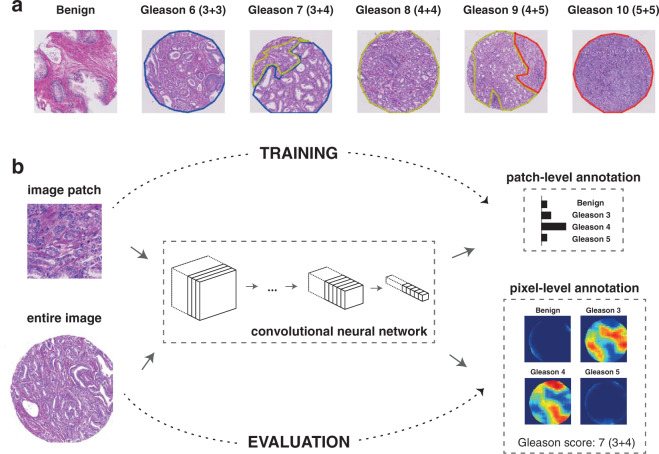
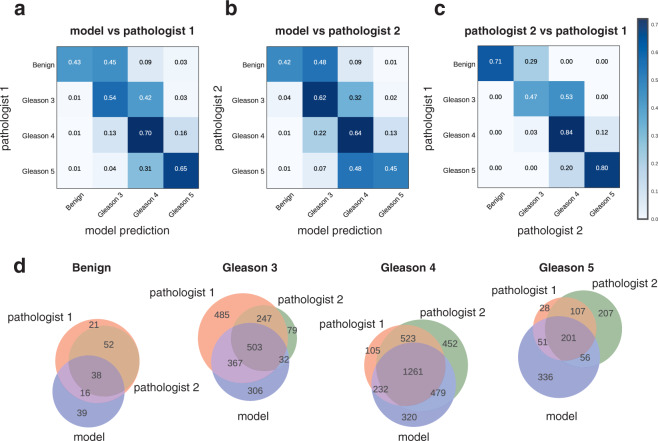
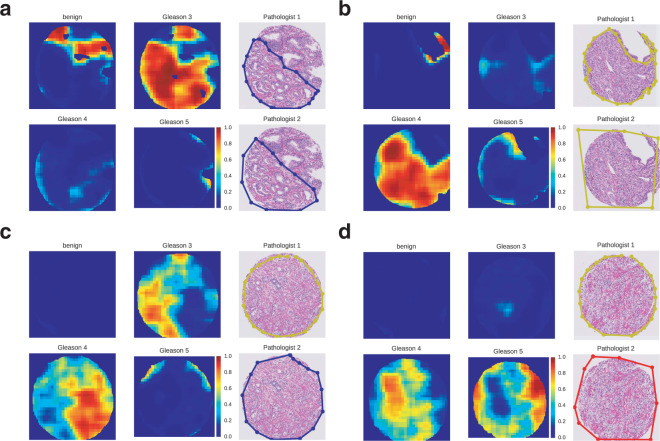
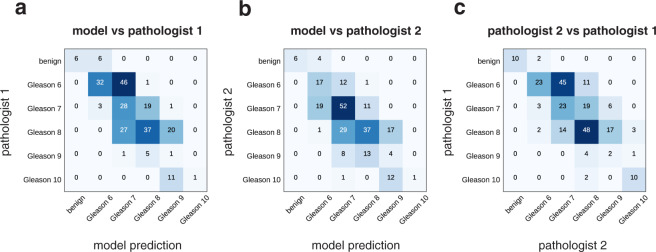
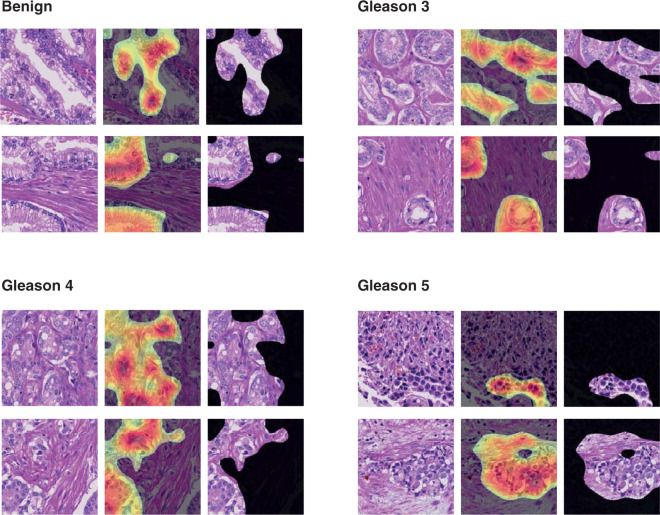
The Gleason grading system remains the most powerful prognostic predictor for patients with prostate cancer since the 1960s. Its application requires highly-trained pathologists, is tedious and yet suffers from limited inter-pathologist reproducibility, especially for the intermediate Gleason score 7. Automated annotation procedures constitute a viable solution to remedy these limitations. In this study, we present a deep learning approach for automated Gleason grading of prostate cancer tissue microarrays with Hematoxylin and Eosin (H&E) staining. Our system was trained using detailed Gleason annotations on a discovery cohort of 641 patients and was then evaluated on an independent test cohort of 245 patients annotated by two pathologists. On the test cohort, the inter-annotator agreements between the model and each pathologist, quantified via Cohen's quadratic kappa statistic, were 0.75 and 0.71 respectively, comparable with the inter-pathologist agreement (kappa = 0.71). Furthermore, the model's Gleason score assignments achieved pathology expert-level stratification of patients into prognostically distinct groups, on the basis of disease-specific survival data available for the test cohort. Overall, our study shows promising results regarding the applicability of deep learning-based solutions towards more objective and reproducible prostate cancer grading, especially for cases with heterogeneous Gleason patterns.
自 20 世纪 60 年代以来,格里森分级系统一直是前列腺癌患者最有力的预后预测指标。它的应用需要经过高度训练的病理学家,既繁琐又存在有限的病理学家间可重复性,特别是对于中间的格里森评分 7 级。自动化注释程序是解决这些限制的可行方法。在这项研究中,我们提出了一种基于深度学习的方法,用于对前列腺癌组织微阵列进行苏木精和伊红(H&E)染色的自动化格里森分级。我们的系统使用详细的格里森注释在一个由 641 名患者组成的发现队列中进行了训练,然后在一个由两名病理学家注释的独立测试队列中进行了评估。在测试队列中,模型与每位病理学家之间的标注者间一致性,通过 Cohen 的二次 kappa 统计量来量化,分别为 0.75 和 0.71,与病理学家间的一致性(kappa=0.71)相当。此外,该模型的格里森评分分配基于测试队列中可用的疾病特异性生存数据,将患者分层为具有不同预后的组,达到了病理专家水平。总的来说,我们的研究表明,基于深度学习的解决方案在更客观和可重复的前列腺癌分级方面具有应用前景,特别是对于具有异质性格里森模式的病例。