Liao Yi, Xiao Jiapeng, Fang Feng, Zhou Hua, Liu Lingling, Liu Xinglou
Department of Pediatrics, Tongji Hospital, Tongji Medical College, Huazhong University of Science and Technology, Wuhan, China.
Department of Pediatrics, Luotian County People's Hospital, Huanggang, China.
Front Med (Lausanne). 2023 Mar 1;10:1135178. doi: 10.3389/fmed.2023.1135178. eCollection 2023.
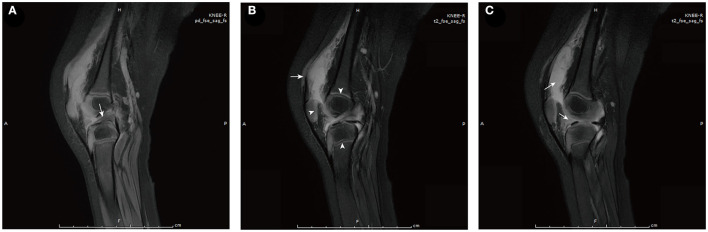
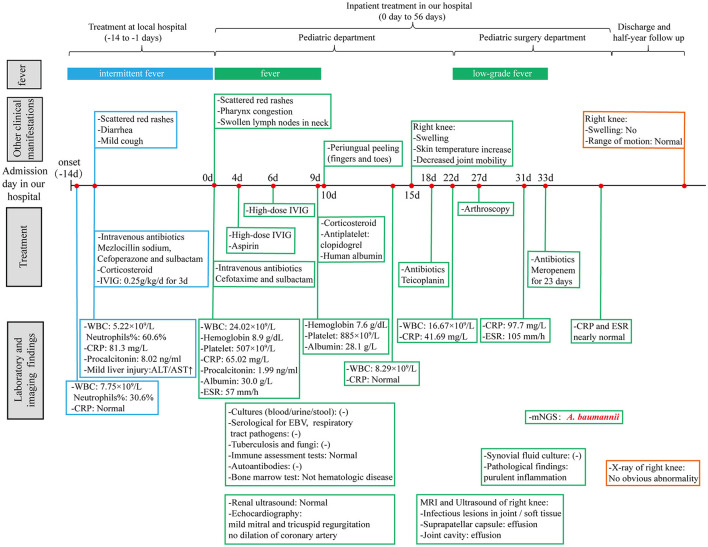
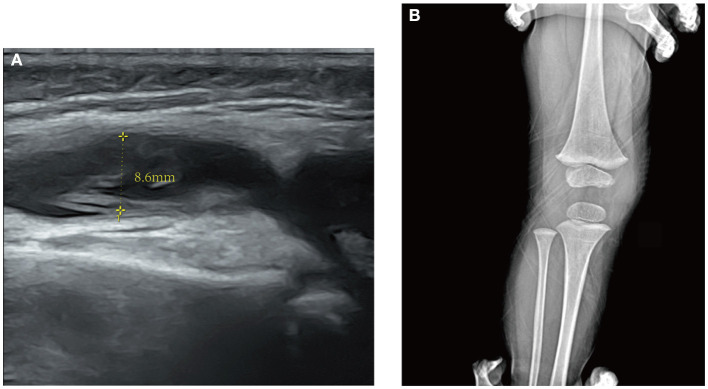
is a gram-negative coccobacilli, mainly causing nosocomial infections with poor prognosis, especially in patients with prolonged hospitalization or antibiotics administration. pneumonia is the most common clinical form and usually occurs in critically ill patients in the intensive care unit. However, septic arthritis caused by is rarely reported. In this report, we describe a case of septic arthritis combined with incomplete Kawasaki disease in an infant. The child's chief complaint was a 2-week intermittent fever with poor response to antibiotics. Initial physical examination revealed swollen lymph nodes in the neck, pharynx congestion, and the appearance of rashes. Combined with laboratory tests, the diagnosis of incomplete Kawasaki disease was considered. After administration of high-dose intravenous immunoglobulin and corticosteroids, the child's fever improved and periungual desquamation appeared simultaneously. Swelling of the right knee occurred 5 days after the fever improved and imaging tests of MRI and ultrasound suggested the existence of infection. A diagnosis of septic arthritis was established subsequently, and arthroscopy was carried out. was finally identified by metagenomics next-generation sequencing of joint draining fluid for pathogenic microorganisms. Treatment with meropenem was then started. The patient eventually recovered and was discharged from the hospital after 23 days of treatment with meropenem. Although is not a common bacterium of septic arthritis, this rare infection can still occur in infants. Early diagnosis, pathogenic identification, and target antibiotic treatment are important to reduce the occurrence of joint sequelae.
是一种革兰氏阴性球杆菌,主要引起医院感染,预后较差,尤其是在住院时间延长或使用抗生素的患者中。肺炎是最常见的临床形式,通常发生在重症监护病房的重症患者中。然而,由引起的化脓性关节炎很少被报道。在本报告中,我们描述了一例婴儿化脓性关节炎合并不完全川崎病的病例。患儿的主要症状是持续2周的间歇性发热,对抗生素反应不佳。初次体格检查发现颈部淋巴结肿大、咽部充血和皮疹出现。结合实验室检查,考虑诊断为不完全川崎病。在给予大剂量静脉注射免疫球蛋白和糖皮质激素后,患儿发热情况改善,同时出现指(趾)周脱皮。发热改善5天后右膝出现肿胀,MRI和超声影像学检查提示存在感染。随后确诊为化脓性关节炎,并进行了关节镜检查。最终通过对关节引流液进行宏基因组学下一代测序鉴定出病原体。然后开始使用美罗培南治疗。患者最终康复,在使用美罗培南治疗23天后出院。虽然不是化脓性关节炎的常见细菌,但这种罕见感染仍可发生在婴儿中。早期诊断、病原体鉴定和针对性抗生素治疗对于减少关节后遗症的发生很重要。