Agarwal Ayush, Mishra Biswamohan, Gupta Anu, Srivastava M Vasantha Padma, Basheer Aneesh, Sharma Jyoti, Vishnu Venugopalan Y
Department of Neurology, All India Institute of Medical Sciences, New Delhi, India.
DM Wayanad Institute of Medical Sciences (DM WIMS), Wayanad, India.
Front Aging Neurosci. 2023 Mar 1;15:1134775. doi: 10.3389/fnagi.2023.1134775. eCollection 2023.
Bacopa monnieri (BM), a commonly used herb, has shown neuroprotective effects in animal and studies; but human studies on patients with Alzheimer's Disease (AD) have been inconclusive. Further high-quality trials are required to conclusively state the utility of BM in AD and other neurodegenerative dementias.
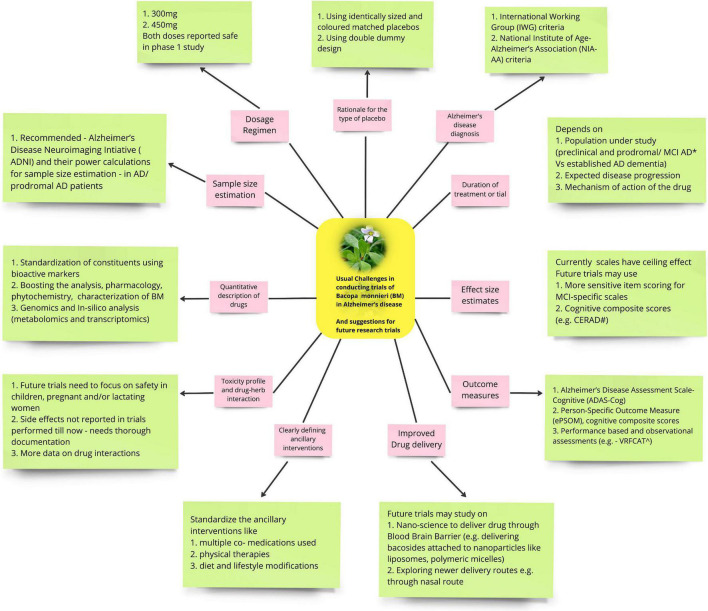
In the present study, we did a narrative review of the current challenges in designing clinical trials of BM in dementia and their evidence-based recommendations.
Many facets of the BM trials need improvement, especially effect size and sample size estimation. Current assessment and outcomes measures need a more holistic approach and newer scales for diagnosing and monitoring prodromal AD. The stringent guidelines in CONSORT and STROBE are often considered difficult to implement for clinical trials in ayurvedic medications like BM. However, adherence to these guidelines will undoubtedly improve the quality of evidence and go a long way in assessing whether BM is efficacious in treating AD/prodromal AD patients and other neurodegenerative dementias.
Future studies on BM should implement more randomized controlled trials (RCTs) with an appropriate sample size of accurately diagnosed AD/prodromal AD patients, administering a recommended dosage of BM and for a pre-specified time calculated to achieve adequate power for the study. Researchers should also develop and validate more sensitive cognitive scales, especially for prodromal AD. BM should be evaluated in accordance with the same rigorous standards as conventional drugs to generate the best quality evidence.
水飞蓟宾(BM)是一种常用草药,在动物和研究中已显示出神经保护作用;但针对阿尔茨海默病(AD)患者的人体研究尚无定论。需要进一步开展高质量试验,以最终确定BM在AD和其他神经退行性痴呆中的效用。
在本研究中,我们对BM治疗痴呆临床试验设计中的当前挑战及其循证建议进行了叙述性综述。
BM试验的许多方面都需要改进,尤其是效应量和样本量估计。当前的评估和结局测量需要更全面的方法以及用于诊断和监测前驱AD的更新量表。CONSORT和STROBE中的严格指南通常被认为难以应用于像BM这样的阿育吠陀药物的临床试验。然而,遵守这些指南无疑将提高证据质量,并在评估BM是否对治疗AD/前驱AD患者及其他神经退行性痴呆有效方面大有帮助。
未来关于BM的研究应开展更多随机对照试验(RCT),纳入适当样本量的准确诊断的AD/前驱AD患者,给予推荐剂量的BM,并在预先指定的时间内进行,以确保研究有足够的效能。研究人员还应开发和验证更敏感的认知量表,尤其是针对前驱AD的量表。应按照与传统药物相同的严格标准评估BM,以产生最佳质量的证据。