Jin Qiankai, Huang Guoqing, Tian Xiaoqing, Shu Yimeng, Tusongtuoheti Ximisinuer, Mao Yushan
Department of Endocrinology, The Affiliated Hospital of Medical School, Ningbo University, Ningbo, China.
School of Medicine, Ningbo University, Ningbo, China.
Endocr Connect. 2023 Apr 25;12(5). doi: 10.1530/EC-22-0424. Print 2023 May 1.
The aim of this study was to elaborate the link of thyroid hormones (THs) and metabolic syndrome (MetS) in a Chinese euthyroid employee population with MetS component(s).
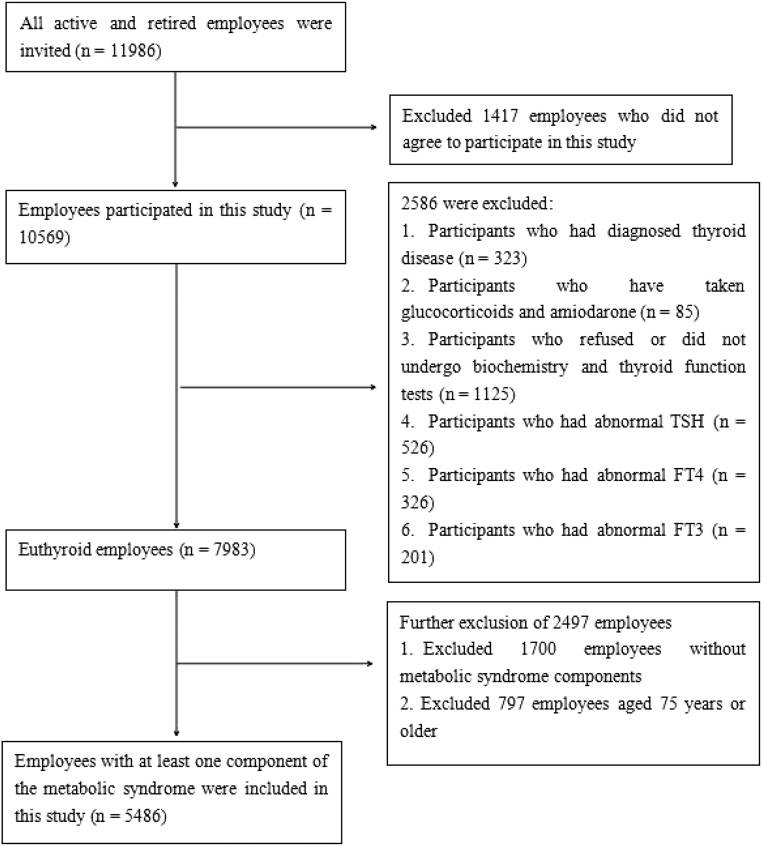
An annual health checkup was performed on employees in 2019. Anthropometric parameters, metabolic parameters, and thyroid function were measured. A questionnaire was used in conjunction with Zhenhai Lianhua Hospital database to receive employees' medication records and thyroid surgical history records.
A total of 5486 eligible employees were included; the prevalence of MetS was generally higher in males than in females (38.9 vs. 30.4%, P < 0.001). Among employees with central obesity, hypertriglyceridemia, hyperglycemia, hypertension, and low high-density lipoprotein cholesterol (HDL-C), the prevalence of MetS was 68.8, 63.6, 68.2, 48.8, and 60.0% in males and 72.6, 63.3, 61.3, 42.3, and 42.3% in females, respectively. Logistic regression analysis showed that thyroid-stimulating hormone and free thyroxine (FT4) quartiles had no significant impact on MetS. Free triiodothyronine/free thyroxine (FT3/FT4) and free triiodothyronine (FT3)) quartiles were positively associated with the increased odds ratio (OR) for MetS and dyslipidemia (hypertriglyceridemia and low HDL-C), regardless of gender. In males, FT3 and FT3/FT4 quartiles were positively associated with the OR for central obesity, whereas FT4 quartiles were negatively associated; both FT3 and FT4 quartiles were positively associated with increased OR of hyperglycemia, while similar results were not observed in females. Interaction analysis indicated no significant effect of gender and TH interactions on risk of MetS.
High FT3 and FT3/FT4 were strongly linked with MetS and dyslipidemia in our study, even in the euthyroid individuals. Tighter control of thyroid function was necessary for those with preexisting MetS component(s).
本研究旨在阐述甲状腺激素(THs)与代谢综合征(MetS)在中国甲状腺功能正常且有MetS组分的员工群体中的联系。
于2019年对员工进行年度健康体检。测量人体测量参数、代谢参数及甲状腺功能。结合镇海炼化医院数据库使用问卷来获取员工的用药记录及甲状腺手术史记录。
共纳入5486名符合条件的员工;MetS患病率总体上男性高于女性(38.9%对30.4%,P<0.001)。在有中心性肥胖、高甘油三酯血症、高血糖、高血压及低高密度脂蛋白胆固醇(HDL-C)的员工中,MetS患病率男性分别为68.8%、63.6%、68.2%、48.8%和60.0%,女性分别为72.6%、63.3%、61.3%、42.3%和42.3%。逻辑回归分析显示促甲状腺激素和游离甲状腺素(FT4)四分位数对MetS无显著影响。游离三碘甲状腺原氨酸/游离甲状腺素(FT3/FT4)和游离三碘甲状腺原氨酸(FT3)四分位数与MetS及血脂异常(高甘油三酯血症和低HDL-C)的比值比(OR)增加呈正相关,无论性别如何。在男性中,FT3和FT3/FT4四分位数与中心性肥胖的OR呈正相关,而FT4四分位数呈负相关;FT3和FT4四分位数均与高血糖的OR增加呈正相关,而在女性中未观察到类似结果。交互分析表明性别与TH相互作用对MetS风险无显著影响。
在我们的研究中,即使在甲状腺功能正常的个体中,高FT3和FT3/FT4也与MetS及血脂异常密切相关。对于已有MetS组分的患者,更严格地控制甲状腺功能是必要的。