Department of Cardiology, Erasmus MC - University Medical Center Rotterdam, PO Box 2040, 3000 CA, Rotterdam, the Netherlands.
Department of Epidemiology, Erasmus MC - University Medical Center Rotterdam, Rotterdam, the Netherlands.
Eur J Epidemiol. 2023 Aug;38(8):853-858. doi: 10.1007/s10654-023-00984-8. Epub 2023 Mar 22.
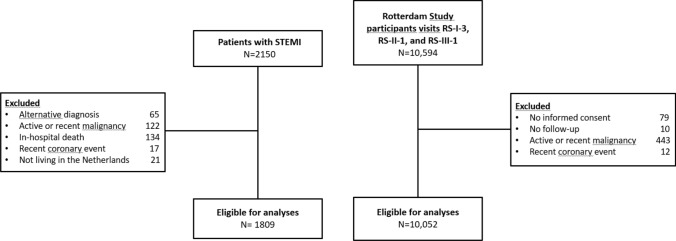
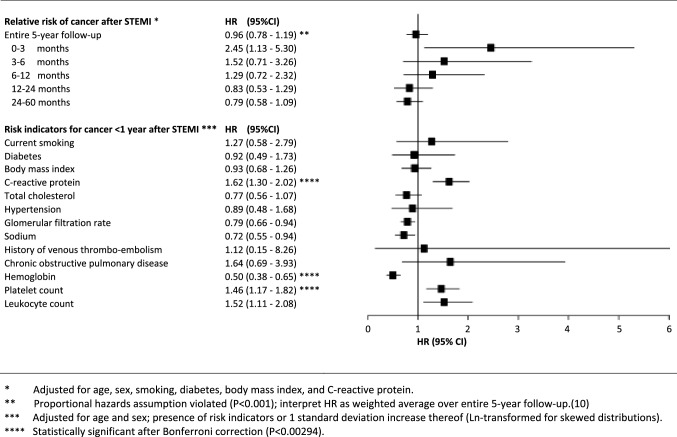
Analyses from administrative databases have suggested an increased cancer incidence among individuals who experienced a myocardial infarction, especially within the first 6 months. It remains unclear to what extent this represents an underlying biological link, or can be explained by detection of pre-symptomatic cancers and shared risk factors. Cancer incidence among 1809 consecutive patients surviving hospitalization for thrombotic ST-segment-elevation myocardial infarction (STEMI; mean age 62.6 years; 26% women; 115 incident cancers) was compared to the cancer incidence among 10,052 individuals of the general population (Rotterdam Study; mean age 63.1 years; 57% women; 677 incident cancers). Pathology-confirmed cancer diagnoses were obtained through identical linkage of both cohorts with the Netherlands Cancer Registry. Cox models were used to obtain hazards ratios (HRs) adjusted for factors associated with both atherosclerosis and cancer. Over 5-year follow-up, there was no significant difference in the incidence of cancer between STEMI patients and the general population (HR 0.96, 95% CI 0.78-1.19). In the first 3 months after STEMI, cancer incidence was markedly higher among STEMI patients compared to the general population (HR 2.45, 95% CI 1.13-5.30), which gradually dissolved during follow-up (P-for-trend 0.004). Among STEMI patients, higher C-reactive protein, higher platelet counts, and lower hemoglobin were associated with cancer incidence during the first year after STEMI (HRs 2.93 for C-reactive protein > 10 mg/dL, 2.10 for platelet count > 300*10, and 3.92 for hemoglobin < 7.5 mmol/L). Although rare, thrombotic STEMI might be a paraneoplastic manifestation of yet to be diagnosed cancer, and is hallmarked by a pro-inflammatory status and anemia.Trial registration Registered into the Netherlands National Trial Register and WHO International Clinical Trials Registry Platform under shared catalogue number NTR6831.
分析来自行政数据库的结果提示,经历心肌梗死的个体其癌症发病率升高,尤其是在首次发病后的 6 个月内。目前尚不清楚这在多大程度上代表了潜在的生物学联系,或者能否用检出的无症状癌症和共同的风险因素来解释。将 1809 例连续存活的血栓性 ST 段抬高型心肌梗死(STEMI;平均年龄 62.6 岁;26%为女性;115 例新发癌症)患者的癌症发病率与一般人群中的 10052 名个体(鹿特丹研究;平均年龄 63.1 岁;57%为女性;677 例新发癌症)进行比较。通过将这两个队列与荷兰癌症登记处进行相同的链接,获得经病理证实的癌症诊断。使用 Cox 模型获得调整了与动脉粥样硬化和癌症均相关的因素后的危险比(HR)。在 5 年的随访期间,STEMI 患者与一般人群的癌症发病率无显著差异(HR 0.96,95%CI 0.78-1.19)。在 STEMI 后 3 个月内,STEMI 患者的癌症发病率明显高于一般人群(HR 2.45,95%CI 1.13-5.30),随着随访的进行,这一差异逐渐消失(趋势检验 P 值=0.004)。在 STEMI 患者中,较高的 C 反应蛋白、较高的血小板计数和较低的血红蛋白与 STEMI 后 1 年内的癌症发病相关(C 反应蛋白>10mg/dL 的 HR 为 2.93,血小板计数>300*10 的 HR 为 2.10,血红蛋白<7.5mmol/L 的 HR 为 3.92)。尽管罕见,但血栓性 STEMI 可能是尚未确诊的癌症的副肿瘤表现,其特征为炎症状态和贫血。
试验注册 已在荷兰国家试验注册处和世界卫生组织国际临床试验注册平台注册,并共享登记号 NTR6831。