Apollo Hospitals Educational and Research Foundation (AHERF), Cell and Molecular Biology Research Lab, 500033, Hyderabad, India.
Department of Infectious Diseases, Apollo Health City, Jubilee Hills, Hyderabad 500033, India.
Biomed Res Int. 2022 Nov 7;2022:5644956. doi: 10.1155/2022/5644956. eCollection 2022.
We intend to identify differences in the clinicodemographic and laboratory findings of COVID-19 patients to predict disease severity and outcome on admission.
This single-centred retrospective study retrieved laboratory and clinical data from 350 COVID-19 patients on admission, represented as frequency tables. A multivariate regression model was used to assess the statistically significant association between the explanatory variables and COVID-19 infection outcomes, where adjusted odds ratio (AOR), value, and 95% CI were used for testing significance.
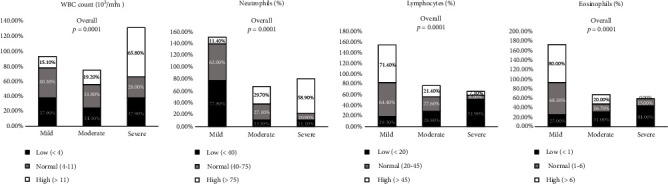
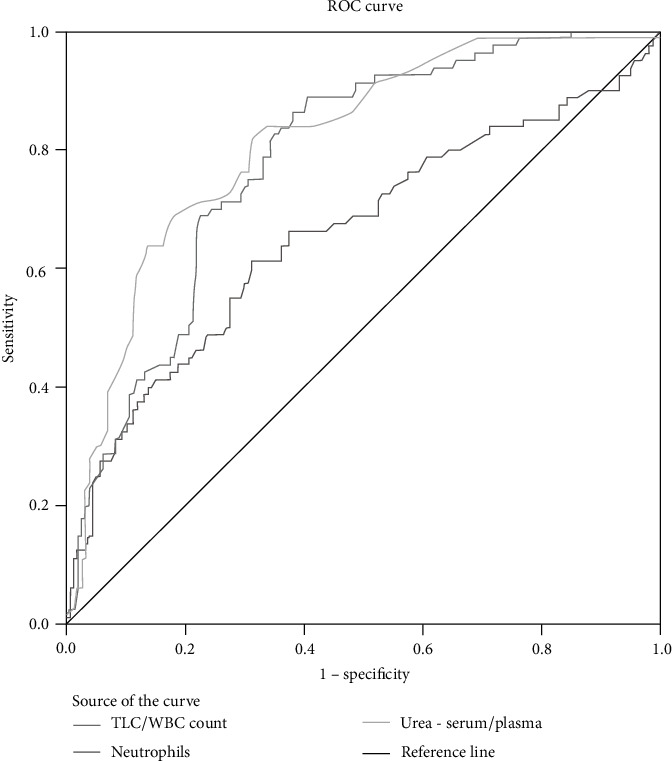
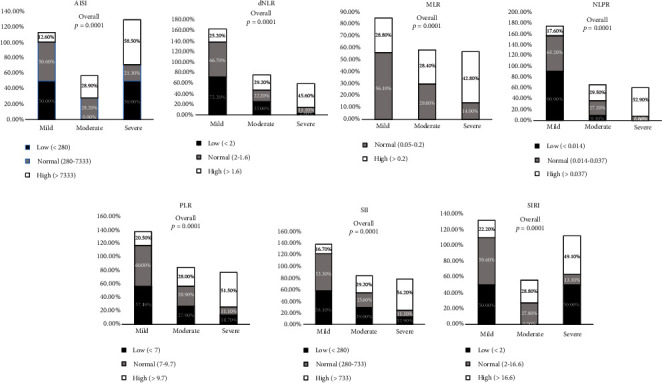
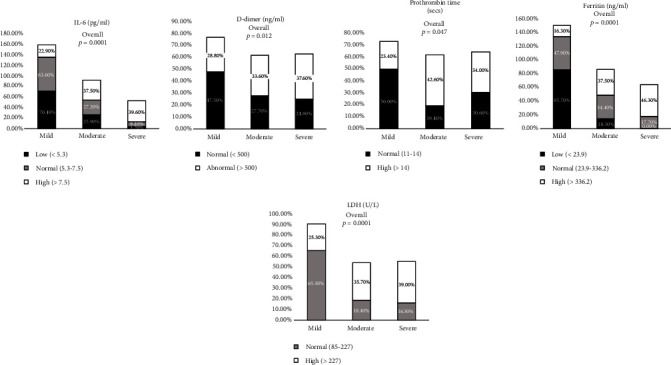
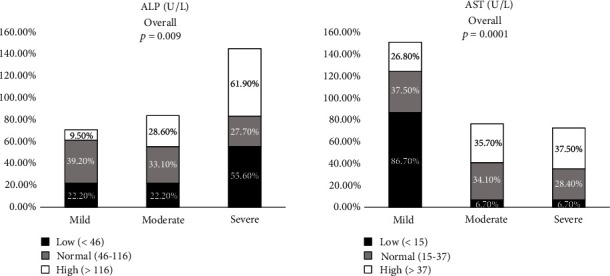
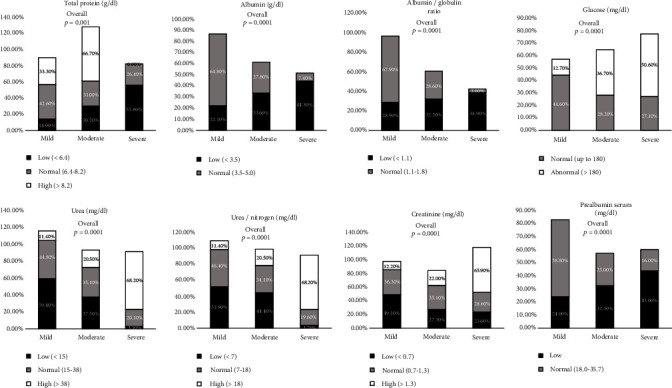
Among the 350 COVID-19 patients studied, there was a significant increase in the WBC count, neutrophils, aggregate index of systemic inflammation (AISI), neutrophil-to-lymphocyte ratio (dNLR), neutrophil-to-lymphocyte and platelet ratio (NLPR), monocyte-to-lymphocyte ratio (MLR), systemic immune-inflammation index (SII), systemic inflammation response index (SIRI), D-dimer, interleukin-6 (IL-6), ferritin, lactate dehydrogenase (LDH), prothrombin time (PT), glucose, urea, urea nitrogen, creatinine, alanine phosphatase (ALP), and aspartate aminotransferase (AST) and a significant decrease in lymphocytes, eosinophils, total protein, albumin, prealbumin serum, and albumin/globulin (A/G) ratio in the severe group when compared with the mild and moderate groups. However, after adjusting their age, gender, and comorbidities, WBC count (adjusted odds ratio (AOR) = 6.888, 95% CI = 1.590-29.839, = 0.010), neutrophils (AOR = 5.912, 95% CI = 2.131-16.402, = 0.001), and urea (AOR = 4.843, 95% CI = 1.988-11.755, = 0.001) were strongly associated with disease severity. . On admission, WBC count, neutrophils, and urea, with their cut of values, can identify at-risk COVID-19 patients who could develop severe COVID-19.
我们旨在确定 COVID-19 患者的临床和实验室检查结果的差异,以预测入院时疾病的严重程度和结局。
这项单中心回顾性研究从 350 名 COVID-19 患者的入院时的实验室和临床数据中提取数据,以频数表表示。使用多变量回归模型来评估解释变量与 COVID-19 感染结局之间的统计学显著关联,其中调整后的优势比(AOR)、P 值和 95%置信区间(CI)用于检验显著性。
在研究的 350 名 COVID-19 患者中,白细胞计数、中性粒细胞、全身炎症综合指数(AISI)、中性粒细胞与淋巴细胞比值(dNLR)、中性粒细胞与淋巴细胞和血小板比值(NLPR)、单核细胞与淋巴细胞比值(MLR)、系统免疫炎症指数(SII)、全身炎症反应指数(SIRI)、D-二聚体、白细胞介素-6(IL-6)、铁蛋白、乳酸脱氢酶(LDH)、凝血酶原时间(PT)、血糖、尿素、尿素氮、肌酐、丙氨酸氨基转移酶(ALP)和天门冬氨酸氨基转移酶(AST)显著增加,而淋巴细胞、嗜酸性粒细胞、总蛋白、白蛋白、血清前白蛋白和白蛋白/球蛋白(A/G)比值显著降低在重症组与轻症和中症组相比。然而,在调整了年龄、性别和合并症后,白细胞计数(调整后的优势比(AOR)=6.888,95%置信区间(CI)=1.590-29.839,P=0.010)、中性粒细胞(AOR=5.912,95%CI=2.131-16.402,P=0.001)和尿素(AOR=4.843,95%CI=1.988-11.755,P=0.001)与疾病严重程度强烈相关。入院时,白细胞计数、中性粒细胞和尿素,其截断值,可以识别可能发展为重症 COVID-19 的高危 COVID-19 患者。