Department of Gastroenterology and Hepatology.
Department of Immunology.
JCI Insight. 2023 May 8;8(9):e167402. doi: 10.1172/jci.insight.167402.
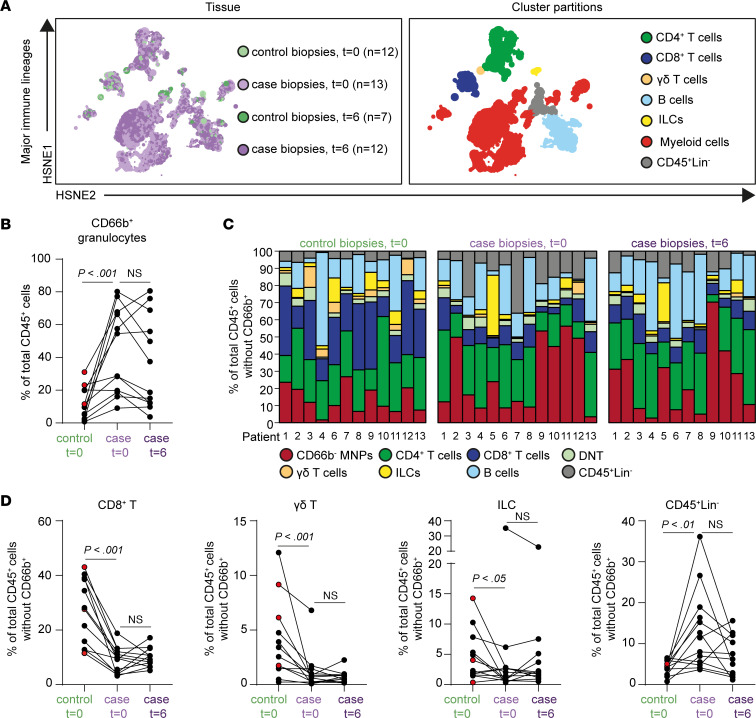
BACKGROUNDDue to their immunoregulatory and tissue regenerative features, mesenchymal stromal cells (MSCs) are a promising novel tool for the management of ulcerative proctitis (UP). Here we report on a phase IIa clinical study that evaluated the impact of local MSC therapy on UP.METHODSThirteen refractory UP patients, with an endoscopic Mayo score (EMS) of 2 or 3, were included. Seven patients received 20-40 million allogeneic MSCs (cohort 1), while 6 patients received 40-80 million MSCs (cohort 2). Adverse events (AEs) were assessed at baseline and on weeks 2, 6, 12, and 24. Clinical, endoscopic, and biochemical parameters were assessed at baseline and on weeks 2 and 6. Furthermore, we evaluated the engraftment of MSCs, the presence of donor-specific human leukocyte antigen (HLA) antibodies (DSAs), and we determined the impact of MSC therapy on the local immune compartment.RESULTSNo serious AEs were observed. The clinical Mayo score was significantly improved on weeks 2 and 6, and the EMS was significantly improved on week 6, compared with baseline. On week 6, donor MSCs were still detectable in rectal biopsies from 4 of 9 patients and DSAs against both HLA class I and class II were found. Mass cytometry showed a reduction in activated CD8+ T cells and CD16+ monocytes and an enrichment in mononuclear phagocytes and natural killer cells in biopsies after local MSC therapy.CONCLUSIONLocal administration of allogeneic MSCs is safe, tolerable, and feasible for treatment of refractory UP and shows encouraging signs of clinical efficacy and modulation of local immune responses. This sets the stage for larger clinical trials.TRIAL REGISTRATIONEU Clinical Trials Register (EudraCT, 2017-003524-75) and the Dutch Trial Register (NTR7205).FUNDINGECCO grant 2020.
由于间充质基质细胞(MSCs)具有免疫调节和组织再生的特性,因此它们是治疗溃疡性直肠炎(UP)的一种很有前途的新型工具。在这里,我们报告了一项评估局部 MSC 治疗对 UP 影响的 IIa 期临床试验。
共纳入 13 例难治性 UP 患者,内镜 Mayo 评分(EMS)为 2 或 3。其中 7 例患者接受 20-4000 万同种异体 MSC(队列 1)治疗,6 例患者接受 40-8000 万 MSC(队列 2)治疗。在基线和第 2、6、12 和 24 周评估不良事件(AE)。在基线和第 2 和 6 周评估临床、内镜和生化参数。此外,我们评估了 MSC 的植入情况、供体特异性人类白细胞抗原(HLA)抗体(DSA)的存在,并确定了 MSC 治疗对局部免疫区室的影响。
未观察到严重的 AE。与基线相比,第 2 和 6 周时临床 Mayo 评分显著改善,第 6 周时 EMS 显著改善。第 6 周时,9 例患者中有 4 例直肠活检中仍可检测到供体 MSC,且针对 HLA Ⅰ类和Ⅱ类均发现了 DSA。质谱细胞术显示,局部 MSC 治疗后,活检中激活的 CD8+T 细胞和 CD16+单核细胞减少,单核吞噬细胞和自然杀伤细胞增多。
局部给予同种异体 MSC 治疗难治性 UP 安全、耐受且可行,并显示出令人鼓舞的临床疗效和局部免疫反应调节迹象。这为更大规模的临床试验奠定了基础。
欧盟临床试验注册中心(EudraCT,2017-003524-75)和荷兰试验注册中心(NTR7205)。
欧洲克罗恩病和结肠炎组织 2020 年拨款。