Medical Systems Biophysics and Bioengineering, Leiden Academic Centre for Drug Research, Leiden University, Leiden, The Netherlands.
Department of Infectious Diseases, Leiden University Medical Center, Leiden, The Netherlands.
J Mol Med (Berl). 2023 May;101(5):557-568. doi: 10.1007/s00109-023-02309-4. Epub 2023 Mar 24.
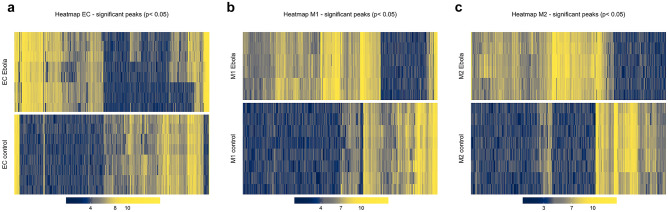
Ebola virus can trigger a release of pro-inflammatory cytokines with subsequent vascular leakage and impairment of clotting finally leading to multiorgan failure and shock after entering and infecting patients. Ebola virus is known to directly target endothelial cells and macrophages, even without infecting them, through direct interactions with viral proteins. These interactions affect cellular mechanics and immune processes, which are tightly linked to other key cellular functions such as metabolism. However, research regarding metabolic activity of these cells upon viral exposure remains limited, hampering our understanding of its pathophysiology and progression. Therefore, in the present study, an untargeted cellular metabolomic approach was performed to investigate the metabolic alterations of primary human endothelial cells and M1 and M2 macrophages upon exposure to Ebola virus-like particles (VLP). The results show that Ebola VLP led to metabolic changes among endothelial, M1, and M2 cells. Differential metabolite abundance and perturbed signaling pathway analysis further identified specific metabolic features, mainly in fatty acid-, steroid-, and amino acid-related metabolism pathways for all the three cell types, in a host cell specific manner. Taken together, this work characterized for the first time the metabolic alternations of endothelial cells and two primary human macrophage subtypes after Ebola VLP exposure, and identified the potential metabolites and pathways differentially affected, highlighting the important role of those host cells in disease development and progression. KEY MESSAGES: • Ebola VLP can lead to metabolic alternations in endothelial cells and M1 and M2 macrophages. • Differential abundance of metabolites, mainly including fatty acids and sterol lipids, was observed after Ebola VLP exposure. • Multiple fatty acid-, steroid-, and amino acid-related metabolism pathways were observed perturbed.
埃博拉病毒进入并感染患者后,可引发促炎细胞因子释放,继而导致血管渗漏和凝血功能障碍,最终导致多器官衰竭和休克。已知埃博拉病毒可通过与病毒蛋白的直接相互作用,直接靶向内皮细胞和巨噬细胞,即使不感染它们也是如此。这些相互作用会影响细胞力学和免疫过程,而这些过程与其他关键细胞功能(如代谢)紧密相关。然而,关于这些细胞在病毒暴露后的代谢活性的研究仍然有限,这阻碍了我们对其病理生理学和进展的理解。因此,在本研究中,采用无靶向细胞代谢组学方法,研究了埃博拉病毒样颗粒(VLP)暴露后原代人内皮细胞和 M1 型和 M2 型巨噬细胞的代谢变化。结果表明,埃博拉 VLP 导致内皮细胞、M1 型和 M2 型细胞的代谢发生变化。差异代谢物丰度和受扰信号通路分析进一步确定了特定的代谢特征,主要是在所有三种细胞类型中与脂肪酸、类固醇和氨基酸相关的代谢途径中,以宿主细胞特异性的方式。总之,这项工作首次描述了埃博拉 VLP 暴露后内皮细胞和两种原代人巨噬细胞亚型的代谢变化,并确定了受差异影响的潜在代谢物和途径,突出了这些宿主细胞在疾病发展和进展中的重要作用。关键信息:
• 埃博拉 VLP 可导致内皮细胞和 M1 型和 M2 型巨噬细胞发生代谢改变。
• 埃博拉 VLP 暴露后观察到代谢物丰度的差异,主要包括脂肪酸和固醇脂质。
• 观察到多个与脂肪酸、类固醇和氨基酸相关的代谢途径受到干扰。