Department of Internal Medicine, Kyung Hee University Hospital, Seoul, Korea.
Department of Digital Health, SAIHST, Sungkyunkwan University, Seoul, Korea.
Sci Rep. 2023 Mar 23;13(1):4724. doi: 10.1038/s41598-023-31686-6.
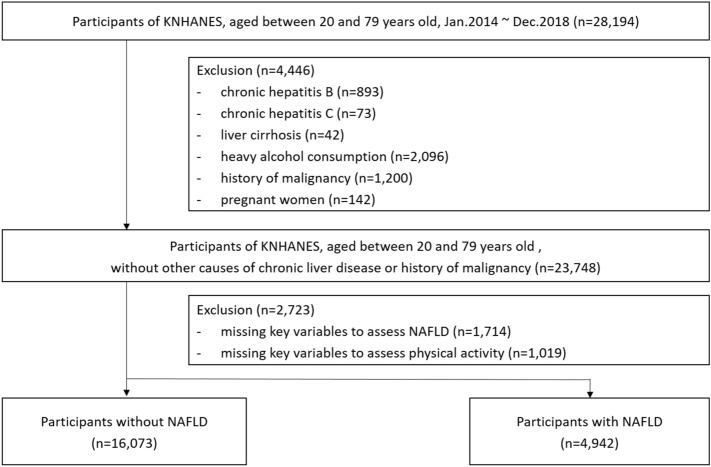
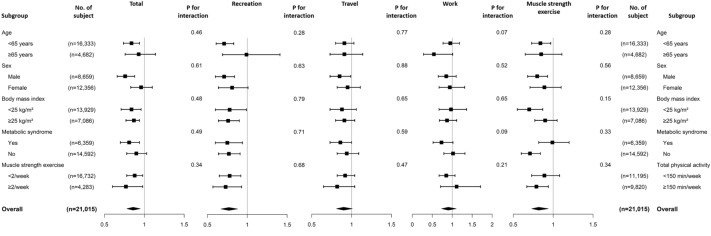
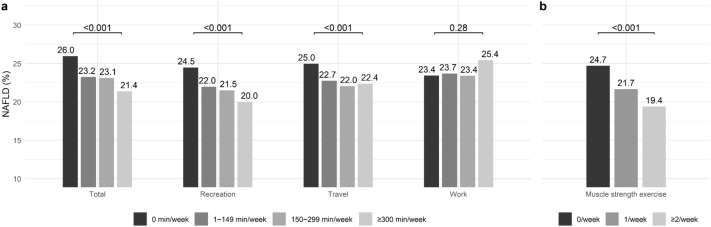
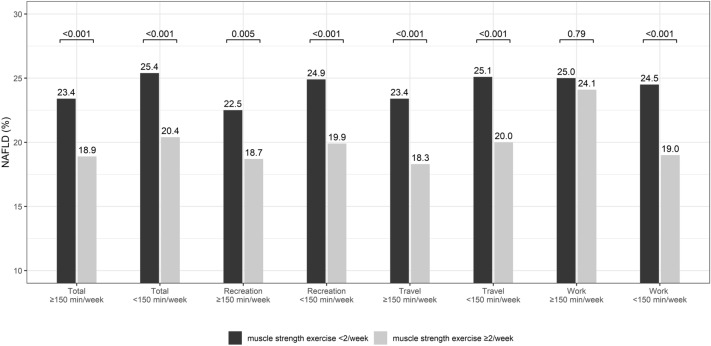
It is unclear if various types and domains of exercise have an identical effect on non-alcoholic fatty liver disease (NAFLD). Thus, this study aimed to investigate associations of different physical activity domains and muscle strength exercise with NAFLD using a nation-wide cohort database. Adults aged 20-79 years who participated in the Korean National Health and Nutrition Examination Survey between 2014 and 2018 were analyzed. Hepatic steatosis index was used to identify NAFLD. Physical activity was assessed with the Global Physical Activity Questionnaire. Of 21,015 participants, 4942 (23.5%) had NAFLD. Participants with ≥ 150 min/week of total physical activity had a lower risk of NAFLD than those with < 150 min/week (the fully adjusted OR: 0.86, 95% CI 0.78-0.95). When the individual domain of physical activity was assessed, ≥ 150 min/week of recreation activity was associated with a reduced risk of NAFLD (OR: 0.77, 95% CI 0.67-0.88), whereas ≥ 150 min/week of travel or work activity was not. The fully adjusted OR for NAFLD comparing participants with ≥ 2/week to those with < 2/week of muscle strength exercise was 0.83 (95% CI 0.73-0.94). Muscle strength exercise ≥ 2/week showed a lower risk of NAFLD for all levels of total and each specific domains of physical activity except for ≥ 150 min/week of work activity. An increased level of physical activity and muscle strength exercise was associated with a reduced risk of NAFLD, albeit the effect varied depending on domains of physical activity. Thus, physical activity should be differentiated by domains for the management of NAFLD. Muscle strength exercise could also be a good option for individuals who could not perform moderate-to-vigorous physical activity.
目前尚不清楚不同类型和领域的运动对非酒精性脂肪性肝病(NAFLD)是否有相同的影响。因此,本研究旨在使用全国性队列数据库调查不同身体活动领域和肌肉力量锻炼与 NAFLD 的相关性。分析了 2014 年至 2018 年参加韩国国家健康和营养检查调查的 20-79 岁成年人。使用肝脂肪变性指数来确定 NAFLD。身体活动通过全球身体活动问卷进行评估。在 21015 名参与者中,有 4942 名(23.5%)患有 NAFLD。每周进行≥150 分钟的总身体活动的参与者患 NAFLD 的风险低于每周进行<150 分钟的参与者(完全调整后的 OR:0.86,95%CI 0.78-0.95)。当评估身体活动的个体领域时,每周进行≥150 分钟的娱乐活动与降低患 NAFLD 的风险相关(OR:0.77,95%CI 0.67-0.88),而每周进行≥150 分钟的旅行或工作活动则没有。与每周进行<2 次肌肉力量锻炼的参与者相比,每周进行≥2 次肌肉力量锻炼的参与者患 NAFLD 的完全调整后 OR 为 0.83(95%CI 0.73-0.94)。每周进行≥2 次的肌肉力量锻炼与所有水平的总身体活动和每个特定身体活动领域(除了每周进行≥150 分钟的工作活动)都与降低 NAFLD 风险相关。身体活动和肌肉力量锻炼水平的增加与 NAFLD 风险的降低相关,尽管效果因身体活动的领域而异。因此,身体活动应该根据领域进行区分,以管理 NAFLD。对于无法进行中等至剧烈身体活动的个体,肌肉力量锻炼也可能是一个不错的选择。