Lutz Jennifer, Levenbrown Yosef, Hossain Md Jobayer, Hesek Anne, Massa Kelly E, Keith James P, Shaffer Thomas H
Division of Pediatric Critical Care, Nemours Children's Health, 1600 Rockland Road, Wilmington, DE, 19803, USA.
Department of Pediatrics, Sidney Kimmel Medical School of Thomas Jefferson University, Philadelphia, PA, USA.
Intensive Care Med Exp. 2023 Mar 24;11(1):13. doi: 10.1186/s40635-023-00497-4.
The effect of intravenous fluid (IVF) administration during cardiopulmonary resuscitation (CPR) is an unexplored factor that may improve cardiac output (CO) during CPR. The aim of this study was to determine the effect of IVF administration on CO and oxygenation during CPR.
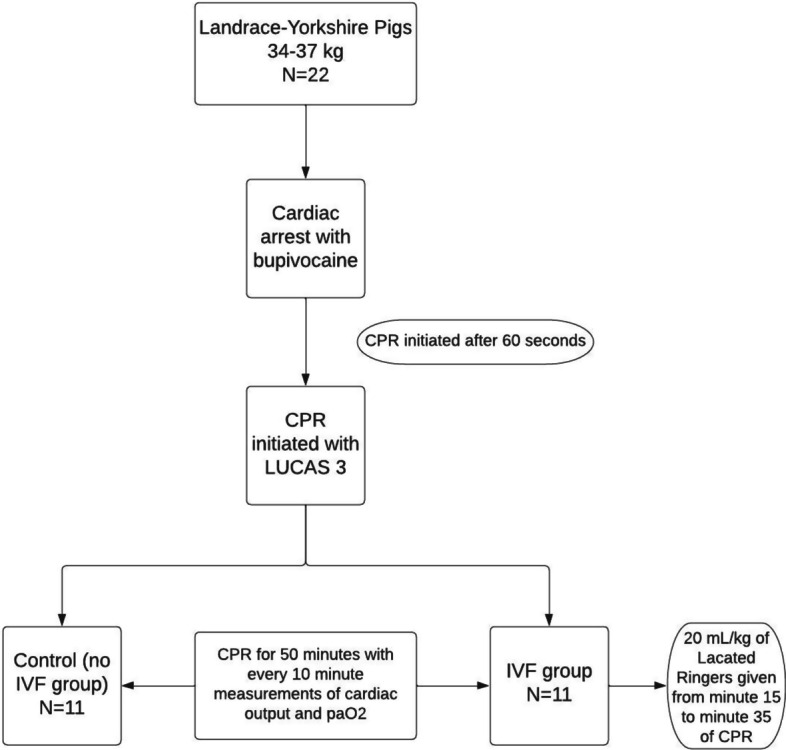
This experimental animal study was performed in a critical care animal laboratory. Twenty-two Landrace-Yorkshire female piglets weighing 27-37 kg were anesthetized, intubated, and placed on positive pressure ventilation. Irreversible cardiac arrest was induced with bupivacaine. CPR was performed with a LUCAS 3 mechanical compression device. Pigs were randomized into IVF or no-IVF groups. Pigs in the IVF group were given 20 mL/kg of Plasma-Lyte (Baxter International, Deerfield, IL USA), infused from 15 to 35 min of CPR. CPR was maintained for 50 min with serial measurements of CO obtained using ultrasound dilution technology and partial pressure of oxygen (PaO).
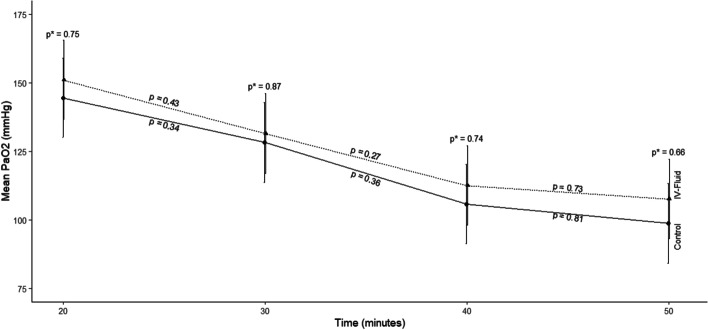
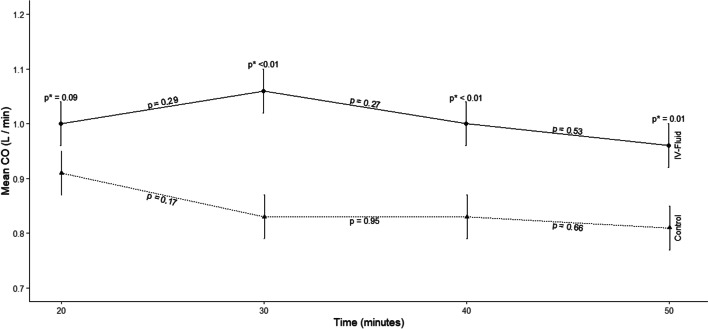
A mixed-effects repeated measures analysis of variance was used to compare within-group, and between-group mean changes in CO and PaO over time. CO and PaO for the piglets were measured at 10-min intervals during the 50 min of CPR. CO was greater in the IVF compared with the control group at all time points during and after the infusion of the IVF. Mean PaO decreased with time; however, at no time was there a significant difference in PaO between the IVF and control groups.
Administration of IVF during CPR resulted in a significant increase in CO during CPR both during and after the IVF infusion. There was no statistically significant decrease in PaO between the IVF and control groups.
在心肺复苏(CPR)期间给予静脉输液(IVF)的效果是一个尚未探索的因素,可能会改善CPR期间的心输出量(CO)。本研究的目的是确定IVF给药对CPR期间CO和氧合的影响。
本实验动物研究在重症监护动物实验室进行。22只体重27 - 37千克的长白-约克夏雌性仔猪被麻醉、插管并置于正压通气下。用布比卡因诱导不可逆性心脏骤停。使用LUCAS 3机械按压装置进行CPR。将猪随机分为IVF组或非IVF组。IVF组的猪在CPR的15至35分钟内给予20毫升/千克的平衡液(百特国际公司,美国伊利诺伊州迪尔菲尔德)。使用超声稀释技术和氧分压(PaO)连续测量CO,将CPR维持50分钟。
采用混合效应重复测量方差分析来比较组内以及组间CO和PaO随时间的平均变化。在CPR的50分钟内,每隔10分钟测量仔猪的CO和PaO。在输注IVF期间及之后的所有时间点,IVF组的CO均高于对照组。平均PaO随时间下降;然而,IVF组和对照组之间的PaO在任何时候均无显著差异。
在CPR期间给予IVF导致在IVF输注期间及之后CPR期间的CO显著增加。IVF组和对照组之间的PaO没有统计学上的显著下降。