Johnson Elliott Aidan, Johnson Matthew Thomas, Kypridemos Christodoulos, Villadsen Aase, Pickett Kate E
Northumbria University, Newcastle Upon Tyne, UK.
Social Work, Education and Community Wellbeing, Northumbria University, Newcastle upon Tyne, United Kingdom.
Pilot Feasibility Stud. 2023 Mar 23;9(1):51. doi: 10.1186/s40814-023-01276-4.
In the context of the COVID-19 pandemic, upstream interventions that tackle social determinants of health inequalities have never been more important. Evaluations of upstream cash transfer trials have failed to capture comprehensively the impacts that such systems might have on population health through inadequate design of the interventions themselves and failure to implement consistent, thorough research measures that can be used in microsimulations to model long-term impact. In this article, we describe the process of developing a generic, adaptive protocol resource to address this issue and the challenges involved in that process. The resource is designed for use in high-income countries (HIC) but draws on examples from a UK context to illustrate means of development and deployment. The resource is capable of further adaptation for use in low- and middle-income countries (LMIC). It has particular application for trials of Universal Basic Income but can be adapted to those covering other kinds of cash transfer and welfare system changes.
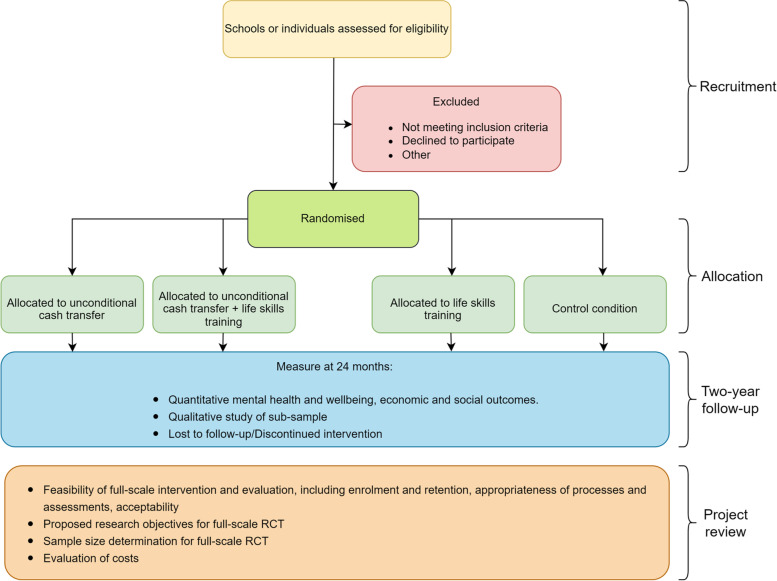
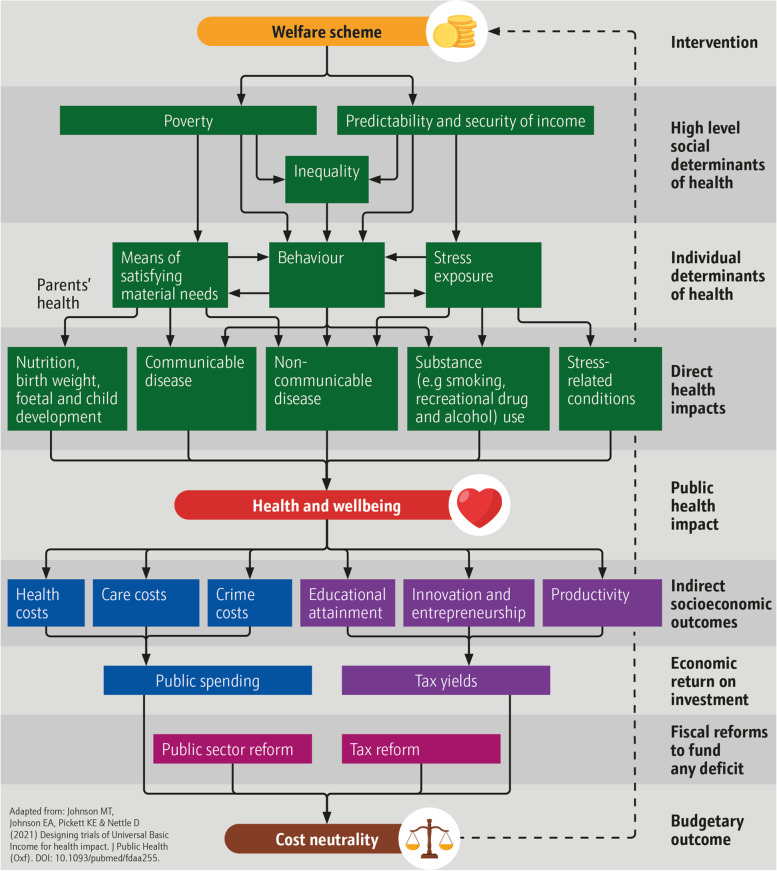
We outline two types of prospective intervention based on pilots and trials currently under discussion. In developing the remainder of the resource, we establish six key principles, implement a modular approach based on types of measure and their prospective resource intensity, and source (validated where possible) measures and baseline data primarily from routine collection and large, longitudinal cohort studies. Through these measures, we seek to cover all areas of health impact identified in our theoretical model for use in pilot and feasibility studies.
We find that, in general, self-reported measures alongside routinely collected linked respondent data may provide a feasible means of producing data capable of demonstrating comprehensive health impact. However, we also suggest that, where possible, physiological measures should be included to elucidate underlying biological effects that may not be accurately captured through self-reporting alone and can enable modelling of long-term health outcomes. In addition, accurate self-reported objective income data remains a challenge and requires further development and testing. A process of development and implementation of the resource in pilot and feasibility studies will support assessment of whether or not our proposed health outcome measures are acceptable, feasible and can be used with validity and reliability in the target population.
We suggest that while Open Access evaluation instruments are available and usable to measure most constructs of interest, there remain some areas for which further development is necessary. This includes self-reported wellbeing measures that require paid licences but are used in a range of nationally important longitudinal studies instead of Open Access alternatives.
在新冠疫情背景下,应对健康不平等的社会决定因素的上游干预措施从未像现在这样重要。对上游现金转移试验的评估未能全面捕捉此类系统可能对人群健康产生的影响,原因在于干预措施本身设计不当,且未能实施可用于微观模拟以建模长期影响的一致、全面的研究措施。在本文中,我们描述了开发一种通用的、适应性方案资源以解决这一问题的过程以及该过程中涉及的挑战。该资源专为高收入国家(HIC)设计,但借鉴了英国的实例来说明开发和部署方法。该资源能够进一步改编以用于低收入和中等收入国家(LMIC)。它特别适用于普遍基本收入试验,但也可改编用于涵盖其他类型现金转移和福利制度变化的试验。
我们概述了基于目前正在讨论的试点和试验的两种前瞻性干预类型。在开发该资源的其余部分时,我们确立了六项关键原则,基于测量类型及其预期资源强度实施模块化方法,并主要从常规收集以及大型纵向队列研究中获取(尽可能经过验证的)测量方法和基线数据。通过这些措施,我们力求涵盖我们理论模型中确定的、用于试点和可行性研究的健康影响的所有领域。
我们发现,一般而言,自我报告的测量方法以及常规收集的关联受访者数据可能提供一种可行的方法来生成能够证明全面健康影响的数据。然而,我们也建议,在可能的情况下,应纳入生理测量方法,以阐明仅通过自我报告可能无法准确捕捉的潜在生物学效应,并能够对长期健康结果进行建模。此外,准确的自我报告客观收入数据仍然是一个挑战,需要进一步开发和测试。在试点和可行性研究中开发和实施该资源的过程将支持评估我们提议的健康结果测量方法在目标人群中是否可接受、可行,以及是否能够有效且可靠地使用。
我们认为,虽然有开放获取的评估工具可用于测量大多数感兴趣的构念,但仍有一些领域需要进一步开发。这包括需要付费许可的自我报告幸福感测量方法,这些方法在一系列具有国家重要性的纵向研究中使用,而非开放获取的替代方法。