• 文献检索
  • 文档翻译
  • 深度研究
  • 学术资讯
  • Suppr Zotero 插件Zotero 插件
  • 邀请有礼
  • 套餐&价格
  • 历史记录
应用&插件
Suppr Zotero 插件Zotero 插件浏览器插件Mac 客户端Windows 客户端微信小程序
定价
高级版会员购买积分包购买API积分包
服务
文献检索文档翻译深度研究API 文档MCP 服务
关于我们
关于 Suppr公司介绍联系我们用户协议隐私条款
关注我们

Suppr 超能文献

核心技术专利:CN118964589B侵权必究
粤ICP备2023148730 号-1Suppr @ 2026

文献检索

告别复杂PubMed语法,用中文像聊天一样搜索,搜遍4000万医学文献。AI智能推荐,让科研检索更轻松。

立即免费搜索

文件翻译

保留排版,准确专业,支持PDF/Word/PPT等文件格式,支持 12+语言互译。

免费翻译文档

深度研究

AI帮你快速写综述,25分钟生成高质量综述,智能提取关键信息,辅助科研写作。

立即免费体验

学术性不孕症诊疗机构中育龄女性使用草药补充剂的情况。

Herbal supplement use among reproductive-aged women in an academic infertility practice.

作者信息

Friedman Julie, Sheeder Jeanelle, Lazorwitz Aaron, Polotsky Alex Joel

机构信息

Department of Obstetrics and Gynecology, University of Colorado, Aurora, Colorado.

Shady Grove Fertility, Greenwood Village, Colorado.

出版信息

F S Rep. 2022 Dec 17;4(1):104-111. doi: 10.1016/j.xfre.2022.12.001. eCollection 2023 Mar.

DOI:10.1016/j.xfre.2022.12.001
PMID:36959959
原文链接:https://pmc.ncbi.nlm.nih.gov/articles/PMC10028423/
Abstract

OBJECTIVE

To address the knowledge gap surrounding herbal medicine and supplement usage patterns and supplement-prescription medication interactions among patients seeking treatment for infertility.

DESIGN

Cross-sectional survey study.

SETTING

Academic infertility practice.

PATIENTS

Ninety-five reproductive-aged patients.

INTERVENTIONS

Not applicable.

MAIN OUTCOME MEASURES

Use of herbal medications and supplements, baseline demographics, history of infertility treatments, and potential supplement-medication interactions.

RESULTS

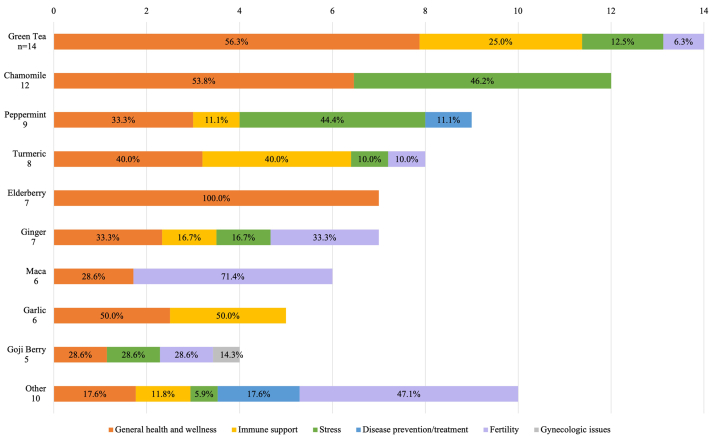
We surveyed 95 participants with a median age of 35 years. Overall, 68.4% of patients reported ever having used supplements or herbal medicines in the past. Current use of herbal supplements and vitamins was reported by 53.7% and 93.7% of participants, respectively, with a median of 2 (range 19) supplements used per person. There were no significant associations between patient demographics, comorbidities, or infertility treatments with increased rates of supplement use. The most commonly used herbal supplements were: green tea (n = 14), chamomile (n = 12), peppermint (n = 9), turmeric (n = 8), elderberry (n = 7), ginger (n = 7), maca (6) with the most common modalities being pills/capsules (23.8%) and tea (42.3%). The most common reasons for use were: general health and wellness (24.5%), immune support (16.2%), stress (14.0%), and fertility (15.0%). Patients used maca (n = 5), chasteberry (n = 3), goji berry (n = 2), ginger (n = 2), yam-based progesterone (n = 2), and combination product (n = 2) for fertility purposes. A total of 7.9% of patients learned about these products from their general health care provider, and 33.3% of supplements were disclosed by patients to their provider. We identified 41 moderate-risk supplement-drug interactions, with 12 of these interactions attributed to infertility therapies. Based on the interaction checker, the most commonly proposed mechanisms of interaction were CYP3A4 and CYP2C19 inhibition. In terms of safety in pregnancy, cannabidiol and chasteberry were suggested to be "possibly unsafe in pregnancy," and red raspberry leaf "likely unsafe in pregnancy" without direct medical supervision.

CONCLUSIONS

We found over two thirds of women seeking treatment for infertility reported past and over half reported current herbal medicine and supplement use. Notably, the Natural Medicines Interaction Checker suggested high rates of moderate-risk supplement-drug interactions and possible harmful effects in early pregnancy. Our results call for further investigation of clinically relevant supplement interactions with infertility therapies.

摘要

目的

填补寻求不孕症治疗的患者在草药和补充剂使用模式以及补充剂与处方药相互作用方面的知识空白。

设计

横断面调查研究。

地点

学术性不孕症诊疗机构。

患者

95名育龄患者。

干预措施

不适用。

主要观察指标

草药和补充剂的使用情况、基线人口统计学特征、不孕症治疗史以及潜在的补充剂与药物相互作用。

结果

我们对95名参与者进行了调查,他们的中位年龄为35岁。总体而言,68.4%的患者报告过去曾使用过补充剂或草药。分别有53.7%和93.7%的参与者报告目前正在使用草药补充剂和维生素,每人使用补充剂的中位数为2种(范围为1至19种)。患者的人口统计学特征、合并症或不孕症治疗与补充剂使用率的增加之间没有显著关联。最常用的草药补充剂有:绿茶(n = 14)、洋甘菊(n = 12)、薄荷(n = 9)、姜黄(n = 8)、接骨木果(n = 7)、生姜(n = 7)、玛咖(n = 6),最常见的剂型是药丸/胶囊(23.8%)和茶(42.3%)。使用的最常见原因是:一般健康和保健(24.5%)、免疫支持(16.2%)、压力(14.0%)和生育(15.0%)。患者出于生育目的使用玛咖(n = 5)、贞节果(n = 3)、枸杞(n = 2)、生姜(n = 2)、山药孕酮(n = 2)和复方产品(n = 2)。共有7.9%的患者从他们的普通医疗保健提供者那里了解到这些产品,33.3%的补充剂是患者向他们的提供者披露的。我们确定了41种中度风险的补充剂与药物相互作用,其中12种相互作用归因于不孕症治疗。根据相互作用检查器,最常见的相互作用机制是CYP3A4和CYP2C19抑制。在妊娠安全性方面,大麻二酚和贞节果被认为“孕期可能不安全”,而红树莓叶“在无直接医疗监督的情况下孕期可能不安全”。

结论

我们发现超过三分之二寻求不孕症治疗的女性报告过去使用过,超过一半报告目前正在使用草药和补充剂。值得注意的是,天然药物相互作用检查器提示中度风险的补充剂与药物相互作用发生率较高,且在怀孕早期可能产生有害影响。我们的结果呼吁进一步研究与不孕症治疗相关的临床相关补充剂相互作用。
https://cdn.ncbi.nlm.nih.gov/pmc/blobs/09a7/10028423/be3f50df9471/gr1.jpg

相似文献

1
Herbal supplement use among reproductive-aged women in an academic infertility practice.学术性不孕症诊疗机构中育龄女性使用草药补充剂的情况。
F S Rep. 2022 Dec 17;4(1):104-111. doi: 10.1016/j.xfre.2022.12.001. eCollection 2023 Mar.
2
Herbal Supplement Use Among Adolescent and Young Adult Women in a Family Planning Clinic.草药补充剂在计划生育诊所中青少年和年轻成年女性中的使用情况。
J Pediatr Adolesc Gynecol. 2024 Jun;37(3):323-329. doi: 10.1016/j.jpag.2023.11.012. Epub 2023 Dec 6.
3
Prevalence of polypharmacy, polyherbacy, nutritional supplement use and potential product interactions among older adults living on the United States-Mexico border: a descriptive, questionnaire-based study.美国-墨西哥边境地区老年人多重用药、多种草药使用、营养补充剂使用情况及潜在产品相互作用的患病率:一项基于问卷调查的描述性研究。
Drugs Aging. 2009;26(5):423-36. doi: 10.2165/00002512-200926050-00006.
4
Folic acid supplementation and malaria susceptibility and severity among people taking antifolate antimalarial drugs in endemic areas.在流行地区,服用抗叶酸抗疟药物的人群中,叶酸补充剂与疟疾易感性和严重程度的关系。
Cochrane Database Syst Rev. 2022 Feb 1;2(2022):CD014217. doi: 10.1002/14651858.CD014217.
5
Identification and evaluation of drug-supplement interactions in Hungarian hospital patients.识别和评估匈牙利住院患者的药物-保健品相互作用。
Int J Clin Pharm. 2014 Apr;36(2):451-9. doi: 10.1007/s11096-014-9923-z. Epub 2014 Feb 23.
6
Demographics, health literacy and health locus of control beliefs of Australian women who take complementary medicine products during pregnancy and breastfeeding: A cross-sectional, online, national survey.在孕期和哺乳期服用补充药物的澳大利亚女性的人口统计学特征、健康素养和健康控制信念:一项横断面、在线、全国性调查。
Health Expect. 2022 Apr;25(2):667-683. doi: 10.1111/hex.13414. Epub 2021 Dec 23.
7
Herbal medicine use during pregnancy in a group of Australian women.一组澳大利亚女性孕期使用草药的情况。
BMC Pregnancy Childbirth. 2006 Jun 19;6:21. doi: 10.1186/1471-2393-6-21.
8
The use of herbal supplements and alternative therapies by patients with amyotrophic lateral sclerosis (ALS).肌萎缩侧索硬化症(ALS)患者对草药补充剂和替代疗法的使用。
J Herb Pharmacother. 2005;5(3):23-31.
9
Prevalence and Correlates of Herbal Medicine Use among Women Seeking Care for Infertility in Freetown, Sierra Leone.在塞拉利昂弗里敦寻求不孕症治疗的女性中使用草药的患病率及相关因素
Evid Based Complement Alternat Med. 2018 Apr 22;2018:9493807. doi: 10.1155/2018/9493807. eCollection 2018.
10
Use of herbal medicines by elderly patients: A systematic review.老年患者使用草药:一项系统综述。
Arch Gerontol Geriatr. 2014 Sep-Oct;59(2):227-33. doi: 10.1016/j.archger.2014.06.002. Epub 2014 Jul 9.

引用本文的文献

1
Neutral effect of Zishen Yutai Pill on frozen-thawed embryo transfer: a propensity score matching study.滋肾育胎丸对冻融胚胎移植结局无影响:一项倾向性评分匹配研究。
Front Endocrinol (Lausanne). 2024 Aug 29;15:1379590. doi: 10.3389/fendo.2024.1379590. eCollection 2024.
2
Mechanisms of intestinal pharmacokinetic natural product-drug interactions.肠道药代动力学天然产物-药物相互作用的机制。
Drug Metab Rev. 2024 Aug;56(3):285-301. doi: 10.1080/03602532.2024.2386597. Epub 2024 Aug 12.
3
Not All Maca Is Created Equal: A Review of Colors, Nutrition, Phytochemicals, and Clinical Uses.

本文引用的文献

1
Citalopram and Cannabidiol: In Vitro and In Vivo Evidence of Pharmacokinetic Interactions Relevant to the Treatment of Anxiety Disorders in Young People.西酞普兰和大麻二酚:与年轻人焦虑障碍治疗相关的药代动力学相互作用的体外和体内证据。
J Clin Psychopharmacol. 2021;41(5):525-533. doi: 10.1097/JCP.0000000000001427.
2
The Efficacy of Complementary and Alternative Medicine in the Treatment of Female Infertility.补充和替代医学在女性不孕症治疗中的疗效
Evid Based Complement Alternat Med. 2021 Apr 23;2021:6634309. doi: 10.1155/2021/6634309. eCollection 2021.
3
Dietary Supplement Use Among Adults: United States, 2017-2018.
并非所有的玛咖都一样:颜色、营养、植物化学成分和临床用途综述。
Nutrients. 2024 Feb 14;16(4):530. doi: 10.3390/nu16040530.
成年人的膳食补充剂使用情况:美国,2017-2018 年。
NCHS Data Brief. 2021 Feb(399):1-8.
4
Progesterone use in assisted reproductive technology.孕激素在辅助生殖技术中的应用。
Best Pract Res Clin Obstet Gynaecol. 2020 Nov;69:74-84. doi: 10.1016/j.bpobgyn.2020.05.005. Epub 2020 Jun 4.
5
Drug-drug interactions with cannabidiol (CBD) appear to have no effect on treatment response in an open-label Expanded Access Program.与大麻二酚 (CBD) 的药物相互作用似乎不会对开放标签扩大准入计划中的治疗反应产生影响。
Epilepsy Behav. 2019 Sep;98(Pt A):201-206. doi: 10.1016/j.yebeh.2019.07.008. Epub 2019 Aug 2.
6
The REDCap consortium: Building an international community of software platform partners.REDCap 联盟:构建软件平台合作伙伴的国际社区。
J Biomed Inform. 2019 Jul;95:103208. doi: 10.1016/j.jbi.2019.103208. Epub 2019 May 9.
7
Evidence of a clinically significant drug-drug interaction between cannabidiol and tacrolimus.有临床意义的药物相互作用的证据,大麻二酚和他克莫司之间。
Am J Transplant. 2019 Oct;19(10):2944-2948. doi: 10.1111/ajt.15398. Epub 2019 May 21.
8
Herbal fertility treatments used in North America from colonial times to 1900, and their potential for improving the success rate of assisted reproductive technology.从殖民时期到1900年北美使用的草药生育疗法及其提高辅助生殖技术成功率的潜力。
Reprod Biomed Soc Online. 2018 Apr 12;5:60-81. doi: 10.1016/j.rbms.2018.03.001. eCollection 2018 Apr.
9
Evidence for the use of complementary and alternative medicines during fertility treatment: a scoping review.生育治疗中补充和替代医学的应用证据:范围综述。
BMC Complement Altern Med. 2018 May 15;18(1):158. doi: 10.1186/s12906-018-2224-7.
10
Common Herbal Dietary Supplement-Drug Interactions.常见草药膳食补充剂与药物的相互作用。
Am Fam Physician. 2017 Jul 15;96(2):101-107.