Nakhuda Gary S, Li Ning, Yang Zheng, Kang Sylvia
Olive Fertility Centre, Vancouver, British Columbia, Canada.
Quanovate Tech, Inc., San Ramon, California.
F S Rep. 2023 Jan 28;4(1):43-48. doi: 10.1016/j.xfre.2023.01.006. eCollection 2023 Mar.
To investigate the feasibility of monitoring urine estrone-3-glucuronide (E3G) with an at-home device during gonadotropin stimulation for in vitro fertilization and oocyte cryopreservation.
Prospective, observational cohort study.
Private fertility clinic.
Thirty patients undergoing stimulation with a gonadotropin-releasing hormone antagonist protocol for in vitro fertilization or oocyte cryopreservation.
Daily collection of the first urine in the morning during stimulation and analysis performed at home by each patient with the Mira Fertility Tracker.
Primary outcomes were correlation of urine E3G and serum estradiol (E2) concentrations on the day of trigger to the number of total and metaphase 2 oocytes (MII). Secondary outcomes of interest were the correlation of matched E3G and E2 measurements and the daily trends of E3G and E2 during stimulation.
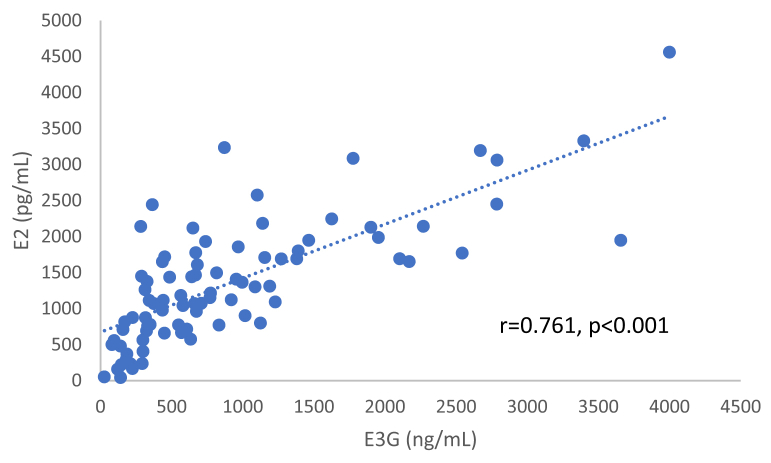
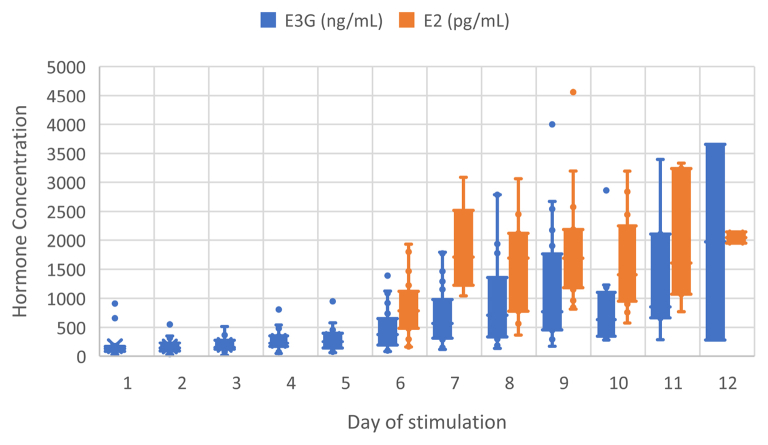
Both urine E3G and serum E2 concentrations on the day of trigger significantly correlated with retrieval outcomes to a similar extent, with E3G demonstrating slightly higher correlation to the number of MII oocytes than that demonstrated by E2 ( = 0.485 vs. 0.391, respectively). The Pearson correlation coefficient for matched E3G and E2 levels was 0.761. The correlation coefficients of determination for daily trends of E3G and E2 during stimulation were 0.7066 and 0.6102, respectively.
Measured on the day of trigger, urine E3G monitoring during gonadotropin stimulation was comparable with serum E2 for predicting oocyte retrieval outcomes. Matched daily samples confirmed good correlation of urine E3G and serum E2. The option of at-home estrogen monitoring with devices such as Mira offers an alternative to traditional serum monitoring that may improve patient experience.
NCT05493202.
探讨在体外受精和卵母细胞冷冻保存的促性腺激素刺激过程中,使用家用设备监测尿雌酮-3-葡萄糖醛酸苷(E3G)的可行性。
前瞻性观察性队列研究。
私立生育诊所。
30例接受促性腺激素释放激素拮抗剂方案刺激以进行体外受精或卵母细胞冷冻保存的患者。
在刺激期间每天早晨收集晨尿,每位患者使用Mira生育追踪器在家中进行分析。
主要结局是扳机日尿E3G和血清雌二醇(E2)浓度与总卵母细胞数和中期Ⅱ卵母细胞(MII)数的相关性。感兴趣的次要结局是匹配的E3G和E2测量值的相关性以及刺激期间E3G和E2的每日变化趋势。
扳机日尿E3G和血清E2浓度与取卵结局均有显著的相似程度的相关性,E3G与MII卵母细胞数的相关性略高于E2(分别为r = 0.485和0.391)。匹配的E3G和E2水平的Pearson相关系数为0.761。刺激期间E3G和E2每日变化趋势的决定系数分别为0.7066和0.6102。
在扳机日测量时,促性腺激素刺激期间的尿E3G监测在预测卵母细胞取卵结局方面与血清E2相当。每日匹配样本证实尿E3G和血清E2具有良好的相关性。使用Mira等设备进行家庭雌激素监测为传统血清监测提供了一种替代方法,可能会改善患者体验。
NCT05493202。