Kyu Kyu, Ko Tin Ko, Lwin Zin Mar, Soe May Kyi, Maw Kyaw Win, Thant Aung Myo, Shin Kyi, Kyaw Myint Moe
Internal Medicine, City Hospital, Mandalay, MMR.
Surgery, City Hospital, Mandalay, MMR.
Cureus. 2023 Feb 19;15(2):e35167. doi: 10.7759/cureus.35167. eCollection 2023 Feb.
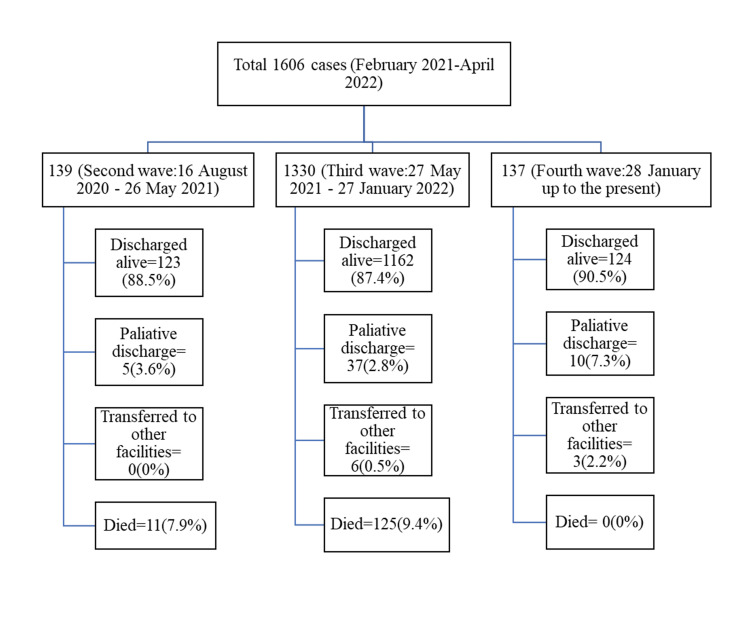
Introduction During the coronavirus disease 2019 (COVID-19) pandemic, private hospitals in Mandalay started to manage COVID-19 infections according to national treatment guidelines since February 2021. Variations of clinical characteristics and their outcomes in different surges could be evaluated in the private hospital. This study aimed to assess the clinical profile and outcomes of COVID-19 patients admitted at a private hospital during three surges in Mandalay. Methods This study is a retrospective record review of the case series of COVID-19 patients admitted at City Hospital, Mandalay. The study was conducted from January to December 2022. All of the hospital records of COVID-19 patients admitted during the second wave from February 2020 to 26 May 2021, the third wave from 27 May 2021 to 27 January 2022, and the fourth wave from 28 January to April 2022 were included in the study. Results A total of 1606 admitted cases were included in the study. The mean with standard deviation (SD) of age was 55.7±18.5, and males were 778 (48.4%). The mean duration of hospital stay in days was 10.8±5.94, 10.6±6.11, and 7.3±2.88 in second, third, and fourth waves, respectively. The mean duration of hospital stay was shortened in the fourth wave. Comorbid conditions with hypertension and/or diabetes diseases were mostly observed in three waves of COVID-19 infection. Fever was the most presented symptom in three waves. Cough, sore throat, and rhinorrhea were observed more in the fourth wave compared with previous waves. Complication with pneumonia (71.3%), liver dysfunction (21.0%), acute respiratory distress syndrome (10.0%), thrombocytopenia (6.2%), acute kidney injury (5.5%), bleeding (3.9%), and pulmonary embolism (2.9%) were investigated. Antiviral treatment such as remdesivir or molnupiravir was used more in the patients of third and fourth waves than those of the second wave. Oxygen therapy (59.9%), prone position (35.5%), non-invasive ventilation (9.5%), invasive ventilation (0.5%), inotropes (4.6%), and renal replacement therapy (1.1%) were recorded in serious cases. Only 7.9% and 9.4% died in the hospital in second and third waves. No mortality was observed in the fourth wave. Conclusions The study recommended that COVID-19 patients with comorbid conditions of hypertension or diabetes and ages 65 and older should be taken with intensive care support at the hospital. This study also concluded that a private hospital in Mandalay could tackle with COVID-19 severe cases in line with national treatment guidelines since the second wave and could provide better management in the fourth wave. Antiviral treatment should be used in severe COVID-19 cases for further emergency management. In conclusion, private hospital involvement in the COVID-19 pandemic is supportive of the healthcare provision in Myanmar in an emergency situation.
引言 在2019年冠状病毒病(COVID-19)大流行期间,曼德勒的私立医院自2021年2月起开始根据国家治疗指南管理COVID-19感染病例。私立医院可以评估不同疫情高峰期间临床特征及其结果的差异。本研究旨在评估曼德勒一家私立医院在三次疫情高峰期间收治的COVID-19患者的临床概况和结局。
方法 本研究是对曼德勒市立医院收治的COVID-19患者病例系列进行的回顾性记录审查。研究于2022年1月至12月进行。纳入了2020年2月至2021年5月26日第二波疫情、2021年5月27日至2022年1月27日第三波疫情以及2022年1月28日至4月第四波疫情期间收治的所有COVID-19患者的医院记录。
结果 本研究共纳入1606例收治病例。年龄的平均值及标准差为55.7±18.5岁,男性778例(48.4%)。第二波、第三波和第四波疫情期间患者的平均住院天数分别为10.8±5.94天、10.6±6.11天和7.3±2.88天。第四波疫情期间平均住院天数缩短。在三波COVID-19感染中,高血压和/或糖尿病等合并症最为常见。发热是三波疫情中最常见的症状。与前几波相比,第四波疫情中咳嗽、咽痛和流涕更为常见。对肺炎(71.3%)、肝功能障碍(21.0%)、急性呼吸窘迫综合征(10.0%)、血小板减少症(6.2%)、急性肾损伤(5.5%)、出血(3.9%)和肺栓塞(2.9%)等并发症进行了调查。与第二波疫情的患者相比,第三波和第四波疫情的患者更多地使用了瑞德西韦或莫努匹韦等抗病毒治疗。重症病例记录了氧疗(59.9%)、俯卧位(35.5%)、无创通气(9.5%)、有创通气(0.5%)、血管活性药物(4.6%)和肾脏替代治疗(1.1%)。第二波和第三波疫情期间医院死亡率分别仅为7.9%和9.4%。第四波疫情期间未观察到死亡病例。
结论 本研究建议,患有高血压或糖尿病合并症且年龄在65岁及以上的COVID-19患者应在医院接受重症监护支持。本研究还得出结论,曼德勒的一家私立医院自第二波疫情以来能够按照国家治疗指南应对COVID-19重症病例,并且在第四波疫情中能够提供更好的管理。对于重症COVID-19病例,应使用抗病毒治疗以进行进一步的紧急处理。总之,私立医院参与COVID-19大流行有助于缅甸在紧急情况下提供医疗服务。

