CARIM School for Cardiovascular Diseases, Maastricht University (UM), Maastricht, The Netherlands.
Department of Internal Medicine, Maastricht University Medical Center+, P. Debyelaan 25, P.O. Box 5800, 6202AZ, Maastricht, The Netherlands.
Cardiovasc Diabetol. 2023 Mar 24;22(1):67. doi: 10.1186/s12933-023-01783-x.
Microvascular dysfunction (MVD) is an important contributor to major clinical disease such as stroke, dementia, depression, retinopathy, and chronic kidney disease. Alcohol consumption may be a determinant of MVD.
Main objectives were (1) to study whether alcohol consumption was associated with MVD as assessed in the brain, retina, skin, kidney and in the blood; and (2) to investigate whether associations differed by history of cardiovascular disease or sex.
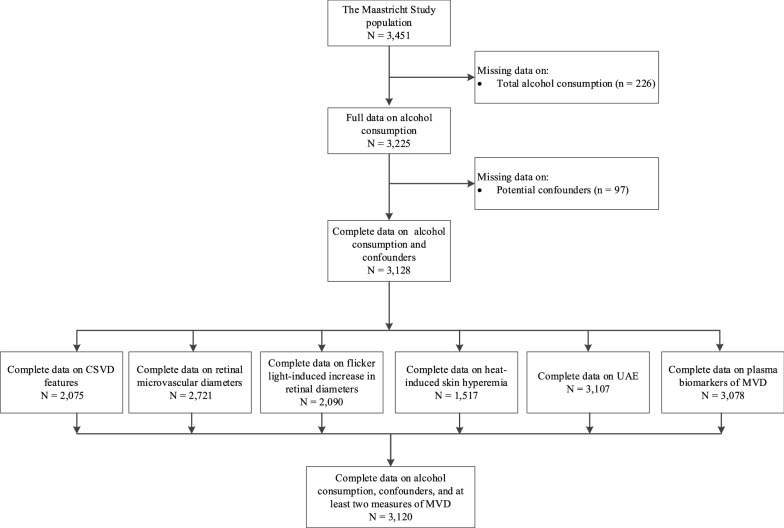
We used cross-sectional data from The Maastricht Study (N = 3,120 participants, 50.9% men, mean age 60 years, and 27.5% with type 2 diabetes [the latter oversampled by design]). We used regression analyses to study the association between total alcohol (per unit and in the categories, i.e. none, light, moderate, high) and MVD, where all measures of MVD were combined into a total MVD composite score (expressed in SD). We adjusted all associations for potential confounders; and tested for interaction by sex, and history of cardiovascular disease. Additionally we tested for interaction with glucose metabolism status.
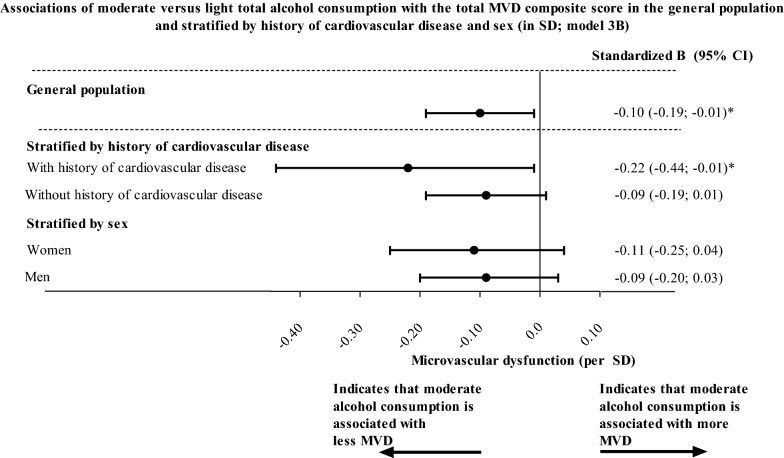
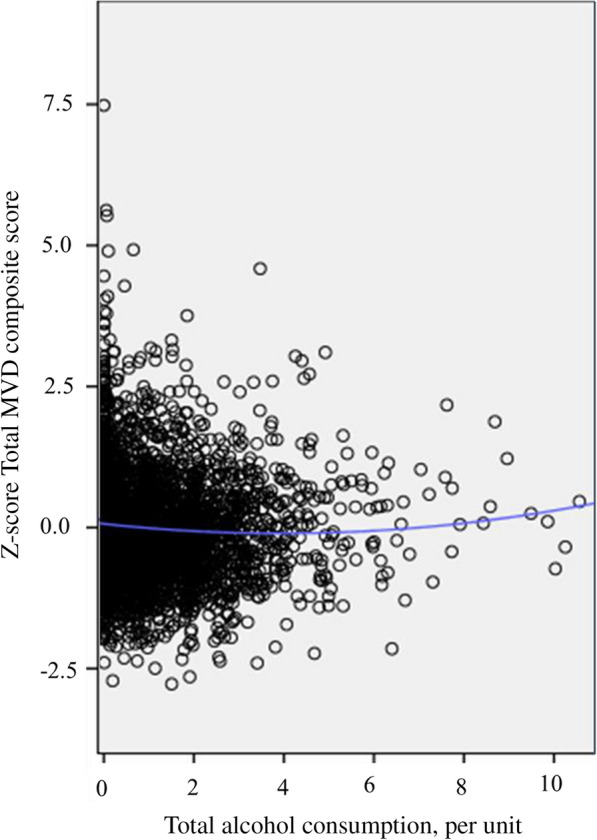
The association between total alcohol consumption and MVD was non-linear, i.e. J-shaped. Moderate versus light total alcohol consumption was significantly associated with less MVD, after full adjustment (beta [95% confidence interval], -0.10 [-0.19; -0.01]). The shape of the curve differed with sex (P = 0.03), history of cardiovascular disease (P < 0.001), and glucose metabolism status (P = 0.02).
The present cross-sectional, population-based study found evidence that alcohol consumption may have an effect on MVD. Hence, although increasing alcohol consumption cannot be recommended as a policy, this study suggests that prevention of MVD may be possible through dietary interventions.
微血管功能障碍(MVD)是导致中风、痴呆、抑郁、视网膜病变和慢性肾脏病等主要临床疾病的重要因素。饮酒可能是 MVD 的决定因素。
主要目的是(1)研究饮酒与大脑、视网膜、皮肤、肾脏和血液中的 MVD 评估之间的关系;(2)探讨这些关联是否因心血管疾病史或性别而异。
我们使用马斯特里赫特研究(Maastricht Study)的横断面数据(N=3120 名参与者,50.9%为男性,平均年龄 60 岁,27.5%患有 2 型糖尿病[后者通过设计进行了超额抽样])。我们使用回归分析来研究总酒精(每单位和类别,即无、轻、中、高)与 MVD 之间的关系,其中所有 MVD 测量值均组合成一个总 MVD 复合评分(以标准差表示)。我们调整了所有关联的潜在混杂因素;并按性别和心血管疾病史进行交互作用检验。此外,我们还检验了与葡萄糖代谢状态的交互作用。
总饮酒量与 MVD 之间的关系是非线性的,即呈 J 形。在充分调整后,与轻饮酒相比,中量饮酒与较少的 MVD 显著相关(β[95%置信区间],-0.10[-0.19;-0.01])。曲线的形状因性别(P=0.03)、心血管疾病史(P<0.001)和葡萄糖代谢状态(P=0.02)而异。
本横断面、基于人群的研究提供了证据表明,饮酒可能对 MVD 有影响。因此,尽管不能将增加饮酒量作为一种政策推荐,但本研究表明,通过饮食干预可能预防 MVD。