Instituto MASIRA. Universidad de Santander (UDES), Bucaramanga, Colombia.
Universidad Simon Bolivar, Barranquilla, Colombia.
J Clin Hypertens (Greenwich). 2023 Apr;25(4):380-387. doi: 10.1111/jch.14621. Epub 2023 Mar 25.
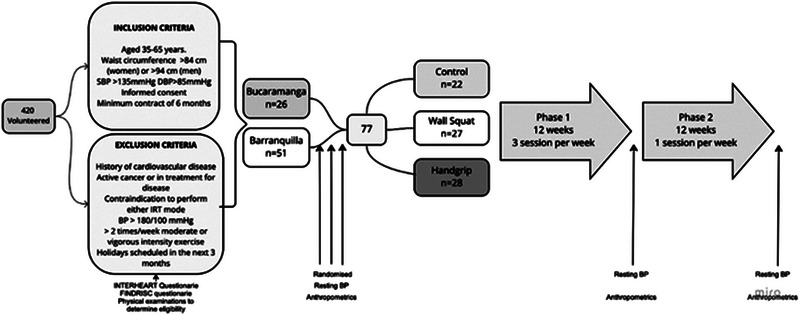
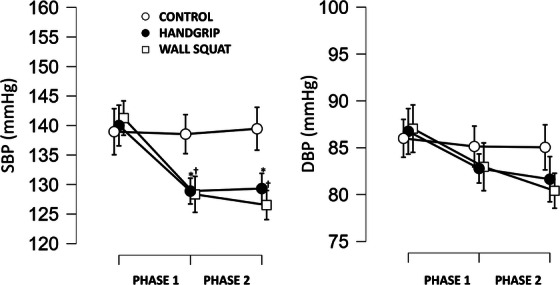
Isometric handgrip or (wall) squat exercise performed three times per week produces reductions in systolic blood pressure (SBP) in adults with hypertension. We aimed to compare these interventions and the potential to retain benefits with one exercise session per week. We compared blood pressure changes following handgrip and squat isometric training interventions with controls in a randomized controlled multicentre trial in 77 unmedicated hypertensive (SBP ≥ 130 mmHg) adults. Exercise sessions were performed in the workplace and consisted of four repetitions-three sessions per week for the first 12 weeks (phase 1), and one session per week for the subsequent 12 weeks (phase 2). Office blood pressure (BP) was measured at baseline, post-phase 1 and post-phase 2. Post-phase 1, mean reductions in SBP were significantly greater in handgrip (-11.2 mmHg, n = 28) and squat (-12.9 mmHg, n = 27) groups than in controls (-.4 mmHg; n = 22) but changes in DBP were not. There were no significant within-group changes during phase 2 but SBP was 3.8 mmHg lower in the wall squat than the handgrip group-a small magnitude but clinically important difference. While both interventions produced significant SBP reductions, the wall squat appears to be more effective in maintaining benefits with a minimal training dose. The low time investment to achieve and retain clinically significant SBP reductions-42 and 12 min, respectively-and minimal cost, particularly of the wall squat, make it a promising intervention for delivery in public health settings.
每周进行三次等长握力或(靠墙)深蹲运动可降低高血压成年人的收缩压(SBP)。我们旨在比较这些干预措施,并评估每周进行一次运动对保持益处的潜力。
我们在一项随机对照多中心试验中比较了等长握力和深蹲训练干预与对照组在 77 名未服药的高血压(SBP≥130mmHg)成年人中的血压变化。运动在工作场所进行,包括四个重复动作-每周三次,持续 12 周(第 1 阶段),然后每周一次,持续 12 周(第 2 阶段)。在基线、第 1 阶段后和第 2 阶段后测量办公室血压(BP)。第 1 阶段后,握力组(-11.2mmHg,n=28)和深蹲组(-12.9mmHg,n=27)的 SBP 平均降低明显大于对照组(-0.4mmHg;n=22),但 DBP 无变化。在第 2 阶段没有明显的组内变化,但靠墙深蹲组的 SBP 比握力组低 3.8mmHg-这是一个小幅度但具有临床重要意义的差异。虽然两种干预都产生了显著的 SBP 降低,但靠墙深蹲似乎更能有效地保持益处,而训练剂量最小。实现和保持具有临床意义的 SBP 降低的时间投入较低-分别为 42 分钟和 12 分钟,而且成本最低,特别是靠墙深蹲的成本,使其成为公共卫生环境中具有前景的干预措施。